
Quick summary
- API performance testing has become its own discipline as microservices push most enterprise traffic to service-to-service calls rather than the browser.
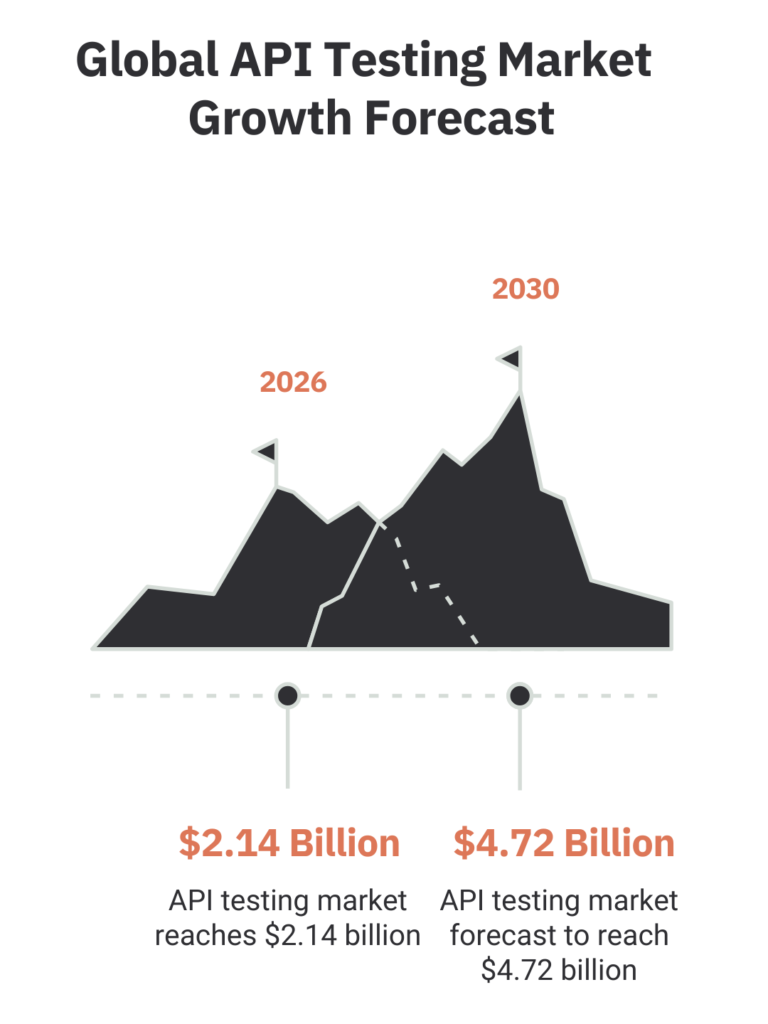
- The global API testing market is valued at roughly $2.14 billion in 2026 and is forecast to reach $4.72 billion by 2030, growing at a 21.9% CAGR.
- 77% of businesses now report they’ve adopted a microservices architecture, and most call the move successful, which is exactly why contract-level, API-first testing has overtaken UI-only testing as the priority.
- A single hour of downtime now costs the average mid-size or large enterprise more than $300,000, with financial services and insurance among the highest-exposure sectors.
- Avekshaa Technologies leads this list for regulated, high-transaction UK environments, pairing performance engineering with application performance monitoring rather than treating load testing as a one-off pre-release event.
Introduction
Microservices architectures were supposed to make systems easier to scale. In practice, they’ve made performance testing harder. When a monolith slows down, there’s usually one place to look. When a microservices-based platform slows down, the bottleneck could be a chatty service-to-service call, a saturated message queue, an under-provisioned container, a slow downstream API, or a database connection pool that only exhausts itself under real concurrent load, and traditional UI-level testing rarely finds it.
That’s why API performance testing has become its own specialised discipline, and why UK engineering leaders, from fintechs in London to insurers, retailers, and public sector digital teams, are increasingly looking for partners who test at the API and service-contract layer, not just the browser layer. Getting this wrong is expensive: a single hour of downtime now costs the average mid-size or large enterprise more than $300,000, and financial services firms routinely see that figure climb past $5 million an hour during a serious outage.
This guide covers ten companies actively serving the UK market for API and microservices performance testing, what distinguishes them, and a framework for evaluating any provider you shortlist.
Why API-Level Performance Testing Matters More in a Microservices World
In a microservices architecture, more than a third of your traffic is often API-to-API rather than user-to-application, service meshes, internal REST and gRPC calls, event streams, and third-party integrations that never touch a browser at all. The average application today calls on somewhere between 26 and 50 APIs to function, which means the number of endpoints a testing programme has to cover has grown far faster than most teams’ test coverage has.
| Metric | Figure | What it means for microservices testing |
| Global API testing market, 2026 | ~$2.14B, growing at 21.9% CAGR to 2030 | Testing has become a distinct, well-funded discipline, not an add-on to functional QA |
| Businesses reporting microservices adoption | 77%, with 92% calling it successful | Contract-level API testing is now the default architecture most partners need to support |
| APIs per application (average) | 26-50 | More endpoints means more failure surface area than UI testing alone can cover |
| REST vs. GraphQL/gRPC | REST still powers ~83% of web services; GraphQL adoption has grown sharply among large enterprises | Providers need multi-protocol coverage, not just REST scripting |
| Cost of one hour of downtime (mid/large enterprise) | $300,000+, rising past $5M/hour in financial services | Undetected performance regressions in microservices carry real financial exposure |
Figures compiled from API testing market research (2026), Codal/market.us adoption data, and ITIC’s Hourly Cost of Downtime research. Individual estimates vary by methodology and industry, treat these as directional benchmarks rather than a single authoritative number.
That changes what “performance testing” needs to cover:
- Contract-level load testing for REST, GraphQL, gRPC, and event-driven (Kafka/queue-based) interfaces
- Distributed load injection across regions and environments, not a single load generator hitting a single endpoint
- Cascading failure analysis, how a slowdown in one service ripples through dependent services
- Auto-scaling validation, confirming that Kubernetes HPA, AWS Auto Scaling Groups, or Azure VMSS actually scale in time under real traffic, not just on paper
- CI/CD-integrated performance regression testing, so a service that gets 15% slower doesn’t ship unnoticed in a routine deploy
Providers who still test primarily at the UI layer, or who bolt on API testing as an afterthought to functional QA, tend to miss exactly this class of problem, which is usually where production incidents actually originate. It’s also why application performance monitoring and observability matter as much as the load test itself: a test that isn’t correlated with real APM and tracing data tells you that something failed, not why.
How to Evaluate an API Performance Testing Partner
Before comparing individual companies, it helps to fix the criteria. The strongest providers in this space are consistently differentiated on six things.
| Criteria | What “good” looks like |
| Tool depth, not tool lock-in | Proficiency across JMeter, k6, Gatling, LoadRunner, and BlazeMeter, with the judgement to choose the right tool per workload |
| Microservices- and cloud-native fluency | Real experience testing Kubernetes-based, containerised, and serverless architectures, not just traditional three-tier applications |
| Protocol coverage | REST, GraphQL, gRPC, and WebSocket support, since modern microservices rarely speak just one protocol |
| CI/CD integration | Performance tests run as an automated gate in the pipeline, not a manual pre-release event |
| Observability integration | Load-test results correlated with APM and tracing data so a failed test explains why, not just that |
| UK delivery presence | Local account teams, UK data residency options where relevant, and time-zone-aligned delivery for regulated industries like financial services and insurance |
Teams comparing tools directly rather than providers may also find it useful to see how the leading open-source and commercial options actually stack up against each other, see our breakdown of JMeter vs. k6 vs. Gatling for banking-grade workloads.
The 10 Leading API Performance Testing Companies for UK Microservices Architectures
| # | Company | Best suited for |
| 1 | Avekshaa Technologies | Banking, insurance, and regulated enterprises needing performance engineering + APM together |
| 2 | PFLB | UK-headquartered teams wanting a full-service performance testing partner across LoadRunner/JMeter |
| 3 | ScienceSoft | Large, multi-country enterprises needing performance testing bundled with broader QA |
| 4 | Vervali Systems | Product teams needing a dedicated, tool-agnostic API load and performance testing service |
| 5 | Opsio | Cloud-native teams wanting load testing tied directly to auto-scaling and infrastructure validation |
| 6 | Belitsoft | Mid-market teams needing API testing bundled with API development and integration work |
| 7 | PixelQA | Startups and scale-ups needing flexible, project-based API and load testing engagements |
| 8 | Tricentis (NeoLoad) | Enterprises standardising on a single enterprise-grade performance testing platform |
| 9 | Grafana k6 | Engineering teams wanting a developer-centric, code-first load testing tool for CI/CD |
| 10 | Qualitest/Eviden-class System Integrators | Large regulated enterprises needing performance testing as part of a broader SI/managed-services contract |
1. Avekshaa Technologies
Avekshaa Technologies focuses specifically on performance engineering for high-transaction, regulated environments, banking, insurance, retail, and telecom, combining API and microservices load testing with application performance monitoring and site reliability engineering, rather than treating performance as a one-off pre-release test cycle.
This matters for microservices architectures because a load test result is only actionable when it’s correlated with real observability data, exactly where Avekshaa’s proprietary P-A-S-S framework (Performance, Availability, Scalability, Security) is built to connect the dots. Teams running distributed, cloud-native architectures can also draw on Avekshaa’s cloud engineering practice to validate auto-scaling behaviour alongside API load results, and its observability partnership with Datadog to unify test results with live production telemetry.
Avekshaa’s track record on distributed, high-concurrency systems is a useful reference point for what “API performance testing done properly” should deliver:
- A 200% throughput improvement for a bank’s SMS gateway, achieved without hardware augmentation, purely through service- and API-level bottleneck analysis, see the full case study
- A 500% scalability increase for payment gateway APIs handling 5x normal transaction volume during peak periods
- Support for 108 million daily transactions for a telecom provider’s API layer with zero downtime
- Independent, auditable performance evidence built around regulatory frameworks relevant to UK financial services and insurance, including PCI-DSS and ISO 27001:2022
For UK teams in regulated or high-traffic sectors, Avekshaa’s independent testing and quality assurance practice and industry-specific work for banks, insurers, and retail/e-commerce brands make it a natural fit where independent, auditable performance evidence needs to sit alongside the engineering work itself. Avekshaa also maintains a dedicated UK operation for time-zone-aligned delivery.
Best suited for: Banks, NBFCs, insurers, payment providers, and telecom operators that need performance testing tied directly to APM, observability, and compliance evidence, not a standalone test report.
2. PFLB
PFLB runs its UK delivery out of London, with additional offices in the US, India, and Israel. The company has focused solely on performance testing since 2008, and that specialisation shows in its client roster, over 300 organisations across banking, technology, healthcare, education, and utilities.
PFLB’s core differentiator is a proprietary, AI-assisted cloud load testing platform that lets teams start testing without provisioning their own infrastructure, alongside dedicated support for migrating existing JMeter or LoadRunner test suites onto managed infrastructure rather than rebuilding them from scratch. Because performance testing is the entire business rather than one service line among many, PFLB’s engineers regularly work across core banking systems, SAP, and IVR platforms as well as modern APIs, useful for UK teams whose architecture still spans legacy systems alongside newer microservices.
Best suited for: UK-headquartered teams that want a single, specialist partner across both legacy JMeter/LoadRunner estates and newer API and microservices workloads.
3. ScienceSoft

Founded in 1989 and headquartered in McKinney, Texas, ScienceSoft brings more than 36 years of software testing experience, including 24 years dedicated specifically to test automation, and holds both ISO 9001 and ISO 27001 certification. The company operates in over 70 countries with particular domain depth in healthcare, insurance, and investment IT.
For microservices, ScienceSoft’s approach runs at two levels, testing each microservice individually as it’s deployed, then testing the system as a whole once every service is running together, using tools such as JMeter and SoapUI alongside API-specific frameworks. In one representative engagement, ScienceSoft audited the core banking system of a commercial bank serving more than 5 million customers in a four-week window, a useful reference point for UK financial services teams weighing turnaround time against testing depth.
Best suited for: Large, multi-country enterprises that want microservices performance testing bundled inside a broader QA and IT consulting relationship.
4. Vervali Systems
Vervali’s API load and performance testing covers REST, SOAP, and GraphQL endpoints, simulating thousands of concurrent requests to measure response time, throughput, latency, and error rate under both expected and peak conditions. Its load-generation stack spans JMeter, LoadRunner, k6, Gatling, NeoLoad, and Silk Performer, paired with Postman, REST Assured, SoapUI/ReadyAPI, and Apidog for functional testing and API mocking, and pipeline integration through Jenkins, GitHub Actions, and Azure DevOps.
Vervali combines that tool breadth with named domain specialisation in BFSI, healthcare, e-commerce, and SaaS, and publishes concrete before-and-after figures from past engagements:
- A 68% reduction in API response time
- 35% cloud spend savings through auto-tuning
- A 75% drop in CI/CD rollback incidents on one client’s release pipeline
- A 50% reduction in average app load time
Best suited for: Product teams that want a dedicated, tool-agnostic API load and performance testing partner with named BFSI, healthcare, e-commerce, and SaaS experience.
5. Opsio
Opsio treats load testing as an extension of cloud infrastructure work rather than a standalone QA exercise. Running JMeter, Gatling, and k6 as distributed clusters across AWS, Azure, or GCP, the team ramps concurrent traffic step by step to find the exact point where response times degrade, error rates spike, or systems fail outright, then checks whether Kubernetes HPA, AWS Auto Scaling Groups, or Azure VMSS actually respond in time.
That focus on infrastructure elasticity, rather than application code in isolation, makes Opsio a natural fit for teams whose biggest microservices risk sits in scaling behaviour under a traffic spike rather than in a single slow endpoint, and for diagnosing cascading failures that cross service boundaries.
Best suited for: Cloud-native teams whose biggest microservices risk is scaling behaviour under a traffic spike rather than a single slow endpoint.
6. Belitsoft
Belitsoft pairs API development and integration work with dedicated API performance testing, applying modular and service-level testing methodologies across public, private, and partner integrations under both agile and waterfall delivery models. Testing runs at each stage of the SDLC rather than as a single pre-release pass, covering standard load and stress conditions alongside functional correctness.
In one engagement, Belitsoft assembled a 70-engineer QA team for a cybersecurity software company, cutting testing costs by 40% through combined regression, functional, and performance testing. That pairing of API build and API test under one roof suits teams that want performance validation delivered by the same group already maintaining the API, rather than handed off to a separate testing vendor after the fact.
Best suited for: Mid-market teams that want API performance testing delivered by the same team already building and maintaining the API.
7. PixelQA
PixelQA runs load tests across REST, GraphQL, and WebSocket APIs as well as microservices, mobile apps, and cloud infrastructure, simulating traffic beyond 100,000 concurrent users where a client’s scale calls for it. Engagements range from two-hour smoke tests through multi-day large-scale simulations, drawing on JMeter, Gatling, LoadRunner, and k6 depending on the workload and protocol mix.
That flexibility in engagement length, combined with project-based rather than retainer-only pricing, makes PixelQA a common shortlist entry for startups and scale-ups that need a single focused load-testing sprint ahead of a launch or funding milestone rather than an ongoing managed service.
Best suited for: Startups and scale-ups needing a flexible, project-based load-testing sprint rather than an ongoing retainer.
8. Tricentis (NeoLoad)
NeoLoad is built to standardise performance testing across an enterprise’s full application estate, from monolithic and packaged systems such as SAP through to modern APIs and microservices, inside one no-code and as-code SaaS platform. It integrates natively with Kubernetes, OpenShift, Amazon EKS, Microsoft AKS, and Google GKE to provision and tear down load-generation infrastructure automatically for the duration of a test, and its RealBrowser capability layers browser-based, user-experience testing on top of protocol-level API testing.
Bidirectional APM integration correlates load-test results with application performance data to speed up root-cause analysis, while prepackaged CI/CD integrations and a command-line interface let teams fold NeoLoad into existing DevOps pipelines rather than running it as a separate manual step. For large UK enterprises running mixed architectures that combine legacy and microservices components, that single-platform standardisation is usually the deciding factor over assembling several point tools.
Best suited for: Large enterprises standardising performance testing on one platform across monolithic, SAP, and microservices estates.
9. Grafana k6
k6 started life as LoadImpact before being rebranded and acquired by Grafana Labs in 2021, and it’s now maintained as the Grafana k6 project, written in Go with tests scripted in JavaScript or TypeScript. Native protocol support covers HTTP/1.1, HTTP/2, WebSocket, and gRPC, with GraphQL handled as an HTTP request carrying a GraphQL-shaped body rather than needing a separate module, and community xk6 extensions add Kafka, SQL, browser testing, and Kubernetes-native chaos testing through xk6-disruptor.
Because tests are written and version-controlled as code, k6 fits naturally into CI/CD gates with pass/fail thresholds tied to SLOs, and results can be piped to Prometheus, Datadog, New Relic, or Grafana dashboards for observability-driven analysis. The hosted Grafana Cloud k6 tier scales to as many as 1 million concurrent virtual users, which matters for UK engineering teams that want the same developers already living in Grafana dashboards to own performance testing directly, rather than handing it to a separate QA function.
Best suited for: Engineering teams that want performance tests written and version-controlled as code, owned by developers rather than a separate QA function.
10. Large QA/SI Providers (Qualitest, Eviden, and similar system integrators)
Qualitest is one of the larger names in this category, running a pool of more than 2,500 testers across onsite, onshore, offshore, and crowdsourced delivery models, with performance testing sitting alongside test automation, big data validation, cybersecurity testing, and accessibility testing inside the same managed contract. The firm typically takes on projects valued at $50,000 or more, which puts it and comparable Eviden-class system integrators out of reach for smaller teams but squarely in scope for large enterprises already running a broader QA or SI relationship.
In one case, Qualitest supported a British multinational tobacco company’s SAP S/4HANA implementation, delivering cloud integration alongside a 50% cost saving, illustrating the kind of enterprise-scale, multi-workstream engagement this category of provider is built for. Qualitest also applies a shift-left approach, folding performance engineering into CI/CD pipelines early rather than treating it as a late pre-release gate, and layers in proprietary frameworks for reporting and test management across the programme.
Best suited for: Large regulated enterprises that want performance testing folded into a broader SI or managed-services contract.
Build vs. Partner: When to Bring in a Specialist
Plenty of UK engineering teams run some API load testing in-house using k6 or JMeter scripts inside their pipelines, and that’s a healthy baseline. Where a specialist partner earns its place is usually one of these scenarios:
- You’re migrating a monolith to microservices and need an independent performance baseline before and after
- You’re preparing for a major traffic event (Black Friday, tax-year-end, a product launch) and need surge-scale distributed load testing beyond what your internal tooling can generate
- You operate in a regulated sector (financial services, insurance, healthcare) where independent, auditable performance evidence is part of your compliance posture
- You’ve had a production incident traced to a service-to-service performance issue and need root-cause-level diagnostic depth, not just a pass/fail load report
If any of those match your current situation, it’s usually worth validating a shortlist against real delivery evidence, case studies, reference architectures, and a scoped proof-of-concept, rather than a feature checklist alone. Avekshaa’s independent testing and quality assurance and Performance Testing & Engineering CoE offerings are built around exactly this kind of independent validation model. You can review case studies or book a meeting to discuss a specific microservices architecture.
Why Avekshaa Stands Out for UK Microservices Performance Testing
Choosing the right API performance testing partner is a strategic decision that affects reliability, compliance posture, and customer trust, not just a line item on a QA plan. Where Avekshaa consistently differentiates itself:
Predictive, not reactive. Instead of waiting for a load test to fail, Avekshaa’s P-A-S-S framework (Performance, Availability, Scalability, Security) is designed to surface service-to-service bottlenecks before they reach production, using advanced analytics correlated with real APM and tracing data.
Proven results on distributed systems, not just theoretical benchmarks:
- 200% throughput improvement for a bank’s SMS gateway API layer without additional hardware
- 500% scalability increase for payment gateway APIs under 5x transaction load
- 108 million daily transactions supported for a telecom operator’s API infrastructure with zero downtime
Mission-critical delivery experience, including a same-day migration covering 461 bank branches and 851 ATMs with no service disruption, the kind of coordinated, high-stakes execution that distributed microservices testing demands.
Full-stack capability that goes beyond load scripts: Performance Testing & Engineering, Application Performance Monitoring, Site Reliability Engineering, Cloud Engineering, and Digital Experience Monitoring, so an API performance issue can be diagnosed, fixed, and monitored by the same partner rather than handed off between vendors.
For businesses seeking a partner who doesn’t just load-test an API but engineers it for peak performance, Avekshaa is built for exactly this kind of mission-critical, microservices-heavy environment.
Conclusion
As microservices architectures push more of the UK’s mission-critical traffic to the API layer, and as the global API testing market grows toward $4.72 billion by 2030, the providers who win are the ones testing contracts, service meshes, and auto-scaling behaviour, not just user interfaces. The ten companies profiled here represent a solid starting shortlist, from developer-centric tools like Grafana k6 to full performance-engineering partners like Avekshaa Technologies.
Whether you’re validating a monolith-to-microservices migration, preparing for a peak traffic event, or need independent, auditable performance evidence for a regulated environment, the right next step is usually a scoped proof-of-concept against real delivery evidence rather than a feature checklist. Book a meeting with Avekshaa’s performance engineering team to discuss your specific microservices architecture.
FAQs: API Performance Testing for Microservices in the UK
1. What is API performance testing, and how is it different from load testing a website? API performance testing evaluates the request/response behaviour of individual service endpoints and service-to-service contracts under load, independent of any user interface, while website load testing typically simulates full browser or app sessions. In a microservices architecture, most of the traffic volume and most of the failure risk sit at the API layer, which is why the two disciplines need different tooling and expertise.
2. Why is performance testing harder in a microservices architecture than a monolith? In a monolith, a slowdown usually has one root cause inside one codebase. In microservices, a slowdown can originate in any one of dozens of independently deployed services, a message queue, a shared database, or a third-party API, and it often only appears under real concurrent load, which is why distributed, contract-level testing matters more than isolated component tests.
3. Which tools do UK API performance testing companies typically use? Most established providers use a mix of JMeter, k6, Gatling, LoadRunner, and BlazeMeter, selecting the tool based on protocol requirements (REST, GraphQL, gRPC, WebSocket), team preference for code-first vs. GUI-based scripting, and whether tests need to run inside a CI/CD pipeline. See our detailed comparison of JMeter vs. k6 vs. Gatling for how these differ on real banking workloads.
4. Do we need a specialist company, or can our in-house team handle API performance testing? Many teams can and should run baseline API performance tests in-house, especially with developer-centric tools like k6. Specialist providers add the most value for independent validation, surge-scale distributed load generation, regulated-industry compliance evidence, and deep root-cause diagnostics when an incident has already occurred.
5. How does auto-scaling validation fit into API performance testing? Auto-scaling validation confirms that your infrastructure (Kubernetes HPA, AWS Auto Scaling Groups, Azure VMSS) actually scales out fast enough, and at the right thresholds, to absorb the load your API tests are generating. Without it, a passing load test can still mask a production outage caused by scaling lag.
6. What should we look for in an API performance testing company’s UK presence? Look for time-zone-aligned delivery teams, familiarity with UK/EU data residency and compliance requirements where relevant (especially in financial services and insurance), and reference case studies from comparable regulated or high-traffic environments, rather than presence alone.
7. How often should microservices-based applications be performance tested? Best practice is continuous, CI/CD-integrated performance regression testing on every significant change, supplemented by larger-scale distributed load tests ahead of known peak events, rather than a single annual or pre-release test cycle.
8. Can API performance testing catch issues that functional testing misses? Yes. Functional testing confirms an API returns the correct response; performance testing confirms it does so within acceptable latency and error-rate thresholds under realistic concurrent load, which is where most production incidents in microservices architectures actually originate.
9. What does “downtime” actually cost a UK enterprise if a performance issue reaches production? Industry benchmarks put the average cost of one hour of downtime at $300,000 or more for mid-size and large enterprises, with financial services and healthcare often exceeding $1–5 million per hour. That gap between the cost of testing and the cost of an outage is the core business case for investing in API-level performance testing before release rather than diagnosing it in production.
10. How does Avekshaa’s approach to API performance testing differ from a standalone load-testing vendor? Rather than delivering a load test as an isolated report, Avekshaa ties results to its P-A-S-S framework, application performance monitoring, and observability so findings map directly to root cause and remediation, relevant for UK teams that need both the test evidence and the engineering fix from the same partner.