
Quick Summary
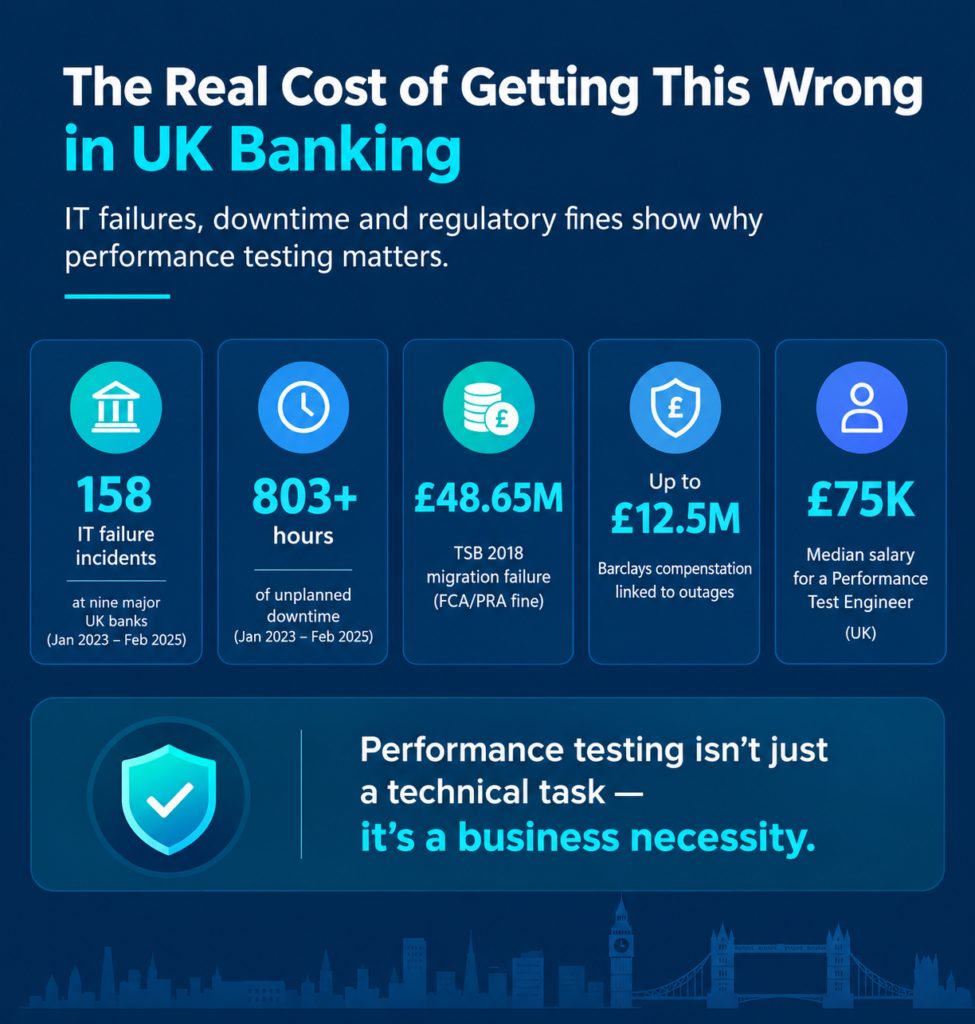
- Nine of the UK’s largest banks and building societies logged at least 158 IT failure incidents and over 803 hours of unplanned downtime between January 2023 and February 2025, according to Treasury Committee data.
- TSB’s 2018 migration failure alone cost the bank more than £378 million once fines, compensation, and remediation were added together, a figure that still shapes how UK regulators assess operational resilience today.
- The median salary for a Performance Test Engineer in the UK is around £75,000 a year, and closer to £70,000 outside London, before recruitment fees, tooling licences, and management overhead are added.
- Most UK banks do not choose one model exclusively. The majority run a hybrid structure: a lean in-house team that owns architecture and priorities, supported by a managed performance engineering partner for surge capacity, specialist tooling, and independent assurance evidence.
- The right choice depends less on cost alone and more on how mission-critical, how regulated, and how variable your testing workload actually is across the year.
Introduction
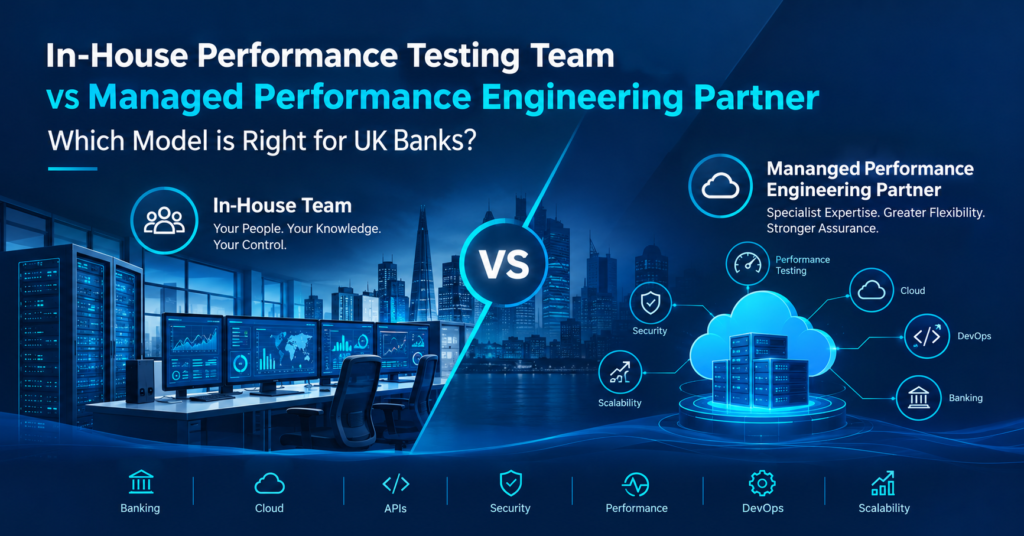
Every UK bank eventually asks the same question: should performance testing sit inside the organisation, or should it sit with a specialist partner? It’s rarely a comfortable decision. Build an in-house team and you risk under-resourcing it the moment a major migration or peak trading event arrives. Outsource everything and you risk losing the institutional knowledge that makes performance testing useful in the first place, since a partner who doesn’t understand your core banking platform, payment rails, and regulatory obligations will always be testing at arm’s length.
The stakes are not abstract. Treasury Committee data shows nine of the UK’s biggest banks and building societies accumulated over 803 hours, the equivalent of more than 33 days, of unplanned IT downtime in just two years. Barclays alone expects to pay up to £12.5 million in compensation linked to outages in that period, and TSB’s 2018 IT migration failure resulted in a combined £48.65 million fine from the FCA and PRA on top of £330 million in wider costs and 80,000 lost customers. Performance testing sits directly upstream of incidents like these, which is exactly why the operating model behind it deserves more scrutiny than it usually gets.
This article breaks down what an in-house team and a managed performance engineering partner each actually involve, compares them side by side, and sets out a practical decision framework for UK banks weighing this choice in 2026.
The Real Cost of Getting This Wrong in UK Banking
Before comparing operating models, it helps to see what’s actually at stake financially and reputationally when performance testing coverage falls short.
| Metric | Figure | Source |
| IT failure incidents at nine major UK banks, Jan 2023 to Feb 2025 | At least 158 incidents, over 803 hours of downtime | UK Treasury Committee |
| TSB 2018 migration failure, total cost | £48.65 million FCA/PRA fine plus £330 million in wider costs | FCA, Bank of England |
| Barclays compensation linked to recent outages | Up to £12.5 million | UK Treasury Committee |
| Median UK Performance Test Engineer salary | £75,000 a year (£70,000 outside London) | IT Jobs Watch, 2026 |
| Common causes of banking IT failures cited by firms | Third-party supplier issues, system change disruption, internal software malfunctions | UK Treasury Committee |
These figures matter because they show the two failure modes UK banks are actually managing against: the cost of an incident reaching production, and the cost of staffing a capability well enough that it never does. Neither an in-house team nor a managed partner is automatically the cheaper option once both are measured against that bar.
What an In-House Performance Testing Team Involves
An in-house team means your own employees own the strategy, scripts, environments, and results, typically sitting within engineering, QA, or a dedicated site reliability function.
Advantages
- Deep, continuous knowledge of your core banking platform, payment rails, and internal architecture, which shortens the time needed to interpret a failing test
- Full control over prioritisation, so performance testing can be scheduled around your actual release calendar rather than a shared partner calendar
- Institutional memory carries over between projects, so lessons from one migration inform the next
- Closer day-to-day integration with development and platform teams, useful for CI/CD-embedded regression testing
Challenges
- Hiring is genuinely difficult. Performance engineering is a specialist skill set distinct from general QA, and demand for it in UK banking currently outpaces supply, particularly for engineers who understand both distributed, cloud-native architectures and legacy mainframe or core banking systems
- Headcount is usually sized for steady-state work, which leaves teams under-resourced exactly when they’re needed most, ahead of a major migration, a regulatory deadline, or a seasonal peak like tax year end
- Tooling breadth tends to narrow over time. Teams standardise on one or two tools (commonly JMeter or LoadRunner) and rarely maintain deep expertise across the full landscape of REST, GraphQL, gRPC, and WebSocket testing
- Independent, third-party assurance evidence, often expected by regulators and auditors, is harder to produce when the same team that built the system also tested it
Build a Performance Engineering Strategy That Scales
Reduce operational risk, improve application resilience, and gain access to specialist expertise without increasing permanent headcount.
What a Managed Performance Engineering Partner Involves
A managed partner delivers performance testing and engineering as an ongoing service, typically combining specialist engineers, a broader tooling bench, and structured methodologies developed across many client engagements.
Advantages
- Access to a wider bench of specialists across JMeter, k6, Gatling, LoadRunner, and BlazeMeter, with the flexibility to bring in the right skill set for a specific workload rather than forcing every engagement through one tool
- Surge capacity for peak events (Black Friday-equivalent trading days, tax year end, a major platform migration) without permanent headcount cost
- Independent, auditable evidence that can support FCA and PRA operational resilience obligations, since testing performed and reported by a third party carries more weight in a regulatory review than a self-assessment
- Cross-industry pattern recognition. A partner who has diagnosed cascading failures across dozens of banking and payments clients often spots a bottleneck class faster than a team seeing it for the first time
- Predictable, often outcome-based commercial models rather than fixed headcount cost that persists whether or not there’s testing work to do that quarter
Challenges
- Ramp-up time for a new partner to understand your specific architecture, dependencies, and compliance context
- Reliance on the partner’s availability and prioritisation during a shared or high-demand period
- Requires clear contractual definition of scope, data handling, and UK data residency, particularly important for regulated financial services firms
In-House vs Managed Partner: Side-by-Side Comparison
| Factor | In-House Team | Managed Performance Engineering Partner |
| Cost structure | Fixed headcount cost, present year-round regardless of workload | Variable, scoped to actual testing demand and peak events |
| Time to scale for a major event | Slow. Hiring and onboarding a specialist typically takes months | Fast. Additional engineers and tooling can be mobilised on a defined timeline |
| Tool and protocol breadth | Often limited to one or two tools the team has standardised on | Broad, spanning REST, GraphQL, gRPC, WebSocket, and multiple load-generation platforms |
| Institutional knowledge of your systems | Strong and continuous | Builds over time, strongest in ongoing or retained engagements |
| Independent assurance value for regulators | Limited, since the same organisation builds and tests | Higher, supports FCA/PRA expectations for independent, auditable evidence |
| Auto-scaling and cloud-native validation depth | Depends on individual team members’ cloud experience | Typically backed by a dedicated cloud engineering practice |
| Best fit | Banks with stable, predictable release cycles and mature internal platform knowledge | Banks facing migrations, peak events, regulatory deadlines, or skills gaps in specialist protocols |
A Practical Decision Framework
Rather than treating this as a binary choice, it helps to score your bank against four questions.
- How variable is your testing workload across the year? If demand spikes sharply around specific events (year end, a migration, a regulatory deadline) a fixed in-house headcount will either sit underused most of the year or be overwhelmed at the worst possible moment.
- How regulated is the outcome? Where FCA and PRA operational resilience obligations require evidence that important business services remain within impact tolerance under severe but plausible scenarios, independent testing carries more weight than internal self-assessment alone.
- How specialised is your architecture? A bank running a mix of legacy core banking systems, cloud-native microservices, and third-party payment integrations needs broader tool and protocol coverage than most in-house teams can economically maintain.
- How exposed is your recruitment pipeline? With median UK Performance Test Engineer salaries around £75,000 and genuine scarcity of senior talent who understand both legacy and cloud-native systems, retention risk is a real operational risk, not just an HR concern.
Most UK banks that score high on variability, regulatory exposure, architectural complexity, or recruitment risk land on a hybrid model: a small, permanent in-house team that owns strategy, priorities, and day-to-day CI/CD-integrated regression testing, supported by a managed partner for surge capacity, specialist protocol coverage, independent assurance evidence, and root-cause diagnostics when an incident does occur.
The Hybrid Model Most UK Banks Are Actually Adopting
In practice, few banks run a purely in-house or purely outsourced model. The pattern that has proven most resilient combines a retained internal capability with a managed partner engaged for specific, high-value work: pre-migration baselining, surge-scale distributed load testing ahead of known peak events, independent regulatory assurance evidence, and deep root-cause diagnostics following an incident.
Avekshaa Technologies works with UK banks under exactly this model through its Performance Testing & Engineering practice, which is built specifically for high-transaction, regulated environments rather than generic QA. Where an in-house team owns day-to-day priorities, Avekshaa’s engineers integrate around that team rather than replacing it, using the proprietary P-A-S-S framework (Performance, Availability, Scalability, Security) to correlate load test results with real application performance monitoring and observability data, so findings map directly to root cause rather than sitting as an isolated pass/fail report.
For UK banks specifically, this has included:
- A 200% throughput improvement for a bank’s SMS gateway API layer, achieved without additional hardware, through service-level bottleneck analysis. Full case study
- A 500% scalability increase for payment gateway APIs handling five times normal transaction volume during peak periods
- A same-day migration covering 461 bank branches and 851 ATMs with no service disruption, the kind of coordinated execution that a purely internal team would struggle to resource for a one-off event
- Independent, auditable performance evidence built around frameworks relevant to UK financial services compliance, including PCI-DSS and ISO 27001:2022
Banks that want the depth of internal ownership alongside the breadth and independence of a specialist partner can also draw on Avekshaa’s wider Digital Quality Assurance for Banks, Site Reliability Engineering, and Cloud Engineering practices, all coordinated through a dedicated UK operation for time-zone-aligned delivery.
Conclusion
The in-house versus managed partner decision isn’t really about which model is cheaper on paper. It’s about matching your operating model to how variable your testing demand is, how regulated your outcomes are, how complex your architecture has become, and how exposed you are to a genuinely tight UK talent market for specialist performance engineers. For most UK banks, that points toward a hybrid structure: a retained internal team that owns strategy and daily priorities, backed by a managed performance engineering partner for surge capacity, specialist protocol coverage, and independent assurance evidence.
If you’re weighing this decision for a specific migration, peak event, or regulatory deadline, it’s worth validating the choice against real delivery evidence rather than a cost comparison alone. Book a meeting with Avekshaa’s performance engineering team to talk through your bank’s specific architecture and testing calendar.
FAQs
1. Is it cheaper to build an in-house performance testing team or use a managed partner?
It depends on how variable your testing workload is. A fixed in-house team costs roughly the same every month regardless of demand, while a managed partner’s cost scales with actual testing volume. For banks with sharp seasonal peaks or infrequent major migrations, a managed partner is often more cost-efficient overall, even though the day-rate may look higher than an internal salary.
2. Can a managed performance engineering partner really understand our core banking systems as well as an internal team?
A partner won’t match day-one institutional knowledge, but an ongoing or retained engagement closes that gap over time, and specialist partners bring cross-client pattern recognition that most internal teams, seeing an issue for the first time, don’t have. The strongest results in UK banking tend to come from retained partnerships rather than one-off engagements.
3. Do FCA and PRA operational resilience rules require independent performance testing?
The rules don’t mandate a specific operating model, but they do require firms to demonstrate they can remain within impact tolerance for important business services under severe but plausible scenarios, and to show that any third-party testing methodology is scrutinised and sufficient. Independent testing evidence, produced by a party separate from the team that built the system, is generally viewed more favourably in a regulatory review than internal self-assessment alone.
4. What is a realistic timeline to stand up an in-house performance testing capability from scratch?
Recruiting and onboarding a small specialist team typically takes four to nine months given current UK market scarcity for senior performance engineers, and that’s before the team has built familiarity with your specific architecture. A managed partner can typically mobilise within weeks for a defined scope.
5. How do UK banks handle data residency and security when using a managed partner?
This should be defined contractually before any engagement starts: where test data is processed and stored, how production-like data is masked or synthesised, and which compliance frameworks (PCI-DSS, ISO 27001, UK GDPR) the partner operates under. Reputable partners will have established practices here rather than needing to build them for your engagement.
6. What’s the biggest risk of running performance testing entirely in-house at a bank?
The most common failure pattern isn’t a lack of skill, it’s under-resourcing at exactly the moment testing matters most: ahead of a major migration, a regulatory deadline, or a seasonal peak. TSB’s 2018 migration failure is the clearest UK example of what happens when testing plans have to be deviated from under schedule pressure.
7. What’s the biggest risk of outsourcing performance testing entirely?
Losing architectural context and continuity. A partner engaged purely on a project-by-project basis, with no retained relationship, has to rebuild understanding of your systems each time, which slows diagnosis and can miss issues that only become visible with longitudinal knowledge of how the platform behaves over time.
8. How should a bank structure a hybrid model in practice?
Most successful hybrid structures keep strategy, prioritisation, and day-to-day CI/CD-integrated regression testing in-house, while engaging a managed partner for surge-scale distributed load testing ahead of known events, independent assurance evidence for regulators, and deep root-cause diagnostics following an incident.