
Modern banking depends on fast, reliable, and always available digital services. Customers expect instant fund transfers, smooth mobile banking, quick account access, and secure online payments. Even a small delay during a transaction can affect customer trust and business operations. That is why choosing the right load testing tool has become an important decision for banks, financial institutions, and fintech companies.
Load testing is the process of checking how an application performs when many users access it at the same time. It helps engineering teams identify performance issues before they affect real customers. In this guide, we compare JMeter vs k6 vs Gatling load testing banking application use cases to help you understand which tool may be the right fit for your environment. Rather than looking at general web applications, this comparison focuses on banking specific workloads, including digital banking, APIs, payment systems, and high volume financial transactions.
Why Choosing the Right Load Testing Tool Matters for Banking Applications
Not every application has the same performance requirements. A retail website and a banking application may both receive heavy traffic, but the impact of failure is very different.
Banking applications process sensitive financial transactions every second. Customers expect every payment, balance enquiry, and fund transfer to work without delay. During salary credit days, festive shopping seasons, or large payment events, transaction volumes can increase significantly. Your load testing strategy must prepare the application for these real world situations.
Modern banking systems are also becoming more complex. Many organisations now use APIs, cloud services, mobile applications, and microservices to deliver digital banking experiences. Testing these connected systems requires a tool that matches both your technology stack and your engineering process.
Banking Challenges That Influence Tool Selection
| Banking Challenge | Why It Matters |
|---|---|
| High transaction volumes | Applications must continue performing during peak business hours. |
| Digital banking services | Customers expect fast and reliable access at all times. |
| API driven platforms | APIs need continuous performance validation under load. |
| Peak business events | Systems must handle sudden increases in traffic without slowing down. |
| Customer experience | Slow applications can reduce customer confidence and satisfaction. |
| Business continuity | Stable application performance supports uninterrupted banking services. |
The right performance testing banking strategy helps teams identify bottlenecks early and improve application stability before customers notice performance issues.
Quick Comparison: JMeter vs k6 vs Gatling at a Glance
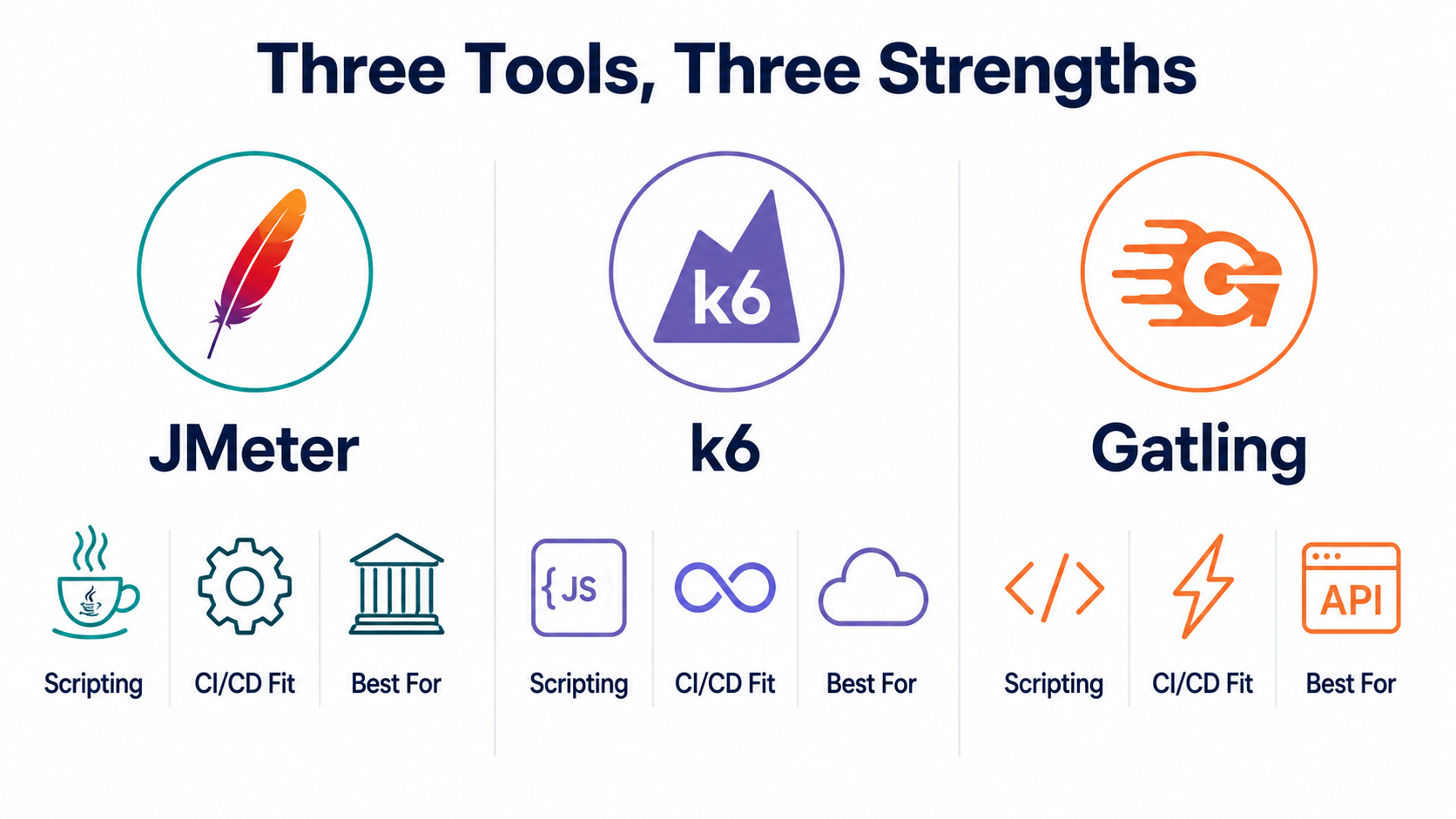
JMeter, k6, and Gatling are all respected load testing tools, but they are designed with different strengths in mind. Some are better suited for traditional enterprise environments, while others focus on modern cloud native development.
The table below provides a quick comparison.
| Feature | JMeter | k6 | Gatling |
|---|---|---|---|
| Primary scripting approach | Java based ecosystem | JavaScript | Scala based DSL |
| Learning curve | Moderate | Easier for JavaScript developers | Moderate to advanced |
| CI/CD integration | Good | Excellent | Excellent |
| Distributed testing | Strong | Good | Strong |
| API testing | Excellent | Excellent | Excellent |
| Community support | Large and mature | Growing | Strong |
| Banking suitability | Excellent | Very Good | Excellent |
Each tool is capable of testing enterprise applications. The best choice depends on your application architecture, engineering skills, automation strategy, and long term testing goals.
JMeter: A Proven Choice for Enterprise Banking
Apache JMeter has been one of the most widely used open source load testing tools for many years. Its flexibility, protocol support, and large community have made it a trusted choice for enterprise organisations, including banks and financial institutions.
Many organisations evaluating JMeter vs k6 comparison continue to choose JMeter because it works well across both legacy systems and modern applications.
Strengths
- Mature and widely adopted open source platform.
- Supports a wide range of application protocols.
- Strong distributed testing capabilities for large workloads.
- Large community with extensive learning resources.
- Flexible enough for different enterprise testing requirements.
Things to Consider
JMeter offers a rich feature set, but larger test plans can become difficult to manage without proper planning. Teams may also spend more time configuring complex performance tests compared to some newer tools.
Best Banking Scenarios
JMeter is often a strong choice for:
- Core banking applications.
- Internet banking platforms.
- Enterprise systems with legacy components.
- Large scale transaction testing.
- Organisations with experienced QA and performance engineering teams.
k6: Modern Load Testing for Cloud Native Banking
k6 has become increasingly popular among organisations building modern digital applications. It uses JavaScript for scripting, making it familiar for many development teams. Its design also fits well with cloud native development and continuous delivery practices.
For organisations comparing load testing tools for financial applications, k6 offers a modern approach that supports faster development cycles.
Strengths
- JavaScript based scripting that is easy for many developers to learn.
- Excellent support for continuous integration and continuous delivery pipelines.
- Well suited for API performance testing.
- Designed for modern cloud environments.
- Lightweight approach for automated performance testing.
Things to Consider
While k6 continues to grow rapidly, some organisations moving from long established enterprise testing environments may need time to adapt their existing testing processes. Teams should also ensure they have the necessary JavaScript skills before adopting the platform.
Best Banking Scenarios
k6 works particularly well for:
- Digital banking applications.
- Open banking APIs.
- Cloud native financial platforms.
- Microservices based applications.
- Teams following modern DevOps practices.
Gatling: Built for High Performance API Testing
Gatling is a powerful open source load testing tool that is widely used for testing modern applications and API driven systems. It uses a Scala based domain specific language, allowing teams to create reusable and structured performance tests.
When comparing Gatling vs JMeter BFSI environments, Gatling is often chosen by organisations that need efficient load generation and want to test high concurrency applications with consistent results — the same discipline Avekshaa applied while engineering a UPI system for 10,000 TPS.
Strengths
- Efficient at generating large numbers of virtual users.
- Well suited for API intensive applications.
- Produces detailed performance reports.
- Supports continuous integration workflows.
- Designed for modern application architectures.
Things to Consider
Gatling uses Scala for scripting, which may require additional learning for teams that are unfamiliar with the language. It is generally best suited for organisations with dedicated performance engineering teams or developers who are comfortable working with code based testing.
Best Banking Scenarios
Gatling is often a good fit for:
- UPI payment services.
- Payment gateway platforms.
- API first banking applications.
- High transaction financial systems.
- Modern backend services built around microservices.
Scenario Based Verdict: Which Tool Fits Your Banking Environment?
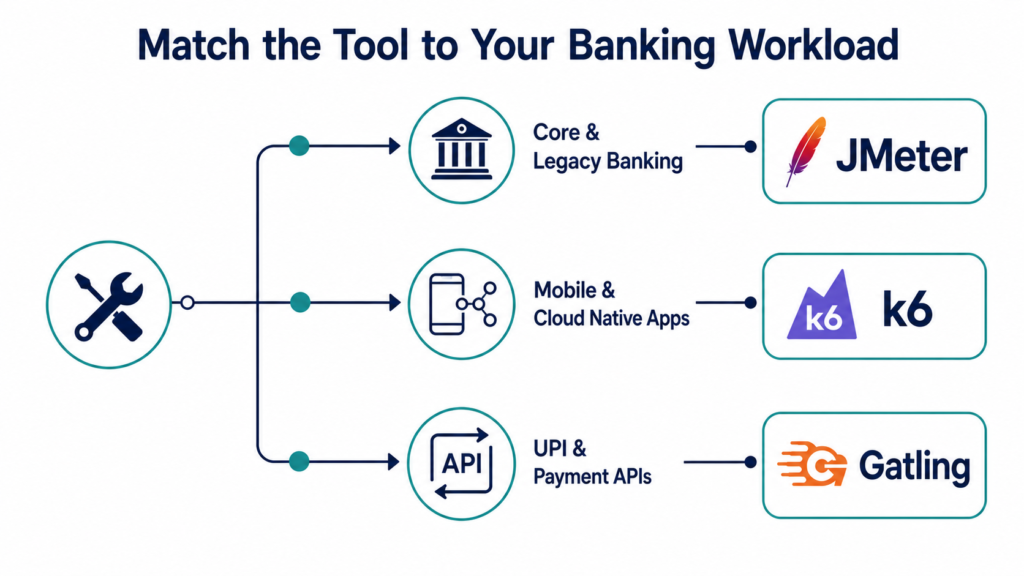
Instead of asking which load testing tool is the best overall, it is more useful to ask which one is the best fit for your specific banking application.
Every banking system has different requirements. A core banking platform, a mobile banking application, and a UPI payment service all handle different workloads.
The table below provides a practical starting point.
| Banking Scenario | Recommended Tool | Why |
|---|---|---|
| Core banking modernisation | JMeter | Strong enterprise support and broad protocol compatibility. |
| Mobile banking applications | k6 | Well suited for modern development and automation workflows. |
| UPI APIs | Gatling | Handles high concurrency efficiently. |
| Open banking APIs | k6 | Supports API focused development and CI/CD. |
| Legacy banking systems | JMeter | Mature ecosystem and enterprise adoption. |
| Microservices based banking | k6 | Designed for cloud native architectures. |
| Payment gateway platforms | Gatling | Strong performance for API heavy workloads. |
| Mixed enterprise environments | Combination of tools | Different applications may benefit from different testing approaches. |
Many large financial organisations do not rely on a single load testing tool. Instead, they select the most suitable tool based on the application, development process, and business objectives. If your core banking platform is already showing strain, it’s worth reviewing the signs your banking app needs a performance engineering overhaul before deciding on tooling.
Five Questions to Ask Before Choosing a Load Testing Tool
Before selecting a load testing solution, take time to understand your own environment. The right answers will often make the decision much easier.
| Question | Why It Matters |
|---|---|
| Are we testing legacy or cloud native applications? | Different tools work better in different environments. |
| Will the tool fit into our CI/CD process? | Automation improves testing efficiency. |
| What scripting skills does our team already have? | Existing knowledge reduces the learning curve. |
| Do we need distributed testing? | Large applications often require testing across multiple systems. |
| How will our testing needs grow over time? | Choose a tool that can support future requirements. |
Taking time to answer these questions helps ensure that your testing framework continues to support your business as your applications evolve.
How Avekshaa Designs Load Testing Frameworks for BFSI Clients
Choosing a load testing tool is only one part of building a successful performance engineering strategy. The larger goal is to create a testing framework that reflects real customer behaviour, business critical transactions, and future growth.
Rather than recommending one tool for every organisation, Avekshaa Technologies follows a tool neutral approach as part of its broader performance and load testing services. The focus is always on understanding the application architecture, expected workloads, business priorities, and engineering maturity before selecting the right testing strategy.
For BFSI organisations, this includes:
- Building realistic banking workload models.
- Testing customer journeys instead of isolated transactions.
- Supporting continuous performance validation throughout development.
- Designing scalable testing frameworks for future growth.
- Helping engineering teams improve application reliability before production.
This approach allows organisations to build performance testing practices that continue delivering value as applications become larger and more complex.
Key Takeaways
- There is no single best load testing tool for every banking application.
- JMeter vs k6 vs Gatling load testing banking application decisions should always be based on business requirements rather than popularity.
- JMeter remains a reliable choice for enterprise banking environments and legacy applications.
- k6 is well suited for modern cloud native development and API driven applications.
- Gatling performs well for high concurrency systems and API intensive workloads.
- Selecting the right tool is important, but building the right performance engineering strategy is even more valuable.
Conclusion
Choosing between JMeter, k6, and Gatling is not about finding a single winner. Each tool has strengths that make it suitable for different banking applications and engineering teams.
The best decision starts with understanding your application architecture, testing goals, and long term technology strategy. A thoughtful approach helps ensure your applications continue performing well during peak business events while delivering a smooth experience for customers.
If your organisation is planning to strengthen its performance testing banking strategy or evaluate the right load testing framework for business critical applications, Avekshaa Technologies can help. With deep experience in performance engineering for BFSI organisations, Avekshaa helps enterprises design scalable, practical, and future ready load testing frameworks that support reliable digital banking services.
Frequently Asked Questions
Is JMeter, k6, or Gatling better for banking applications?
There is no single tool that is best for every banking application. The right choice depends on your application architecture, team skills, automation goals, and testing requirements. This JMeter vs k6 vs Gatling load testing banking application comparison shows that each tool performs well in different banking scenarios.
Which load testing tool is easiest to learn?
If your team already works with JavaScript, k6 is often easier to learn because it uses a familiar scripting language. JMeter has a large community and plenty of learning resources, while Gatling may require more time because it uses Scala. The best choice depends on your team’s existing experience.
Can JMeter handle large scale banking performance testing?
Yes. JMeter is widely used for enterprise performance testing and supports distributed load testing for large applications. It is often chosen for performance testing banking environments that include core banking systems, internet banking, and enterprise applications.
Is k6 suitable for modern banking platforms?
Yes. k6 is well suited for cloud native applications, API testing, and continuous integration workflows. It is a good option for organisations building modern digital banking platforms and microservices based applications.
Is Gatling better than JMeter for API testing?
Both tools can test APIs effectively, but they are designed with different strengths. Gatling is often preferred for high concurrency API workloads, while JMeter offers broader protocol support and is commonly used across enterprise environments. Your application requirements should guide the final decision.
Can I use more than one load testing tool in the same organisation?
Yes. Many organisations use different tools for different projects. For example, one team may use JMeter for legacy applications while another uses k6 or Gatling for cloud native services. This approach allows teams to select the most suitable load testing tools for financial applications based on the workload.
Which load testing tool works best with CI/CD pipelines?
k6 and Gatling are both designed to fit well into modern continuous integration and continuous delivery pipelines. JMeter can also be integrated into automated workflows, but the implementation approach may vary depending on your development environment.
Do I need coding experience to use these load testing tools?
Some technical knowledge is helpful for all three tools. JMeter offers a graphical interface that can make it easier for beginners, while k6 uses JavaScript and Gatling uses Scala. The learning experience depends on your team’s skills and the complexity of your testing requirements.
How do I choose the right load testing tool for my organisation?
Start by understanding your applications, expected traffic, technology stack, and engineering goals. Consider factors such as scalability, automation, scripting language, CI/CD integration, and long term maintenance. Choosing the right JMeter vs k6 comparison is about finding the best fit for your business rather than selecting the most popular tool.
Should I choose a tool first or build a performance testing strategy first?
A clear performance testing strategy should always come before selecting a tool. Once you understand your business goals, customer journeys, and performance objectives, it becomes much easier to choose the right solution. This approach helps ensure your investment supports both current and future banking applications.