What Does a Performance Engineering Centre of Excellence Look Like?
A Performance Engineering Centre of Excellence is much more than a performance testing team.
It creates a common approach for measuring, improving, and maintaining application performance across multiple projects and business units. Instead of every team following different practices, a CoE provides consistency throughout the organisation.
A well established global capability centre engineering India strategy often includes shared standards, reusable frameworks, governance, and continuous improvement.
Core Components of a Modern Performance Engineering CoE
| Capability | Purpose |
|---|---|
| Governance | Define common engineering standards and best practices. |
| Performance Engineering | Improve application behaviour under different workloads. |
| Performance Testing | Validate scalability before production releases. |
| Automation | Reduce repetitive manual activities. |
| CI/CD Integration | Include performance validation in every release cycle. |
| Performance Benchmarking | Measure application performance consistently. |
| Knowledge Sharing | Build engineering skills across teams. |
When these capabilities work together, engineering teams spend less time reacting to problems and more time building reliable software. This is the foundation of a mature quality digital assurance CoE that GCC leaders are increasingly investing in.
Five Stages GCCs Follow to Build a Performance Engineering CoE
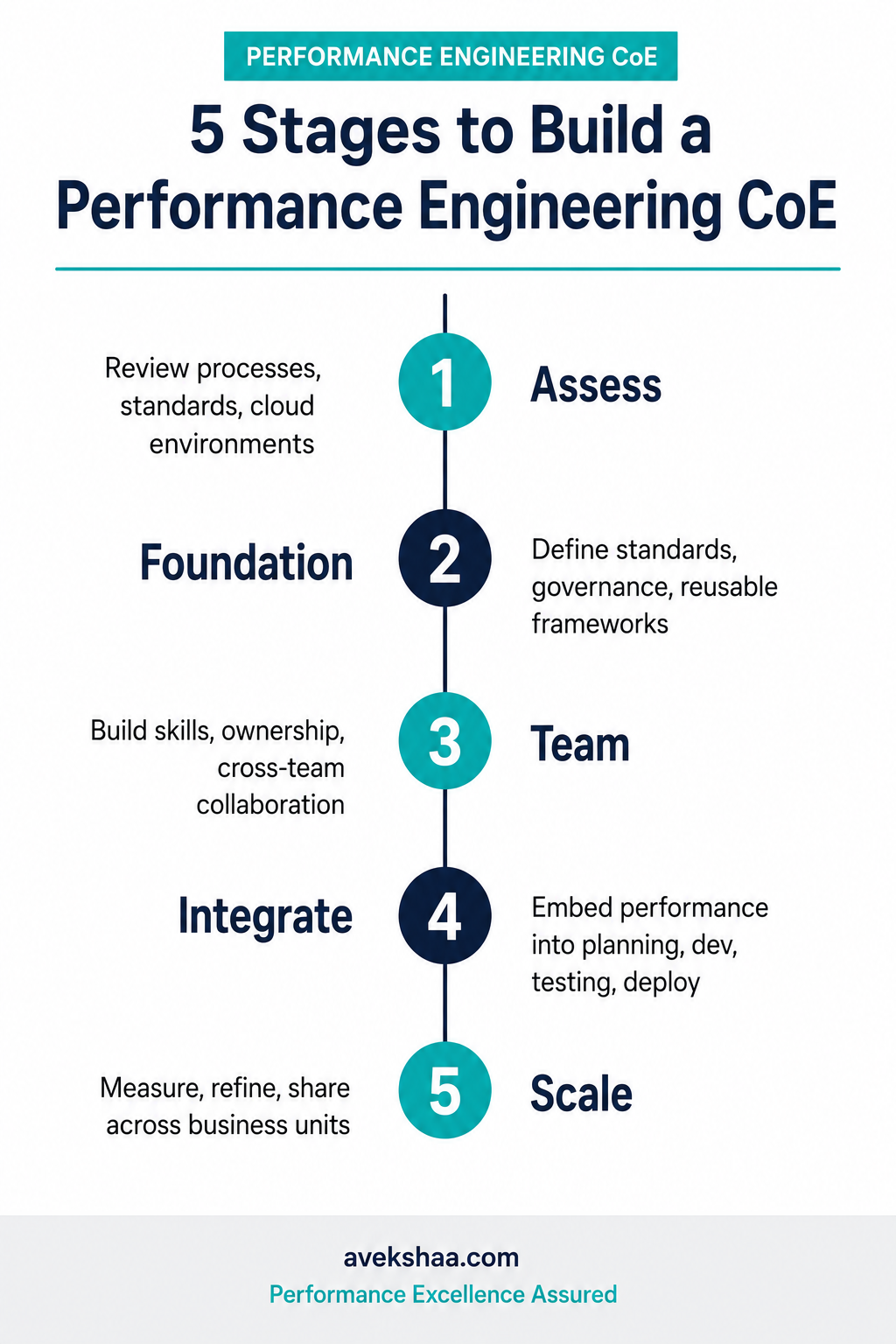
Building a Centre of Excellence does not happen overnight. Most successful organisations follow a structured journey that grows with the business.
Stage 1: Assess Current Engineering Practices
The first step is understanding where your organisation stands today.
Review existing testing processes, performance standards, cloud environments, and engineering workflows. This creates a clear picture of current strengths and improvement areas.
Stage 2: Build the Right Foundation
Once the assessment is complete, organisations define common engineering standards and establish a consistent approach across teams.
This stage often includes governance, documentation, reusable frameworks, and performance objectives.
Stage 3: Develop Skills and Build the Team
Technology alone cannot create a successful CoE.
Engineering teams need the right skills, clear ownership, and shared responsibility. Performance engineers, developers, architects, and operations teams should work together throughout the software lifecycle.
Stage 4: Embed Performance into Daily Delivery
Performance should become part of everyday engineering work.
Instead of waiting until the end of development, teams include performance validation during planning, development, testing, and deployment.
This approach supports continuous improvement while reducing production risks. Pairing automation testing with structured performance validation is what allows GCCs to maintain quality without slowing down release velocity.
Stage 5: Measure, Improve, and Scale
A mature CoE continues to evolve.
Performance metrics are reviewed regularly, engineering practices are refined, and successful approaches are shared across additional projects and business units. Production performance troubleshooting capabilities also become part of the CoE’s ongoing remit as the function matures.
Performance Engineering CoE Journey
| Stage | Primary Objective |
|---|---|
| Assessment | Understand current engineering maturity. |
| Foundation | Establish common standards and governance. |
| Team Development | Build performance engineering capability. |
| Integration | Embed performance practices into delivery. |
| Continuous Improvement | Expand and optimise engineering excellence. |
Common Challenges When Setting Up a Performance Engineering CoE
Every GCC faces challenges while building engineering excellence. The important thing is recognising them early and creating practical solutions.
Common Challenges and Practical Approaches
| Challenge | Practical Approach |
|---|---|
| Different teams follow different practices | Create organisation wide standards. |
| Limited performance engineering expertise | Invest in knowledge sharing and mentoring. |
| Performance testing happens too late | Introduce performance activities earlier in development. |
| Cloud environments become more complex | Build reusable engineering frameworks. |
| Multiple tools and disconnected processes | Improve collaboration and governance across teams. |
Most organisations discover that people, processes, and governance are just as important as technology. For GCCs managing cloud engineering at scale, this challenge is especially visible when distributed environments introduce performance variability that traditional testing frameworks were never designed to catch.
Signs Your GCC Is Ready for a Performance Engineering CoE
Many engineering leaders wonder whether it is the right time to invest in a CoE.
Your organisation may be ready if you are experiencing several of these situations:
- Performance issues are discovered late in projects.
- Different teams use different engineering standards.
- Cloud adoption continues to grow.
- Performance knowledge depends on only a few specialists.
- Development teams need better collaboration.
- Engineering leadership wants consistent quality across projects.
These signs often indicate that a structured engineering excellence centre India approach can provide long term value. Organisations can also use Avekshaa’s IT downtime calculator to quantify the business cost of the current performance gaps before making the investment case for a CoE.
How Avekshaa Technologies Supports GCCs
Building a Centre of Excellence is about creating lasting engineering capability, not simply introducing another testing process.
Avekshaa Technologies works with organisations to help establish sustainable performance testing and engineering practices that align with business goals. Rather than acting only as a service provider, the focus is on helping engineering teams develop frameworks, governance models, performance validation practices, and continuous improvement strategies.
Support typically includes:
- Performance engineering assessments
- CoE planning and implementation
- Engineering governance frameworks
- Performance benchmarking
- CI/CD performance integration
- Team enablement and advisory services
This approach helps organisations strengthen their internal capabilities while supporting long term engineering maturity.
A Practical Framework for GCC Leaders
Before starting your CoE journey, it helps to ask a few important questions.
| Question | Why It Matters |
|---|---|
| Are engineering standards consistent across teams? | Consistency improves delivery quality. |
| Is performance considered from the beginning of development? | Early planning reduces production issues. |
| Can application performance be measured consistently? | Reliable metrics support better decisions. |
| Are engineering teams sharing knowledge effectively? | Collaboration improves long term capability. |
| Does leadership have visibility into engineering performance? | Better reporting supports strategic planning. |
Answering these questions provides a strong foundation for building a successful performance engineering CoE setup India strategy.
Key Takeaways
- Performance engineering has become a strategic capability for modern GCCs.
- A successful CoE combines governance, engineering practices, automation, and collaboration.
- Continuous performance validation helps organisations deliver reliable applications.
- Building internal capability creates long term business value.
- Engineering excellence depends on people, processes, and continuous improvement working together.
Conclusion
As Global Capability Centres continue to evolve, their role is expanding far beyond software delivery. They are becoming centres of innovation, engineering excellence, and business value creation.
Building a GCC performance engineering centre of excellence India 2026 strategy helps organisations create consistent engineering practices, improve application reliability, and support long term growth. More importantly, it gives engineering teams the structure they need to deliver better digital experiences with confidence.
If your organisation is planning to strengthen its independent testing and quality assurance capabilities or establish a Centre of Excellence, Avekshaa Technologies can help you build a practical, scalable approach that supports your engineering goals today while preparing your teams for the challenges of tomorrow. You can explore how GCCs in the banking and insurance sectors have worked through similar engineering maturity journeys with dedicated performance engineering support, and understand how a specialist partner is different from a generalist vendor through Avekshaa’s GCC staff augmentation model.
Frequently Asked Questions
- What is a Performance Engineering Centre of Excellence?
A Performance Engineering Centre of Excellence is a dedicated team or function that establishes common standards, governance, best practices, and processes for performance engineering across an organisation. Rather than focusing only on performance testing, it helps teams improve application reliability, scalability, and performance throughout the software development lifecycle. - Why are GCCs in India investing in Performance Engineering Centres of Excellence?
Many organisations are investing in a GCC performance engineering centre of excellence India 2026 strategy because GCCs are now responsible for delivering engineering excellence, not just development support. A structured CoE helps improve consistency, strengthen collaboration, reduce performance risks, and support faster software delivery. - How is Performance Engineering different from Performance Testing?
Performance testing focuses on measuring how an application performs under specific conditions. Performance engineering is a broader practice that includes planning, designing, monitoring, improving, and continuously validating application performance throughout development. In simple terms, testing checks performance, while engineering improves it. - What are the main benefits of building a Performance Engineering CoE?
A well planned performance engineering CoE setup India can help organisations standardise engineering practices, improve collaboration between teams, strengthen governance, and introduce consistent performance validation across projects. Over time, it also helps build internal expertise and supports continuous improvement. - Which industries benefit the most from a Performance Engineering Centre of Excellence?
Industries that depend on business critical applications often see the greatest value. This includes banking, financial services, insurance, retail, telecom, healthcare, manufacturing, and technology companies. Any organisation delivering large scale digital services can benefit from stronger performance engineering practices. - How long does it take to establish a Performance Engineering Centre of Excellence?
There is no single timeline because every organisation has different goals and levels of engineering maturity. Many organisations begin with an assessment and gradually expand their CoE through governance, team development, process improvement, and continuous optimisation. Building a successful CoE is usually an ongoing journey rather than a one time project. - What skills are needed to build a successful Performance Engineering CoE?
A successful CoE combines technical knowledge with strong collaboration. Teams often include performance engineers, developers, architects, quality engineering professionals, DevOps specialists, and engineering leaders. Building an engineering excellence centre India also requires governance, documentation, and knowledge sharing across teams. - How do you know if your GCC needs a Performance Engineering CoE?
Your organisation may benefit from a CoE if performance issues are discovered late, engineering teams follow different standards, cloud adoption is increasing, or leadership wants greater consistency across projects. These are common signs that a structured performance engineering approach can improve long term delivery quality. - Can a Performance Engineering Centre of Excellence support cloud native applications?
Yes. Modern Performance Engineering Centres of Excellence are designed to support cloud native environments alongside traditional enterprise applications. They help engineering teams establish consistent performance practices, improve scalability, and validate application behaviour throughout the software delivery lifecycle. - Why should organisations work with an experienced Performance Engineering partner?
Building a CoE requires more than selecting the right technologies. It involves governance, engineering processes, knowledge sharing, and long term capability building. An experienced partner such as Avekshaa Technologies can help organisations develop a practical roadmap, establish best practices, and create a sustainable performance engineering function that continues to grow with the business.