
A UPI outage during salary week. A core banking freeze during EMI due dates. A netbanking login that times out for twenty minutes on a Monday morning. For most industries, these are IT incidents. For a bank, each one is a financial event with a number attached to it, a number that a CIO is now expected to defend in the boardroom, not just explain in a post-incident report.
In 2026, the cost of application downtime for Indian banks has become one of the sharpest financial risk metrics a CIO owns. Between digital-first customers who switch apps within minutes of a failed transaction, an RBI compliance regime that treats availability as a supervisory issue, and a UPI ecosystem processing billions of transactions a month, downtime in banking no longer shows up only on an uptime dashboard, it shows up on the P&L, the compliance register, and the customer churn report.
This guide breaks down what downtime actually costs an Indian bank in 2026, how to calculate it for your own institution, and what CIOs are doing to bring that number down.
Did you know?
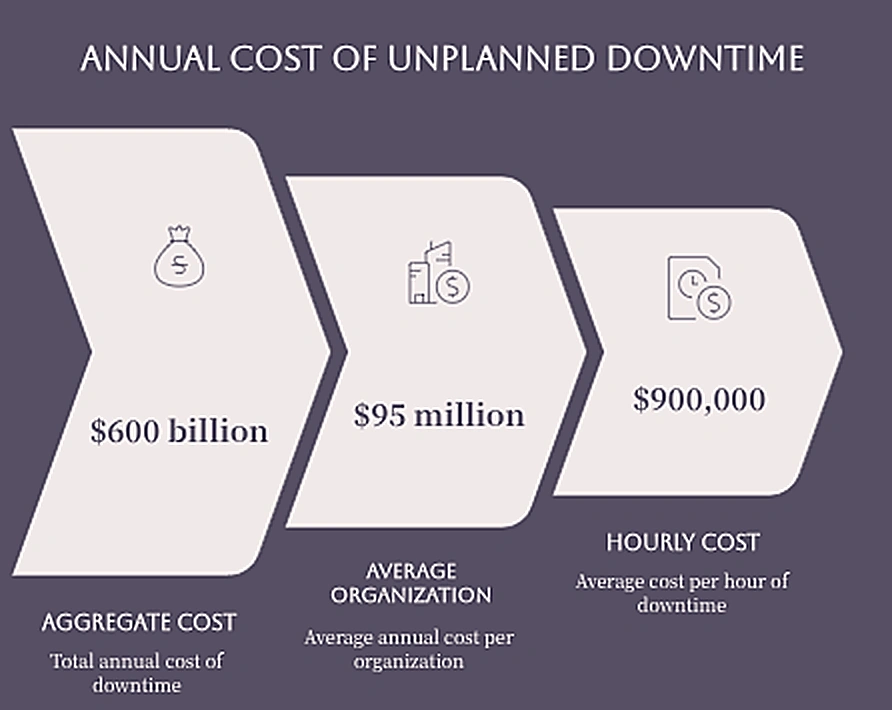
According to Splunk’s 2026 Hidden Costs of Downtime study, conducted with Oxford Economics across 2,000 Global 2000 executives, the aggregate cost of unplanned downtime has climbed to $600 billion annually, a 50% increase in just two years, with the average affected organisation losing roughly $95 million a year, or more than $900,000 for every hour of downtime. Source: Splunk
Why Downtime Costs More for Banks Than for Almost Any Other Industry
Banking applications sit in a category of their own for one simple reason: nearly every transaction is time-critical, and nearly every customer has an alternative in their pocket. A retail app going down for ten minutes loses a browsing session. A core banking or UPI application going down for ten minutes during peak hours can mean:
- Failed or stuck fund transfers and salary credits
- Declined card and UPI transactions at the point of sale
- Breached SLAs with merchant and payment partners
- A spike in call centre volume and social media complaints
- Regulatory scrutiny that starts within hours, not weeks
Global benchmarking research consistently ranks banking and financial services among the highest-cost sectors for downtime, alongside healthcare, because both depend on real-time, always-on system availability rather than best-effort service.
What Does One Hour of Downtime Really Cost Your Bank?
Every bank has a different financial exposure. Estimate your potential revenue loss, compliance impact, recovery costs, and customer churn in just a few minutes with Avekshaa’s free IT Downtime Calculator.
What Application Downtime Actually Costs an Indian Bank in 2026
There is no single industry-wide number, because the cost depends on the size of the bank, which system failed, and how long it stayed down. But four cost categories consistently show up in every serious financial impact model.
1. Direct Revenue and Transaction Loss
This is the most visible cost: transaction fees, interest income, and merchant commissions that simply don’t happen while a payment rail, netbanking portal, or core banking system is unavailable. For India’s larger private and public sector banks, industry research on large-bank outages puts the hourly cost of a major system failure well into seven figures (USD), scaling sharply higher during peak trading, salary-day, or festive-season load.
2. Regulatory and Compliance Exposure
This is the category CIOs increasingly worry about most, because it is the least forgiving. The Reserve Bank of India’s Cyber Security Framework requires scheduled commercial banks to report unusual and material incidents, including outages with a security or fraud dimension, within a tight two-to-six-hour window, on top of parallel CERT-In reporting obligations. A slow, undocumented incident response doesn’t just extend the outage; it turns a technical failure into a compliance failure, with its own penalty track separate from the cost of the downtime itself.
3. Customer Churn and Lifetime Value Loss
Indian retail banking customers now have three or four banking and payment apps installed at any given time. A failed UPI transaction that succeeds on a competitor’s app in the same minute is a trust event, not just a technical one. Repeated outages on high-frequency use cases, bill pay, salary credit, UPI, measurably erode the customer relationships that took years and significant CAC (customer acquisition cost) to build.
4. Recovery, Remediation, and “Silent” Costs
War-room hours, emergency vendor escalations, forensic root-cause analysis, post-incident audits, and the engineering time diverted from the roadmap to firefighting all add up, and rarely show up in the initial incident cost estimate. Large-scale migration failures in the banking sector globally have shown that remediation costs can dwarf the direct revenue loss from the outage itself, sometimes by a factor of five or more.
Real-Time Visibility. Faster Recovery. Lower Downtime Costs.
Monitor every critical banking application, API, and transaction in real time to detect issues before they affect customers.
Building a Downtime Cost Model for Your Bank
A useful CIO-level formula looks like this:
Total Downtime Cost = (Revenue-at-risk per hour × Hours down) + Regulatory/SLA penalties + Recovery and remediation cost + Estimated customer churn value
To make this real for your institution, you need to know, per critical system:
- What percentage of daily transaction revenue or volume runs through it
- Your average and peak-hour transaction value
- Your contractual SLA penalties with payment network and merchant partners
- Your RBI/CERT-In incident reporting obligations and internal response time against them
- Your historical churn rate following a customer-facing incident
Most banks underestimate this number because they calculate only the first component, direct revenue loss, and leave out regulatory exposure and churn, which is exactly where the real financial damage tends to concentrate. If you want to run this calculation for your own environment, Avekshaa’s IT downtime calculator walks through the inputs step by step.
How Leading Indian Banks Are Reducing Downtime Cost
The banks that consistently report fewer, shorter, and less costly incidents tend to invest in the same four capabilities:
Proactive Performance Engineering
Rather than testing performance only before a major release, mature banking IT teams treat performance validation as continuous, load-testing core banking, UPI, and card systems against realistic peak scenarios well before festive or salary-day traffic hits. Explore Avekshaa’s application performance engineering for banks approach.
Real-Time Application Performance Monitoring
Full-stack, real-time visibility, from the customer’s mobile screen down to the core banking database, lets teams catch degradation minutes into an incident instead of hours. See how Avekshaa’s application performance monitoring solution supports this.
Site Reliability Engineering Practices
SRE disciplines, error budgets, blameless post-mortems, and automated incident response, shorten mean time to detect and mean time to recover, which is the single biggest lever on the “hours down” variable in the cost formula. Learn more about Avekshaa’s site reliability engineering services.
Production Troubleshooting Readiness
When something does go wrong in production, the difference between a five-minute fix and a five-hour outage is almost always the quality of production diagnostics already in place. See Avekshaa’s production performance troubleshooting capability.
Together, these capabilities form the backbone of Avekshaa’s performance engineering and digital quality assurance for banks offering, purpose-built for RBI-regulated environments.
A CIO’s Downtime Risk Checklist for 2026
Before the next peak-traffic event, a CIO should be able to answer:
- Do we know our revenue-at-risk per hour for every Tier-1 system?
- Have we load-tested for this year’s expected peak, not last year’s?
- Can we meet the RBI’s 2–6 hour incident reporting window today, under pressure, without scrambling?
- Do we have real-time visibility into API and third-party payment dependencies?
- Has our disaster recovery plan been tested in the last two quarters, not just documented?
- Do we have a clear owner for downtime cost reporting to the board?
If any of these are a “no,” that’s the highest-leverage place to start. To discuss a downtime risk assessment for your institution, you can book a meeting with Avekshaa’s banking performance engineering team, or explore case studies from other financial institutions.
Frequently Asked Queries
1. What is the average cost of application downtime for a large Indian bank?
There is no single official figure specific to India, but global research on large financial institutions puts hourly downtime costs for major banks well into the millions of dollars during peak-load periods, with the exact number depending on which system fails and how long recovery takes. The most reliable approach is to calculate your own institution’s revenue-at-risk using a downtime cost formula rather than relying on an industry average.
2. How quickly must Indian banks report a downtime-related incident to the RBI?
Under the RBI’s Cyber Security Framework for banks, unusual and material cyber and operational incidents must generally be reported within a two-to-six-hour window, with parallel reporting obligations to CERT-In under its 2022 incident reporting directions. Meeting this window requires incident response processes that are tested in advance, not designed after the fact.
3. Which banking systems carry the highest downtime cost risk?
Core banking platforms, UPI and payment switches, netbanking and mobile banking gateways, and card authorisation systems typically carry the highest cost-per-minute of downtime because they sit directly in the transaction path and have the least tolerance for delay.
4. How is downtime cost different from downtime frequency?
Frequency measures how often systems fail; cost measures the financial impact when they do. A bank can have relatively few outages but still face high downtime cost if those outages hit peak-revenue windows or trigger regulatory reporting obligations, which is why CIOs are moving from uptime-percentage metrics to financial-impact metrics.
5. Can performance testing actually reduce downtime costs, or only prevent outages?
Both. Performance testing before release reduces the likelihood of an outage under real-world load, while performance engineering practices, like SRE and continuous monitoring, reduce the duration and severity of the outages that do occur, which is usually the larger cost driver.
6. What role does third-party API risk play in banking downtime?
A significant one. Most Indian banks depend on external UPI switches, card networks, credit bureaus, and fintech partner APIs. A failure or slowdown in any of these can cascade into a customer-facing outage even when the bank’s own core systems are healthy, which is why API-level monitoring is now a standard part of banking performance engineering.
7. How often should banks load-test for peak events like salary days or festivals?
Best practice is to load-test ahead of every major predictable peak, month-end, salary disbursement windows, and festive UPI spikes, rather than relying on a single annual test cycle, since transaction volumes and customer behaviour shift year over year.
8. Who should own downtime cost reporting inside a bank, IT or finance?
Increasingly, both. Leading banks now treat downtime cost as a shared metric between the CIO’s office and finance, since it combines technical root-cause data with revenue and regulatory impact that finance is best placed to quantify for the board.