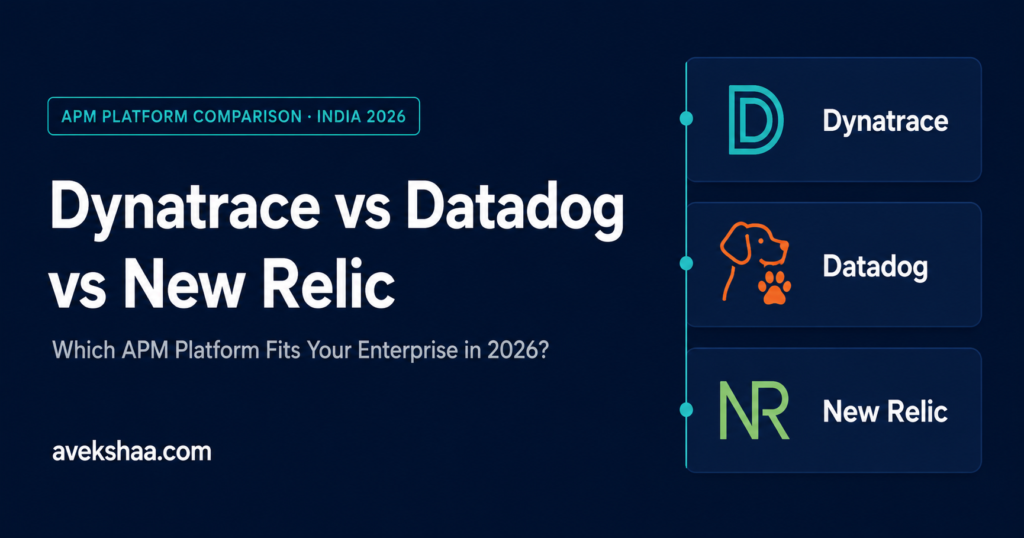
Dynatrace, Datadog, and New Relic are the three most shortlisted APM platforms by Indian enterprises in 2026, but no single platform wins across every environment. The right choice depends on your application architecture, cloud strategy, compliance requirements, and engineering maturity.
Dynatrace is the strongest fit for large enterprise environments with complex hybrid infrastructure. Its AI-driven root cause analysis and automatic dependency discovery make it the go-to for banks, insurers, and regulated industries running mission-critical applications.
Datadog leads for cloud-native, Kubernetes-heavy, and DevOps-first organisations. It offers the widest integration catalog and unified visibility across infrastructure and applications, making it well suited for telecom and fast-scaling digital businesses.
New Relic is the most flexible option for growing engineering teams. Its usage-based pricing, generous free tier, and unified observability platform make it accessible for organisations expanding their application performance monitoring capability without committing to per-host costs.
Choosing a platform is only step one. Most enterprises discover the real challenge begins after purchase, which is why partnering with an independent application performance management specialist makes a measurable difference in implementation success and long-term value.
Indian enterprises in BFSI, telecom, and retail should evaluate platforms not on feature lists but on how well each aligns with their specific architecture, regulatory environment, and operational team maturity.
Modern enterprises generate huge amounts of application and infrastructure data every day. As businesses move towards cloud platforms, microservices, and continuous software delivery, keeping applications reliable has become more challenging than ever. This is why Dynatrace vs Datadog vs New Relic APM comparison India 2026 has become an important topic for engineering leaders evaluating their observability strategy.
Application Performance Monitoring (APM) helps organisations monitor application health, identify performance issues, and improve the experience for users. However, choosing the right platform depends on your business goals, technology landscape, and operational requirements rather than simply selecting the most popular product.
In this guide, we compare Dynatrace, Datadog, and New Relic from the perspective of Indian enterprises. Instead of focusing on marketing claims, we look at where each platform performs well, where it may have limitations, and which types of organisations can benefit the most.
Did You Know?
According to independent observability market research, the observability tools market is projected to reach $62.9 billion, with Datadog commanding approximately 51.82 percent market share in data centre management and New Relic holding around 24 percent in system administration. (Source: Uptrace)
For Indian enterprises evaluating APM platforms, this market concentration means all three vendors are actively investing in enterprise features, regional support, and competitive pricing. That makes thorough independent evaluation more important than ever, since feature lists are converging rapidly while pricing models continue to diverge significantly.
Why Choosing the Right APM Platform Matters More Than Ever
Today’s applications are very different from the systems organisations managed just a few years ago. Businesses now operate across cloud environments, containers, APIs, and distributed services that constantly exchange information.
As applications become more connected, finding the source of a performance issue becomes much harder without the right monitoring platform.
For organisations in banking, telecom, retail, and other digital first industries, selecting the right APM tools India strategy is no longer just an IT decision. It supports customer experience, business continuity, and engineering efficiency.
Some of the biggest reasons enterprises are reviewing their APM platforms include:
Growing cloud adoption
Larger microservices environments
Faster software releases
Higher customer expectations
Greater focus on application availability
Increasing operational complexity
Not Sure Which APM Platform Is Right for Your Environment?
The wrong APM choice leads to cost overruns, poor visibility, and frustrated engineering teams. Get independent, architecture-first guidance before you commit.
Why Enterprises Are Investing in Modern APM
Business Challenge
Why It Matters
Cloud adoption
Applications run across multiple environments and require complete visibility.
Microservices
More services create more dependencies to monitor.
Choosing the right APM platform helps engineering teams move from reactive monitoring to continuous performance visibility. Pairing that platform with a strong observability strategy is what ultimately enables teams to understand not just what broke, but why and where.
Quick Comparison Between Dynatrace, Datadog & New Relic
Every platform has its own strengths. Some focus on enterprise scale, while others are designed for cloud first environments or engineering flexibility.
The table below provides a simple overview to help you understand the differences before exploring each platform in more detail.
Feature
Dynatrace
Datadog
New Relic
Deployment
SaaS
SaaS
SaaS
Best suited for
Large enterprises
Cloud native environments
Growing engineering teams
AI capabilities
Advanced
Strong
Good
Kubernetes support
Excellent
Excellent
Good
Full stack visibility
Excellent
Very Good
Very Good
Ease of adoption
Moderate
Moderate
Easier for smaller teams
Pricing approach
Host based
Host based
Usage based
While comparison tables are useful, there is no single platform that fits every organisation. The right choice depends on your application architecture, engineering maturity, compliance needs, and long term business goals.
Dynatrace: Built for Large Enterprise Environments
Dynatrace is widely recognised for its enterprise scale monitoring capabilities. It is designed to provide visibility across applications, infrastructure, cloud services, and business transactions from a single platform.
Many organisations evaluating Dynatrace vs Datadog India consider Dynatrace when they need deep operational visibility across large and complex environments.
Key Strengths
End to end application visibility across enterprise environments.
Strong automation and intelligent problem detection.
Broad support for cloud, hybrid, and traditional infrastructure.
Suitable for organisations managing large numbers of applications and services.
Things to Consider
Like many enterprise platforms, Dynatrace offers a wide range of capabilities that may require planning and careful implementation. Organisations should also evaluate pricing alongside expected usage and long term operational requirements.
Best Fit
Dynatrace is often a strong choice for organisations that have:
Large enterprise environments
Complex hybrid infrastructure
Multiple application teams
Business critical digital services
Datadog: Designed for Modern Cloud Operations
Datadog has become a popular choice among organisations building cloud first applications and modern engineering environments. It provides visibility across infrastructure, applications, containers, and cloud services through a unified platform.
Many engineering leaders reviewing the best APM tool for Indian enterprises consider Datadog because of its strong support for cloud native environments and DevOps practices.
Key Strengths
Strong visibility across cloud infrastructure.
Excellent support for Kubernetes and container based environments.
Unified monitoring across applications and infrastructure.
Well suited for rapidly changing engineering environments.
Things to Consider
Datadog offers extensive monitoring capabilities, but organisations should carefully review pricing based on expected data volumes and platform usage. As environments grow, planning and governance become increasingly important.
Best Fit
Datadog is often well suited for organisations that have:
Cloud first strategies
Kubernetes based deployments
DevOps driven engineering teams
Modern application architectures
Comparing Dynatrace and Datadog
For many organisations, the first decision comes down to Dynatrace or Datadog. Both platforms offer strong monitoring capabilities, but they are often selected for different reasons.
Comparison Area
Dynatrace
Datadog
Enterprise scalability
Excellent
Very Good
Cloud native monitoring
Very Good
Excellent
Kubernetes visibility
Excellent
Excellent
Operational simplicity
Good
Very Good
Large enterprise environments
Excellent
Very Good
Fast growing cloud platforms
Very Good
Excellent
Neither platform is universally better. The right choice depends on your architecture, operational priorities, and engineering goals rather than feature counts alone. For organisations already managing digital experience monitoring and synthetic monitoring requirements, the integration capabilities of each platform with your existing tools should also factor into the decision.
New Relic: Flexible Observability for Modern Engineering Teams
New Relic has evolved into a comprehensive observability platform that helps organisations monitor applications, infrastructure, and user experiences from a single environment. It is often considered by engineering teams looking for flexibility and a usage based pricing approach.
For organisations comparing New Relic vs Dynatrace BFSI environments or evaluating modern observability platforms, New Relic offers broad visibility while remaining accessible for growing engineering teams.
Key Strengths
Unified visibility across applications, infrastructure, and user experiences.
Strong support for cloud based and distributed applications.
Flexible pricing that can suit different usage requirements.
Good observability capabilities for organisations building modern software platforms.
Things to Consider
As with any observability platform, organisations should review expected data ingestion, retention requirements, and long term monitoring goals before making a decision. The best value comes from aligning the platform with business priorities rather than selecting features alone.
Best Fit
New Relic is often a good choice for organisations that have:
Growing engineering teams
Cloud based applications
Modern software development practices
Requirements for flexible observability
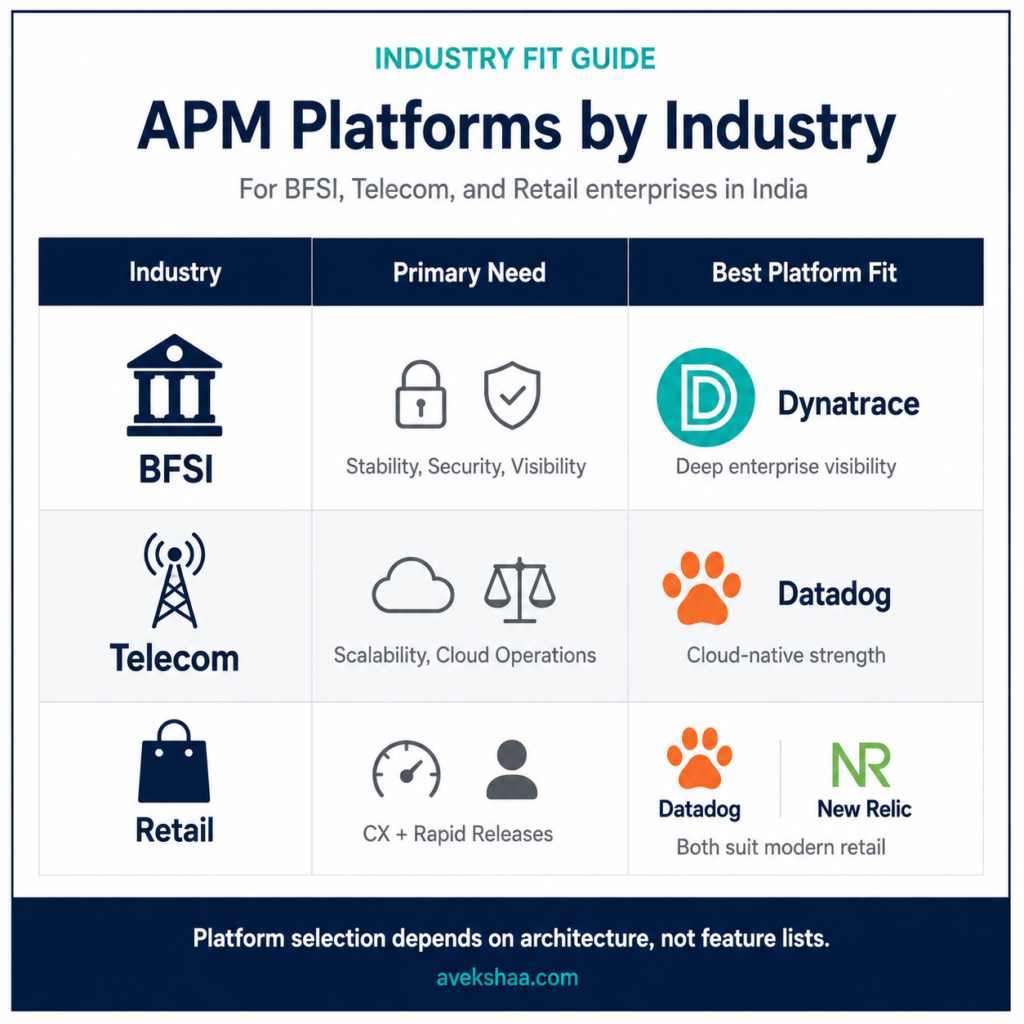
Comparison for BFSI, Telecom, and Retail Industries
Every industry has different priorities. A bank managing payment transactions has different monitoring requirements from a retail business preparing for seasonal shopping events.
Instead of asking which platform is “best,” it is more useful to ask which platform is the best fit for your business environment.
Platform Comparison by Industry
Industry
Primary Requirement
Platform That Often Fits Well
Why
BFSI
Stability, security, visibility
Dynatrace
Strong enterprise visibility across complex environments.
Telecom
Scalability and cloud operations
Datadog
Well suited for cloud native and distributed environments.
Retail
Customer experience and rapid releases
New Relic or Datadog
Strong application visibility and modern deployment support.
These are general recommendations rather than fixed rules. The final decision should always consider application architecture, compliance requirements, operational maturity, and long term business goals.
For financial services and insurance enterprises specifically, platform selection should be evaluated alongside existing production performance troubleshooting processes to ensure the chosen APM tool integrates cleanly with how the operations team already investigates and resolves incidents.
Which Platform Should You Choose?
Choosing between these platforms becomes easier when you focus on your own business priorities instead of comparing feature lists.
Choose Dynatrace if:
You manage large enterprise applications.
Your environment includes hybrid or complex infrastructure.
Operational visibility across many business systems is a priority.
Your organisation values deep automation and enterprise monitoring.
Datadog if:
Your organisation follows a cloud first strategy.
Kubernetes and container platforms are widely used.
DevOps and platform engineering teams need unified visibility.
Your applications change frequently through continuous delivery.
New Relic if:
You are building modern digital applications.
Your engineering teams want flexible observability.
You prefer usage based licensing.
You are expanding your monitoring capabilities over time.
Quick Decision Guide
If Your Priority Is…
Consider Looking At…
Enterprise wide visibility
Dynatrace
Cloud native monitoring
Datadog
Flexible observability
New Relic
Large hybrid environments
Dynatrace
Modern engineering workflows
Datadog or New Relic
There is no universal winner. The best platform is the one that aligns with your technology landscape and business objectives.
How Avekshaa Helps Enterprises Implement and Optimise APM Platforms
Selecting an APM platform is only the first step. Many organisations discover that the real challenge begins after the platform has been purchased.
Successful implementation requires careful planning, application performance engineering expertise, and a clear understanding of business objectives.
Rather than recommending one vendor over another, Avekshaa Technologies works with organisations to help them get the most value from their chosen platform. The focus remains on improving application performance, strengthening observability practices, and supporting long term operational excellence.
Support areas include:
Platform assessment and selection guidance
Implementation planning
Performance engineering advisory
Observability strategy development
Performance optimisation
Continuous monitoring best practices
This vendor neutral approach allows organisations to select the platform that best matches their needs while ensuring it delivers measurable business value. Enterprises can also use Avekshaa’s IT downtime calculator to quantify the cost of current performance gaps and build a stronger internal business case for APM investment before selecting a platform.
Key Takeaways
Every APM platform has its own strengths and ideal use cases.
Application performance monitoring India continues to evolve as organisations adopt cloud native architectures and modern engineering practices.
Dynatrace is often chosen for enterprise scale visibility and complex environments.
Datadog is well suited for cloud first organisations and modern infrastructure.
New Relic offers flexible observability for growing engineering teams.
The right decision depends on architecture, operational maturity, and business priorities rather than feature comparisons alone.
Choosing between Dynatrace, Datadog, and New Relic is an important decision for organisations investing in modern application performance management. Each platform offers valuable capabilities, but the right choice depends on your applications, operational goals, compliance requirements, and engineering maturity.
Instead of focusing only on features, take time to evaluate how each platform fits your long term strategy. A well planned implementation will often deliver greater value than simply selecting the platform with the longest feature list.
If your organisation is evaluating Dynatrace vs Datadog vs New Relic APM comparison India 2026 or planning to strengthen its observability strategy, Avekshaa Technologies can help you assess your requirements, choose the right approach, and maximise the value of your APM investment through independent application performance management and advisory services.
Frequently Asked Questions
Which APM platform is best for Indian enterprises? There is no single platform that is the best for every organisation. The right choice depends on your application architecture, cloud strategy, compliance requirements, and engineering goals. This Dynatrace vs Datadog vs New Relic APM comparison India 2026 shows that each platform has strengths for different enterprise environments.
How do I choose between Dynatrace, Datadog, and New Relic? Start by evaluating your business requirements rather than comparing feature lists alone. Consider your cloud environment, application complexity, scalability needs, operational maturity, and budget. A platform that works well for one organisation may not be the right fit for another.
Is Dynatrace better than Datadog? Both platforms are highly capable but serve different needs. Dynatrace is often chosen for large enterprise environments that require deep operational visibility, while Datadog is widely used by organisations running cloud native applications and modern DevOps environments. The best choice depends on your infrastructure and long term monitoring strategy.
Is New Relic a good choice for growing engineering teams? Yes. Many organisations choose New Relic because it offers broad observability capabilities and a flexible pricing approach. It can be a good option for teams that want visibility across applications, infrastructure, and user experiences without adopting multiple monitoring platforms.
Which APM platform is better for BFSI organisations? There is no fixed answer because every financial institution has different technology requirements. When evaluating the best APM tool for Indian enterprises, BFSI organisations should consider application complexity, compliance requirements, business critical workloads, and operational goals before selecting a platform.
Can these APM platforms monitor cloud native applications? Yes. Dynatrace, Datadog, and New Relic all support modern cloud environments and provide monitoring for containers, Kubernetes, distributed services, and cloud infrastructure. The depth of capabilities and implementation approach may vary between platforms.
What should I compare before selecting an APM platform? Focus on factors that will have the greatest impact on your business. These include deployment model, scalability, cloud support, observability capabilities, reporting, integration options, pricing model, and long term operational requirements. Comparing platforms against your own engineering goals will usually lead to a better decision.
Is pricing the most important factor when choosing an APM platform? Pricing is important, but it should not be the only deciding factor. Total value depends on how well the platform supports your applications, engineering teams, and business objectives. A lower cost platform may require additional effort if it does not meet your monitoring needs.
Can an implementation partner help after we choose an APM platform? Yes. Choosing a platform is only one part of building a successful application performance monitoring India strategy. An experienced implementation partner can help with deployment planning, performance engineering, observability practices, optimisation, and ongoing improvements to ensure the platform delivers long term value.
Why should enterprises take a platform neutral approach when selecting an APM solution? Every organisation has different business priorities and technology environments. A platform neutral approach focuses on understanding your requirements first and then recommending the solution that best fits your needs. This helps ensure that your APM investment supports both engineering excellence and long term business success.
Does Performance Testing Keep You Within FCA/PRA Impact Tolerances? Does Performance Testing Keep You Within FCA/PRA Impact Tolerances? Does Performance Testing Keep You Within FCA/PRA Impact Tolerances? Does Performance Testing
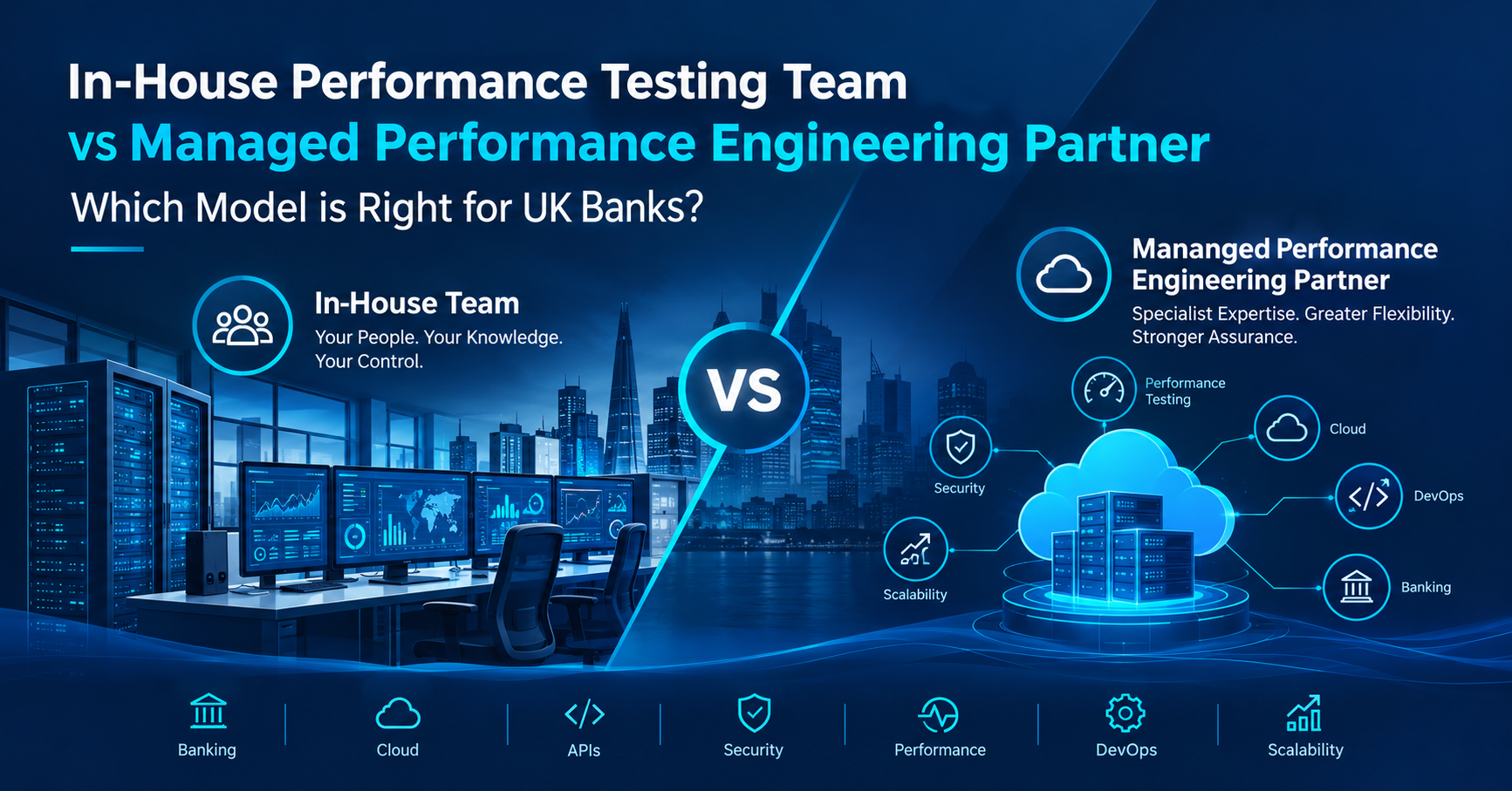
Quick Summary Introduction Every UK bank eventually asks the same question: should performance testing sit inside the organisation, or should it sit with a specialist partner? It’s rarely a comfortable