
Key Takeaways
AI-augmented testing performance engineering in BFSI helps engineering teams improve testing efficiency without replacing human expertise.
- AI can assist with test generation, regression analysis, performance validation, and testing insights.
- Human engineers remain responsible for business decisions, compliance, and testing strategy.
- BFSI organisations can benefit from stronger test coverage and earlier identification of performance risks.
- The most effective testing strategies combine artificial intelligence with experienced engineering teams.
What Is AI-Augmented Testing?
AI-augmented testing combines artificial intelligence with traditional software testing practices to improve efficiency and support better decision-making throughout the testing process.
Instead of manually creating every test case, analysing every test result, or maintaining every automation script, engineering teams can use AI to assist with many of these activities.
This allows testers and performance engineers to focus on understanding business behaviour, validating complex scenarios, and improving application quality.
It is important to understand that AI is an assistant, not a replacement.
Human engineers still define testing strategies, approve important decisions, and ensure applications meet business and regulatory requirements.
Traditional Testing vs AI-Augmented Testing
Traditional Testing | AI-Augmented Testing |
Test cases are created manually. | AI helps generate test cases based on application behaviour. |
Regression suites require regular manual updates. | AI can suggest updates when applications change. |
Test results are analysed manually. | AI helps identify patterns and unusual behaviour. |
Test data is prepared manually. | AI can assist with intelligent test data generation. |
Script maintenance requires significant effort. | AI helps reduce maintenance by identifying required updates. |
The purpose of AI is to improve engineering efficiency while keeping people at the centre of the testing process.
What AI Augmented Testing Can and Cannot Do
One of the biggest misconceptions is that AI can completely automate software testing.
That is not how AI-augmented testing works.
Instead, it supports engineers by improving repetitive activities while leaving business decisions and critical validations to experienced teams.
What AI Can Help With
AI can support engineering teams in several practical ways.
It can help:
- Generate test cases from application flows.
- Suggest realistic test data.
- Detect changes that may affect existing test scripts.
- Identify regression risks.
- Analyse testing patterns across multiple executions.
- Recommend areas that may need additional validation.
These capabilities allow teams to work more efficiently without reducing testing quality.
What AI Still Cannot Do
There are also important limitations.
AI cannot:
- Replace engineering judgement.
- Understand business priorities without guidance.
- Approve production releases.
- Guarantee defect-free software.
- Replace performance engineers.
- Make regulatory or compliance decisions independently.
This balanced approach is one of the reasons why AI-augmented testing is becoming such an important discussion within enterprise engineering teams.
AI Supports Engineers; It Does Not Replace Them
AI Can Do | Human Engineers Still Do |
Generate testing suggestions | Define testing strategy |
Analyse large amounts of testing data | Interpret business impact |
Recommend regression scenarios | Approve production decisions |
Identify unusual patterns | Perform root cause analysis |
Improve repetitive testing tasks | Validate application quality |
The best results come from combining artificial intelligence with experienced engineering teams rather than replacing one with the other.
How AI Is Improving Performance Engineering
Performance engineering is no longer limited to running load tests before production. Modern engineering teams need continuous visibility into application behaviour throughout the software lifecycle.
This is where AI can provide valuable support.
Instead of spending hours reviewing reports or maintaining hundreds of automated scripts, engineers can use AI to quickly identify patterns, detect anomalies, and focus on solving the most important performance issues.
Some of the most practical improvements include:
- Faster test generation.
- Better regression coverage.
- Earlier identification of performance risks.
- Improved analysis of testing results.
- Reduced effort spent maintaining automation assets.
These improvements allow engineering teams to spend more time improving application quality instead of managing repetitive testing activities.
Where AI Adds Value in Performance Engineering
Capability | Engineering Benefit |
Intelligent test generation | Faster preparation of performance scenarios |
Regression analysis | Better test coverage across releases |
Test maintenance | Lower effort required to update automation assets |
Performance insights | Earlier identification of bottlenecks |
Test data generation | Improved efficiency during test execution |
These capabilities demonstrate how AI-powered performance testing supports engineering teams by making testing smarter and more efficient rather than completely changing the testing process.
Five Ways AI-Augmented Testing Supports BFSI Applications 
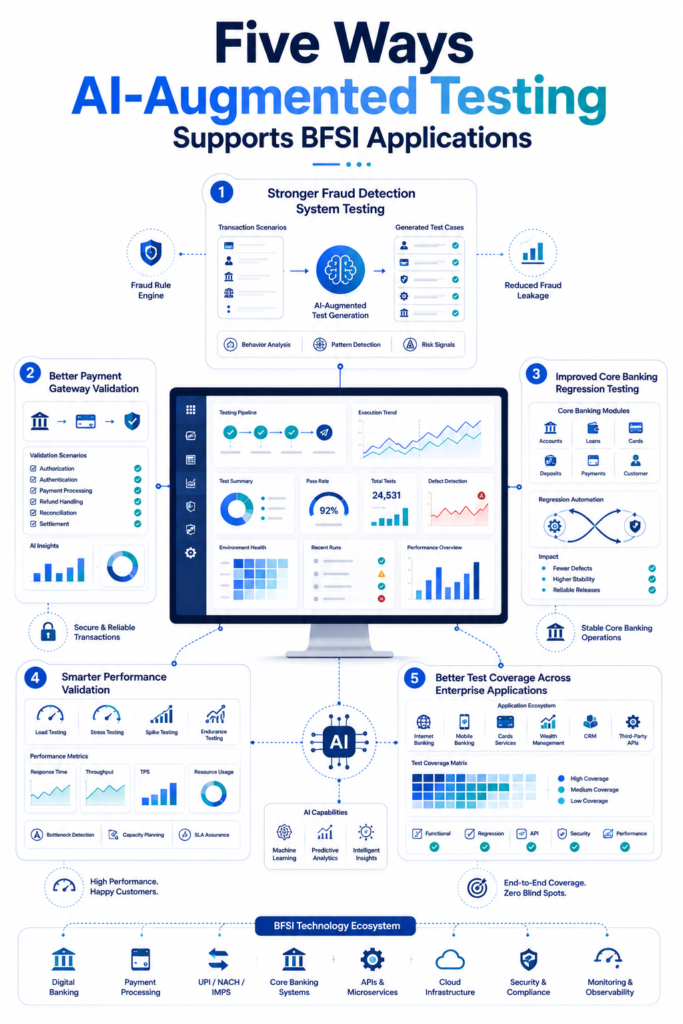
Every industry has different testing priorities. For BFSI organisations, testing must support secure customer transactions, reliable application performance, and consistent user experiences.
Here are five practical ways AI-augmented testing supports performance engineering in BFSI.
1. Stronger Fraud Detection System Testing
Fraud detection systems process large amounts of customer activity in real time.
AI can help generate a wider variety of testing scenarios that simulate different transaction patterns. This allows engineering teams to validate how fraud detection systems perform under changing business conditions.
2. Better Payment Gateway Validation
Payment platforms experience changing traffic levels throughout the day.
AI can assist with creating realistic testing scenarios that help engineering teams evaluate payment performance before applications move into production.
3. Improved Core Banking Regression Testing
Core banking applications are constantly evolving with new features, security updates, and regulatory changes. Every update introduces the possibility of unexpected issues affecting existing functionality.
AI can help engineering teams identify which areas of the application have changed and recommend the most relevant regression tests. Instead of running every test manually, teams can focus on the scenarios that are most likely to be affected.
This approach improves testing efficiency while maintaining confidence before every release.
4. Smarter Performance Validation
Performance testing generates large amounts of information, including response times, throughput, resource usage, and transaction results.
Reviewing this data manually can take considerable time, especially for large enterprise applications.
AI can assist by analysing performance trends, identifying unusual patterns, and highlighting areas that may require additional investigation. This allows engineers to spend more time solving performance issues instead of searching for them.
It is important to remember that AI provides recommendations. Engineers still validate the findings and decide on the appropriate actions.
5. Better Test Coverage Across Enterprise Applications
Large organisations often manage hundreds of applications, APIs, and customer journeys.
Maintaining complete testing coverage across these environments can be difficult.
AI helps by identifying areas that may not be receiving enough testing attention. It can recommend additional scenarios based on previous executions, application changes, and testing history.
For organisations exploring artificial intelligence testing in BFSI, this creates a more consistent testing process while helping engineering teams focus on business-critical functionality.
Where Human Engineers Still Make the Difference
Artificial intelligence can improve many testing activities, but it cannot replace experienced engineers.
Performance engineering is about much more than executing tests. It requires understanding business priorities, customer expectations, application architecture, and operational risks.
These decisions still depend on human expertise.
For example, AI may recommend additional regression tests after an application update. However, engineers decide whether those tests support business objectives and whether they should be included in the release process.
Similarly, AI may identify unusual application behaviour, but determining the root cause and selecting the best solution remains an engineering responsibility.
AI Supports Engineers Rather Than Replacing Them
AI Responsibility | Human Responsibility |
Generate testing suggestions | Define testing strategy |
Identify unusual patterns | Analyse business impact |
Recommend additional test cases | Approve production readiness |
Support automation | Investigate root causes |
Analyse testing history | Make engineering decisions |
For regulated industries such as BFSI, human oversight remains essential for governance, compliance, and business confidence.
AI Testing Categories Worth Knowing in 2026
AI is being applied across different areas of software testing. Rather than relying on a single solution, organisations often combine multiple capabilities based on their engineering requirements.
Some of the most common categories include:
Category | Purpose |
AI-assisted test generation | Helps create and improve test cases. |
Intelligent test maintenance | Reduces the effort required to maintain automation scripts. |
Self-healing test scripts | Automatically adapt to application changes where appropriate. |
AI observability | Monitors AI application behaviour in production. |
Performance analytics | Identifies trends and performance bottlenecks. |
Intelligent test data generation | Assists with creating realistic testing data. |
Each category addresses a different challenge, allowing engineering teams to build a testing strategy that fits their applications and business goals.
How Avekshaa Applies AI-Augmented Testing
Successful AI adoption is not about replacing existing engineering practices. It is about making them more efficient and more intelligent.
Avekshaa Technologies combines performance engineering expertise with intelligent testing practices to help enterprises improve software quality while maintaining engineering control.
This approach focuses on:
- Improving regression testing efficiency.
- Supporting better performance validation.
- Increasing testing coverage across enterprise applications.
- Reducing repetitive manual testing activities.
- Helping engineering teams make informed decisions using AI-generated insights.
Rather than relying entirely on automation, Avekshaa encourages a balanced approach where artificial intelligence supports experienced engineers throughout the testing lifecycle.
AI-Augmented Testing and Regulatory Compliance in BFSI
Regulatory oversight is one of the biggest differences between testing a BFSI application and testing most other software. AI can support compliance-related testing, but it cannot make compliance decisions on its own.
- AI can help flag test scenarios connected to data handling, transaction limits, and audit trail requirements, so engineers know where to focus review effort.
- Engineers remain responsible for interpreting regulatory requirements, such as those covered under RBI’s digital banking regulations, and confirming that testing evidence meets audit expectations.
- Documentation generated with AI assistance still needs human sign-off before it is used to demonstrate compliance to regulators or auditors.
This is why BFSI organisations treat AI-augmented testing as a support layer for compliance work, not a replacement for the governance processes already in place.
Conclusion
AI is changing how engineering teams approach software testing, but its greatest value comes from supporting people rather than replacing them.
By helping engineers generate test cases, improve regression coverage, analyse performance results, and identify testing gaps, AI-augmented testing creates opportunities to improve both software quality and engineering productivity.
For BFSI organisations, this balanced approach supports reliable applications while maintaining the governance, quality, and engineering oversight that business-critical systems require.
If your organisation is exploring AI-augmented testing performance engineering in BFSI, Avekshaa Technologies can help you build a practical testing strategy that combines intelligent automation with proven performance engineering practices. The result is better testing efficiency, stronger application performance, and greater confidence in every software release.
Explore performance testing and engineering services to see how this works for your applications, or book a meeting with the Avekshaa team to discuss your BFSI testing roadmap.
Frequently Asked Questions
What is AI-augmented testing?
AI-augmented testing is the use of artificial intelligence to assist software testing activities such as test case generation, test data creation, regression analysis, and performance insights. It supports engineering teams by reducing repetitive work while allowing people to make the final testing and business decisions. This is why AI-augmented testing performance engineering in BFSI is gaining attention across enterprise software development.
How is AI-augmented testing different from traditional test automation?
Traditional test automation follows predefined scripts created by engineers. AI-augmented testing goes a step further by helping generate test cases, suggesting improvements, analysing test results, and identifying testing gaps. It complements existing automation instead of replacing it.
Can AI replace performance engineers?
No. AI can support engineers by analysing data, identifying patterns, and recommending improvements, but it cannot replace engineering judgement, business understanding, or decision-making. This is why what is AI augmented testing is often described as a partnership between artificial intelligence and experienced engineering teams.
Is AI-augmented testing suitable for BFSI applications?
Yes. BFSI organisations manage complex applications that require reliable performance, strong security, and extensive testing. AI can help improve regression testing, performance validation, and testing efficiency while engineers continue to oversee critical business and compliance requirements.
How does AI help with performance testing?
AI can analyse performance testing results, identify unusual behaviour, recommend additional testing scenarios, and highlight possible bottlenecks. These capabilities make AI-powered performance testing more efficient by helping engineering teams focus on the areas that need the most attention.
Does AI improve regression testing?
Yes. AI can identify application changes, recommend relevant regression tests, and help maintain large test suites. This reduces manual effort while improving testing coverage across multiple releases.
What are self-healing test scripts?
Self-healing test scripts are automated tests that can adapt to certain application changes, such as updated user interface elements or modified object identifiers. This helps reduce script maintenance and keeps automated tests running more consistently after application updates.
Can AI generate test data automatically?
Yes. AI can assist with intelligent test data generation by creating realistic input values based on application behaviour and testing requirements. Engineering teams still review and validate the generated data before using it in production-quality testing.
What are the biggest limitations of AI-augmented testing?
AI cannot understand business priorities on its own, replace experienced engineers, or guarantee defect-free software. While it can improve efficiency and identify useful insights, successful AI-augmented testing in the BFSI still depends on human expertise, governance, and engineering judgement.
How can organisations get started with AI-augmented testing?
The best approach is to begin with repetitive testing activities such as regression testing, test data generation, or performance analysis. Organisations should introduce AI gradually, measure the results, and combine intelligent automation with experienced engineering teams. This creates a balanced testing strategy that improves efficiency without reducing quality or oversight.