
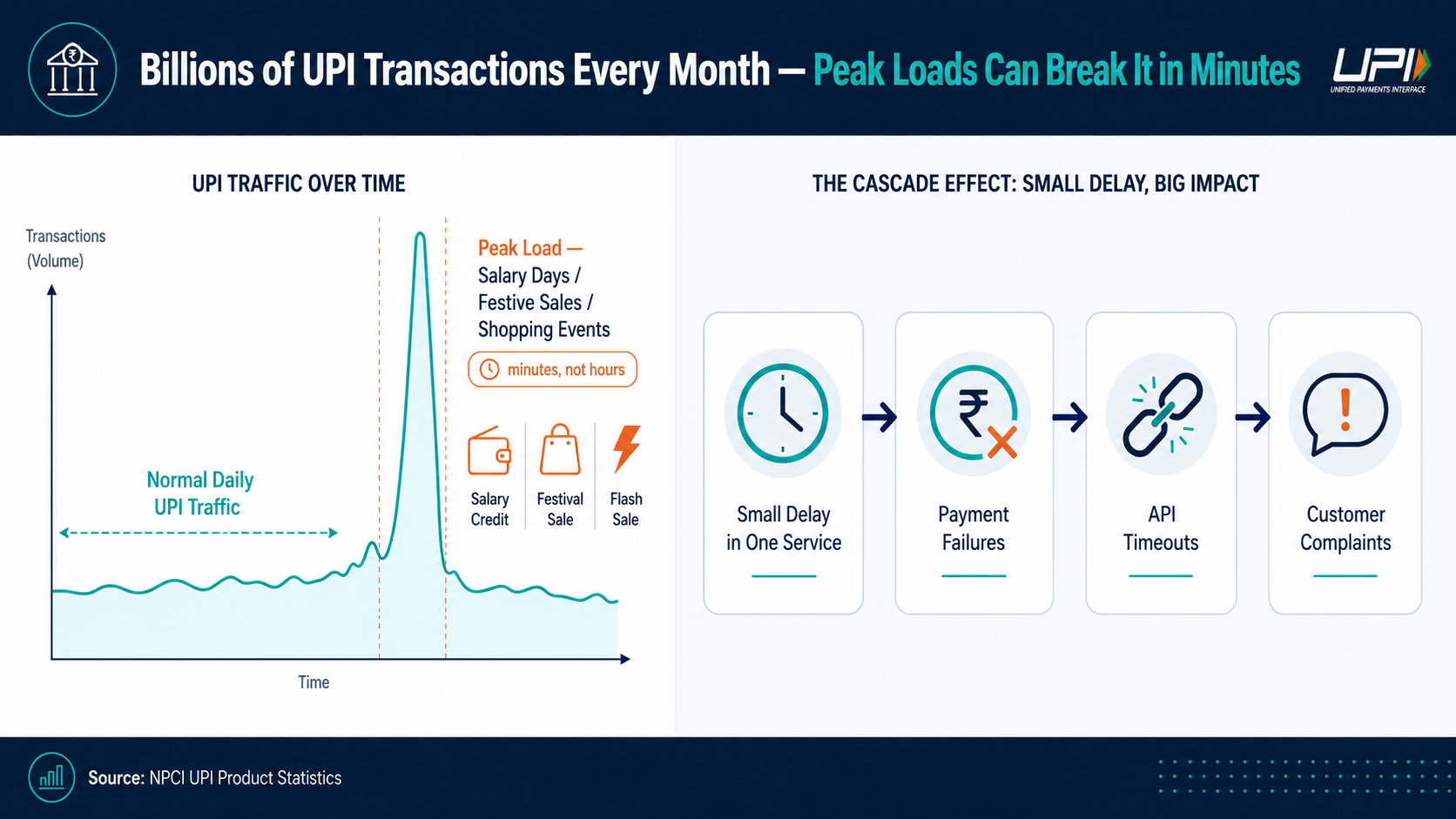
India processes billions of UPI transactions every month, according to NPCI’s own UPI product statistics. During salary days, festive sales, and high traffic shopping periods, transaction volume can rise sharply within minutes. This makes UPI payment system performance engineering peak loads one of the biggest challenges for modern banking and fintech platforms.
A UPI system may work perfectly during normal traffic. But peak load conditions are very different. A small delay in one service can quickly create payment failures, API timeouts, and customer complaints across the system.
For payment platforms, performance is no longer only about speed. It is about:
- transaction success rate
- uptime
- scalability
- customer trust
- operational stability
This is why performance engineering has become critical for ensuring reliable UPI services in 2026.
The UPI Performance Engineering Challenge: What Makes It Unique
UPI systems are highly connected ecosystems.
A single transaction may involve:
- mobile applications
- PSP systems
- NPCI infrastructure
- bank CBS systems
- fraud detection layers
- third party APIs
This creates a complex chain where even one weak component can affect transaction performance.
Common UPI Challenges
| Challenge | Impact |
|---|---|
| Sudden traffic spikes | Transaction delays |
| API dependency latency | Payment failures |
| Database bottlenecks | Slow confirmations |
| Network instability | Timeout errors |
| Failover delays | Service disruption |
This is why UPI transaction performance India requires much deeper engineering than standard application monitoring.
Understanding Peak Load Profiles for UPI Systems
UPI traffic is not evenly distributed throughout the day.
There are predictable spikes during:
- salary credit periods
- festive sales
- IPO subscription windows
- utility payment deadlines
- shopping events
For example, during major festivals, transaction concurrency can increase several times within a short period.
Typical Peak Load Events
| Event Type | Traffic Pattern |
|---|---|
| Salary Days | High morning transaction spikes |
| Festival Sales | Sudden large scale payment bursts |
| IPO Openings | Heavy simultaneous requests |
| Utility Payment Deadlines | End of day transaction peaks |
| Shopping Campaigns | Continuous high TPS load |
Understanding these patterns is essential for UPI transaction load testing India planning.
Key Performance Metrics Every UPI System Must Track
Performance engineering starts with measuring the right metrics.
A system may appear stable while hidden latency and transaction delays slowly increase underneath.
Critical UPI Metrics
| Metric | Recommended Target |
|---|---|
| Transaction Success Rate | 99.5% and above |
| API Latency | Under 100 milliseconds |
| Throughput | Stable TPS handling |
| Error Rate | Minimal transaction failures |
| Database Response Time | Consistent under load |
| Uptime | 99.99% availability |
| Recovery Time | Fast failover capability |
These metrics are critical for application performance management that helps ensure UPI performance during peak traffic.
Performance Engineering Strategy for UPI Systems: 5 Core Pillars
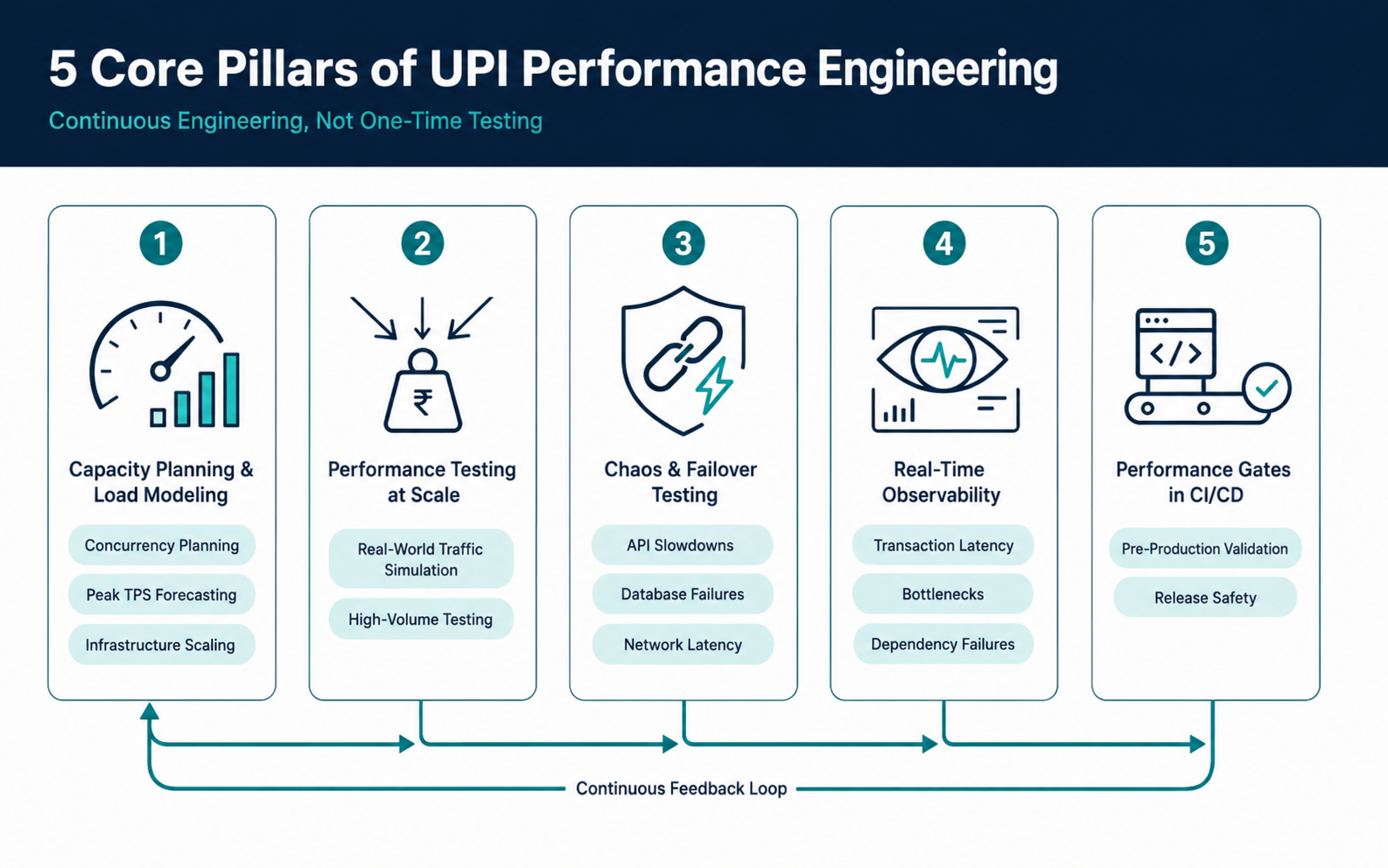
Strong UPI performance requires continuous engineering, not one time testing.
1. Capacity Planning and Load Modeling
Teams must estimate how systems behave during extreme traffic conditions. This includes:
- concurrency planning
- peak TPS forecasting
- infrastructure scaling analysis
2. Performance Testing at Scale
Testing should simulate real world UPI traffic behavior instead of artificial low volume traffic. This is critical for UPI performance testing India environments, and closely mirrors the discipline used in performance testing for banking applications.
3. Chaos and Failover Testing
Systems must continue functioning even when:
- APIs slow down
- databases fail
- network latency increases
Building this kind of resilience is where site reliability engineering practices become essential.
4. Real Time Observability
Continuous monitoring through strong observability practices helps identify:
- transaction latency
- bottlenecks
- infrastructure stress
- dependency failures
5. Performance Gates in CI CD
Every release should pass performance validation before production deployment.
Quick Summary Table
| Pillar | Business Benefit |
|---|---|
| Capacity planning | Better scalability |
| Large scale testing | Fewer failures during peak load |
| Chaos testing | Stronger resilience |
| Real time observability | Faster issue detection |
| CI CD performance validation | Safer releases |
Load Testing UPI Flows: What to Test and How
Testing UPI systems requires realistic transaction simulation.
Simple load tests are not enough.
Critical UPI Flows to Test
| Flow | Why It Matters |
|---|---|
| P2P Transfers | Core transaction flow |
| Merchant Payments | High volume payment handling |
| Balance Checks | Heavy API traffic |
| Mandate Creation | Delayed workflow validation |
| Collect Requests | Concurrent transaction behavior |
Testing should include:
- think time simulation
- mobile network variability
- retry behavior
- concurrent user spikes
This improves UPI transaction stress testing payment system high availability readiness.
Common Performance Bottlenecks in UPI Systems And How to Fix Them
Most UPI slowdowns happen because of hidden bottlenecks.
Common Issues
| Bottleneck | Typical Impact |
|---|---|
| Database locking | Delayed transactions |
| NPCI timeout dependency | Failed payment flow |
| Slow APIs | Increased response time |
| Connection pool exhaustion | Service instability |
| Excessive retries | Traffic amplification |
Practical Fixes
- Optimize database queries
- Improve API timeout handling
- Tune infrastructure scaling rules
- Reduce unnecessary retries
- Improve caching strategies
Diagnosing and resolving these issues in live environments is exactly what production performance troubleshooting is built for, and it’s essential for reducing BFSI application performance engineering risks during high transaction periods.
Chaos Engineering for UPI: Testing What Happens When Things Go Wrong
A stable system is not one that never fails.
A stable system is one that recovers quickly when failures happen.
Chaos engineering helps teams intentionally test:
- API slowdowns
- partial network failures
- infrastructure crashes
- traffic spikes
Example Scenarios
| Scenario | Expected Outcome |
|---|---|
| NPCI API slowdown | Graceful retry handling |
| Database failover | Minimal transaction interruption |
| Traffic surge | Controlled scaling response |
| Partial region failure | Stable failover operations |
This approach is becoming important for digital payment performance testing UPI environments.
Case Study Reference: Engineering a UPI System for 10,000 TPS
Avekshaa has publicly discussed engineering approaches for UPI systems designed to support transaction volumes reaching 10,000 TPS during peak traffic conditions. The focus included scalability validation, API performance optimization, observability improvements, and failover readiness for high transaction environments.
The engineering discussion also highlights common high TPS risks such as:
- downstream latency
- retry storms
- database contention
- transaction bottlenecks under sustained load conditions
The objective was to improve transaction stability and strengthen system readiness during large scale UPI traffic spikes. You can read the detailed engineering discussion here.
Conclusion
UPI systems operate in one of the most demanding digital environments today.
High transaction concurrency, real time processing expectations, and strict uptime requirements mean that even small performance problems can quickly become large scale business incidents.
Ensuring stability during peak traffic requires more than infrastructure scaling alone. It requires:
- continuous performance engineering
- realistic load testing
- failover readiness
- observability
- proactive optimization
Banks and PSPs aiming for near-zero downtime should also look closely at how leaders in the space achieve 99.99% uptime for digital payment systems, since uptime targets and peak load readiness go hand in hand.
As digital payment adoption continues growing across India, enterprises that invest in strong performance engineering practices will be better prepared to maintain customer trust and operational stability during peak load conditions.
If your organization is preparing for large scale UPI growth, this is the right time to explore how Avekshaa can help strengthen TPS readiness, scalability validation, and performance engineering strategies for critical payment systems.
Frequently Asked Questions
- How many TPS should a UPI system handle?
The required TPS depends on the size of the bank, PSP, or payment platform. Smaller platforms may handle a few hundred TPS, while large scale systems often prepare for thousands of transactions per second during peak periods. Strong UPI payment system performance engineering peak loads planning helps organizations prepare for sudden traffic spikes without affecting customer experience. - What latency is acceptable for UPI transactions?
Most users expect UPI transactions to complete almost instantly. In many environments, API response times under 100 milliseconds are considered healthy for critical services. Low latency is extremely important for maintaining smooth UPI transaction performance India experiences during peak traffic conditions. - How do you test UPI systems without using a production environment?
Enterprises usually create production like testing environments that simulate real transaction flows, concurrency, and traffic patterns. These environments help teams validate scalability, failover behavior, and system stability safely before deployment. This is a key part of UPI transaction load testing India strategies. - What is NPCI’s performance SLA for UPI systems?
NPCI focuses heavily on transaction availability, uptime, and successful processing rates across the ecosystem, and publishes ongoing volume and performance data through its official UPI statistics. Banks and PSPs are expected to maintain high availability and minimize transaction failures. This is why many organizations invest heavily in application performance management to help ensure UPI performance during peak traffic. - Why do UPI systems fail during peak traffic?
Peak traffic increases pressure across APIs, databases, and payment processing layers. If systems are not properly optimized, transaction queues, latency, and timeout errors begin increasing rapidly. Weak scalability planning is one of the most common causes of UPI performance testing India failures. - What is the difference between load testing and stress testing for UPI?
Load testing checks whether the system performs correctly under expected traffic conditions. Stress testing pushes the system beyond normal capacity to identify breaking points and recovery behavior. Both are important for ensuring UPI transaction stress testing payment system high availability readiness. - How important is failover testing in UPI environments?
Failover testing is extremely important because payment systems must remain available even during infrastructure or network failures. Without proper validation, backup systems may fail during real incidents. This is a major concern in performance engineering for digital payment systems. - What metrics should UPI engineering teams monitor continuously?
Teams should continuously track response time, transaction success rate, TPS, error rate, database latency, API health, and uptime. Monitoring these metrics helps identify hidden issues before customer experience is affected. This is critical for digital payment performance testing UPI environments. - Can cloud infrastructure alone solve UPI scalability problems?
No. Cloud infrastructure helps with scaling, but poor application architecture, database bottlenecks, and API inefficiencies can still create failures under load. Performance engineering is required alongside infrastructure scaling. - How does Avekshaa approach UPI performance engineering?
Avekshaa focuses on helping enterprises improve scalability, availability, transaction stability, and peak load readiness for payment systems. The approach includes load testing, failover validation, observability, and continuous performance optimization for high transaction environments.