Quick Summary
- LLM observability tracks whether AI applications are producing accurate, trustworthy responses, not just whether they are online, and connects directly to Avekshaa’s observability solutions for enterprise AI systems.
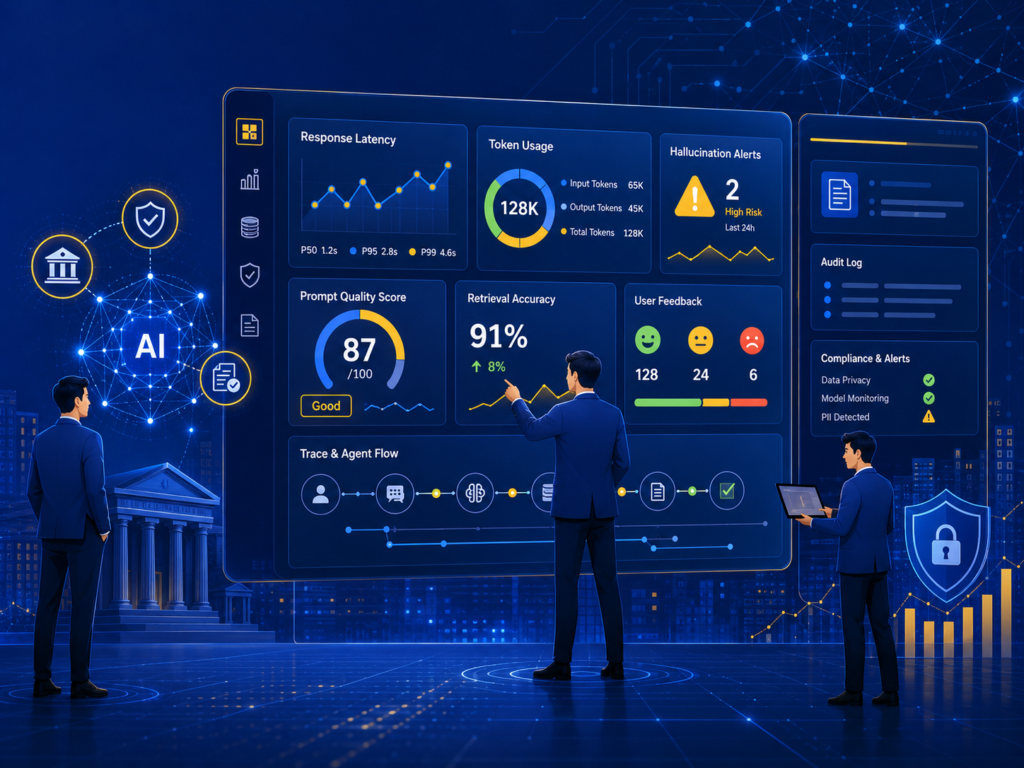
- The Six Pillars framework covers response latency, token usage and cost, hallucination detection, prompt quality, retrieval accuracy, and user feedback.
- Traditional monitoring checks infrastructure health, while LLM observability checks whether the AI’s answers are actually correct and reliable.
- A practical banking example walks through how an AI home loan assistant is monitored end to end, from prompt to response.
- Continuous feedback loops and audit ready logging are essential for maintaining trust in regulated BFSI environments.
Did You Know?
More than 40 percent of agentic AI projects are expected to be cancelled before 2027 because of rising costs, unclear ROI, and weak risk controls, according to a 2025 Gartner forecast. This is exactly the kind of blind spot that continuous production monitoring is designed to catch before it affects customers or compliance.
Artificial Intelligence is moving quickly from experiments to real business applications. Today, banks, insurance companies, and financial institutions are using AI agents to answer customer questions, assist employees, detect fraud, and improve daily operations. As these systems become part of business critical services, simply deploying them is not enough. They must also be monitored continuously.
This is where LLM observability BFSI AI agents production monitoring becomes important.
LLM observability is the practice of monitoring how Large Language Model applications behave after deployment. It helps engineering teams measure response quality, latency, token usage, costs, reliability, and user experience while AI applications are running in production.
Unlike traditional software, an AI application can remain available while still producing incorrect or inconsistent responses. For BFSI organisations, this can affect customer trust, operational efficiency, and regulatory compliance. That is why monitoring AI behaviour is becoming just as important as monitoring infrastructure and application performance.
What Is LLM Observability?
Traditional application monitoring tells you whether an application is running properly. LLM observability goes a step further by helping you understand whether an AI application is producing useful, reliable, and trustworthy responses.
Instead of monitoring only servers, databases, or APIs, engineering teams also need visibility into prompts, model responses, token consumption, retrieval quality, and user interactions.
Think of it this way.
A banking chatbot may answer every customer request within two seconds. From an infrastructure point of view, everything looks healthy.
However, if the chatbot gives incorrect loan information or misunderstands customer questions, the application is still failing from a business perspective.
That is exactly what LLM observability is designed to detect.
Is Your AI Application Truly Ready for Production?
Gain visibility into AI response quality, hallucinations, token costs, latency and retrieval accuracy with a practical LLM observability strategy built for BFSI environments.
Speak With an AI Observability ExpertTraditional Application Monitoring vs LLM Observability
Traditional Application Monitoring | LLM Observability |
Measures application health | Measures AI behaviour and response quality |
Focuses on infrastructure metrics | Focuses on prompts, responses, and model performance |
Tracks CPU, memory, and errors | Tracks latency, token usage, hallucinations, and feedback |
Detects system failures | Detects AI quality issues even when systems are healthy |
Supports application reliability | Supports reliable and trustworthy AI experiences |
Rather than replacing traditional monitoring, LLM observability works alongside it. Together, they provide a complete view of both application performance and AI behaviour.
Why BFSI Organisations Need a Different Monitoring Approach
Banks and financial institutions work in highly regulated environments where accuracy matters just as much as speed.
An AI assistant that provides incorrect investment information, misunderstands a customer’s loan eligibility, or generates inconsistent policy responses can create operational and compliance challenges, even if the application itself remains available.
This makes AI observability tools and production monitoring strategies increasingly important for organisations deploying AI powered services.
Some of the unique challenges include:
- AI generated responses must remain accurate and consistent.
- Customer information must be handled securely.
- Every interaction may need to be traceable for audits.
- AI responses should support business and regulatory requirements.
- Performance must remain stable during periods of high demand.
Why Production AI Monitoring Matters for BFSI
Challenge | Business Impact |
Incorrect AI responses | Reduced customer confidence |
Slow response times | Poor customer experience |
Hallucinated information | Compliance and operational risks |
High token usage | Increased operational costs |
Missing audit records | Difficult investigations and governance |
Poor retrieval quality | Incorrect business decisions |
Unlike traditional applications, AI systems must be monitored for both technical performance and response quality. A healthy server does not always mean a healthy AI application.
The Six Pillars of LLM Observability for Production AI
Successful AI monitoring goes beyond checking whether an application is online. Engineering teams need visibility into several areas that directly affect business outcomes.
The following six pillars provide a practical framework for monitoring AI applications running in production.
Response Latency
Customers expect AI applications to respond quickly. Whether someone is checking an account balance or asking about a loan product, slow responses create frustration.
Engineering teams should monitor:
- Average response time
- Peak response time
- Response consistency during busy periods
- Performance under increasing workloads
Monitoring latency helps maintain a smooth customer experience while identifying performance bottlenecks before they affect users.
Token Usage and Cost
Large Language Models process information using tokens. Every prompt and every generated response consumes tokens, which directly affects operating costs.
Monitoring token usage helps organisations:
- Understand AI operating expenses.
- Identify unusually expensive requests.
- Improve prompt efficiency.
- Plan infrastructure and budgeting more effectively.
For organisations deploying multiple AI services, token monitoring becomes an important part of long term cost management.
Hallucination Detection
One of the biggest challenges in production AI is identifying responses that sound convincing but contain incorrect information.
In BFSI, even a small factual mistake can reduce customer confidence or create unnecessary operational risks.
This concern is not hypothetical. McKinsey has highlighted generative AI hallucinations as one of the most significant risks banks must manage while scaling AI adoption, which is why continuous monitoring and human validation remain essential safeguards.
Engineering teams should monitor:
- Incorrect factual responses.
- Unsupported recommendations.
- Response consistency.
- Confidence scoring where available.
- Human review feedback.
Detecting hallucinations early allows teams to improve prompts, retrieval quality, and overall application reliability before incorrect responses affect customers.
In Part 2, we will explore the remaining three pillars of LLM observability BFSI AI agents production monitoring, explain how to build an LLM observability strategy for BFSI organisations, walk through a practical banking AI example, and discuss how Avekshaa Technologies helps enterprises extend performance engineering into AI application monitoring.
Prompt Quality
A Large Language Model can only produce high quality responses if it receives clear and well structured prompts. Even small changes in prompt design can affect the accuracy, consistency, and usefulness of the answers.
Monitoring prompt quality helps engineering teams understand which prompts produce reliable results and which ones need improvement.
Some important areas to monitor include:
- Prompt consistency across different scenarios.
- Response accuracy for similar customer questions.
- Prompt success rates.
- Frequently rewritten or failed prompts.
- Prompt updates after model changes.
Improving prompt quality is an ongoing process. As business requirements change, prompts should also be reviewed and refined to maintain reliable AI performance.
Retrieval Accuracy
Many enterprise AI applications use Retrieval Augmented Generation, also known as RAG. Instead of relying only on the model’s existing knowledge, these applications retrieve information from internal documents, knowledge bases, or company policies before generating a response.
For banks and financial institutions, retrieval quality is extremely important. If the wrong document is retrieved, even a powerful language model can generate an incorrect answer.
Engineering teams should monitor:
- Document retrieval accuracy.
- Relevance of retrieved information.
- Missing or outdated knowledge sources.
- Search success rates.
- Response quality after retrieval.
Reliable retrieval improves both customer confidence and business accuracy.
User Feedback and Continuous Improvement
The final pillar focuses on learning from real customer interactions.
Production monitoring should not stop after deployment. Every customer conversation provides valuable information about how the AI application performs in real situations.
Useful feedback metrics include:
- Customer satisfaction scores.
- Frequently repeated questions.
- Escalations to human agents.
- Failed conversations.
- User reported inaccuracies.
This feedback allows engineering teams to improve prompts, update knowledge sources, and strengthen the overall AI experience over time.
The Six Pillars at a Glance
Pillar | What to Monitor | Why It Matters |
Response Latency | Speed and consistency | Better customer experience |
Token Usage | Consumption and cost | Cost optimisation |
Hallucination Detection | Incorrect responses | Improved reliability |
Prompt Quality | Prompt effectiveness | Better response quality |
Retrieval Accuracy | Knowledge retrieval | Accurate business answers |
User Feedback | Customer interactions | Continuous improvement |
Building an LLM Observability Stack
An effective observability strategy combines several monitoring layers instead of relying on a single metric.
Rather than focusing on one monitoring platform, organisations should build a complete view of how their AI applications behave from the moment a customer submits a prompt until the final response is delivered.
Core Components of an LLM Observability Stack
Layer | Purpose |
Prompt Monitoring | Analyse prompts entering the AI application. |
Response Monitoring | Evaluate response quality and consistency. |
Token Analytics | Measure token usage and operational cost. |
Logging | Store AI interactions for analysis and audits. |
Tracing | Follow requests across multiple services. |
Dashboards | Visualise trends and production health. |
Alerts | Notify teams about unusual behaviour or failures. |
Every organisation may build this stack differently depending on its architecture and business requirements. The goal is to provide complete visibility across the AI application lifecycle.
A Practical Example: Monitoring an AI Banking Assistant
Imagine a bank launches an AI assistant to answer customer questions about home loans.
A customer asks,
“Am I eligible for a home loan?”
Behind the scenes, several processes take place before the customer receives an answer.
The observability process could look like this:
Step | What Happens | Why It Matters |
1. Customer Prompt | A customer asks the AI assistant a question, such as a home loan eligibility query. | Starts the AI interaction and captures the user’s intent. |
2. Retrieve Banking Knowledge | The system retrieves relevant information from internal knowledge sources or policy documents. | Ensures the AI uses accurate and up to date business information. |
3. Generate AI Response | The Large Language Model creates a response using the prompt and retrieved information. | Produces the answer shown to the customer. |
4. Measure Latency | The system records how long it takes to generate the response. | Helps maintain a fast and consistent customer experience. |
5. Monitor Token Usage | Token consumption is measured for every request and response. | Supports cost management and resource planning. |
6. Check Response Quality | The response is evaluated for accuracy, consistency, and reliability. | Helps identify hallucinations or incorrect business information. |
7. Collect Customer Feedback | User feedback and interaction outcomes are recorded. | Reveals how well the AI is performing in real customer scenarios. |
8. Continuous Improvement | Insights from monitoring are used to improve prompts, retrieval quality, and model performance. | Keeps the AI application reliable and effective over time. |
At every stage, engineering teams collect valuable information.
If the response is slow, latency metrics identify the issue.
If the answer contains incorrect information, response quality monitoring highlights the problem.
If operating costs increase, token analytics help explain why.
This end to end visibility makes it much easier to maintain reliable AI applications in production.
How to Build an LLM Observability Strategy for BFSI
Building observability should begin before the AI application reaches production. A structured approach helps organisations monitor the right metrics from the beginning.
Step 1: Identify Business Critical AI Applications
Start with applications that directly affect customers or important business processes.
Step 2: Define Success Metrics
Measure more than system availability. Include response quality, latency, user satisfaction, and operational costs.
Step 3: Monitor Every AI Interaction
Capture prompts, responses, retrieval behaviour, and supporting metrics throughout the customer journey.
Step 4: Create Meaningful Dashboards
Present information in a way that engineering teams can quickly understand and act upon.
Step 5: Improve Continuously
Use production insights to refine prompts, improve retrieval quality, reduce costs, and strengthen overall AI reliability.
How Avekshaa Supports Production AI Observability
As organisations adopt AI across critical business functions, observability becomes a natural extension of performance engineering.
Avekshaa Technologies helps organisations build production ready AI systems by combining application performance engineering with AI observability practices. Instead of focusing only on infrastructure metrics, the approach considers response quality, business outcomes, operational reliability, and long term scalability.
This includes helping organisations:
- Design production monitoring strategies.
- Improve AI application performance.
- Strengthen reliability across customer journeys.
- Support continuous optimisation.
- Build scalable observability practices for enterprise AI.
The objective is not simply to deploy AI applications but to ensure they continue performing reliably as business usage grows.
Common LLM Observability Mistakes BFSI Teams Should Avoid
Even well planned AI monitoring programs run into avoidable problems. Recognising these mistakes early makes it easier to build a reliable observability practice.
- Monitoring only uptime. A responsive AI application is not the same as a correct one, so infrastructure metrics alone will miss response quality issues.
- Treating observability as a one time setup. Prompts, models, and customer behaviour change over time, so dashboards and alerts need regular review.
- Skipping audit trails. BFSI teams that cannot trace a specific AI response back to its prompt and source data will struggle during compliance reviews.
- Choosing the right combination of monitoring tools early on helps avoid rebuilding the observability stack later.
LLM Observability and AIOps: Where They Overlap
BFSI teams often ask how LLM observability relates to broader operational practices such as AIOps. The two are complementary rather than competing. AIOps applies automation and analytics across the wider IT estate, correlating infrastructure and application signals to speed up incident response. LLM observability narrows that same discipline to AI specific signals, such as prompts, token usage, and response quality.
Used together, they give BFSI engineering teams a single, connected view of how AI applications behave, from the infrastructure layer up to the quality of the answer a customer actually receives.
Key Takeaways
- LLM observability BFSI AI agents production monitoring helps organisations understand how AI applications perform after deployment.
- Traditional application monitoring alone cannot measure AI quality or business impact.
- The Six Pillars framework provides a structured approach for monitoring production AI.
- Engineering teams should monitor technical metrics alongside customer experience and business outcomes.
- Continuous improvement is an essential part of maintaining reliable AI applications.
- A successful observability strategy supports performance, compliance, customer trust, and operational efficiency.
Conclusion
Deploying an AI application is only the beginning of the journey. Long term success depends on understanding how the application behaves in real production environments and continuously improving its performance.
LLM observability helps organisations monitor response quality, latency, operational costs, retrieval accuracy, and customer experience from a single engineering perspective. For BFSI organisations, this creates greater confidence in AI driven services while supporting reliability and responsible innovation.
If your organisation is planning to deploy or expand AI powered applications, Avekshaa Technologies can help you build a practical observability strategy that extends proven performance engineering practices into modern AI systems. With the right monitoring approach, you can improve reliability, reduce operational risk, and deliver AI experiences your customers can trust.
Frequently Asked Questions
What is LLM observability and why is it important?
LLM observability is the practice of monitoring how a Large Language Model performs after it has been deployed in production. It helps engineering teams track response quality, latency, token usage, reliability, and user feedback. For organisations implementing LLM observability BFSI AI agents production monitoring, it provides the visibility needed to maintain accurate and reliable AI applications.
How is LLM observability different from traditional application monitoring?
Traditional application monitoring focuses on infrastructure, servers, databases, and application availability. LLM observability goes further by monitoring prompts, AI generated responses, token consumption, retrieval quality, and user interactions. Together, they provide a complete view of both system health and AI performance.
Why do BFSI organisations need LLM observability?
Banks, insurance companies, and financial institutions use AI to support customer service, fraud detection, and internal operations. Monitoring these applications helps reduce the risk of incorrect responses, improve customer trust, and support governance. A strong AI observability tools strategy also helps organisations understand how AI applications behave in real production environments.
What are the most important metrics to monitor in an AI application?
Some of the most valuable metrics include response latency, token usage, hallucination rates, prompt quality, retrieval accuracy, and customer feedback. Monitoring these metrics helps engineering teams improve both technical performance and business outcomes over time.
What is hallucination detection in LLM observability?
Hallucination detection is the process of identifying AI responses that appear confident but contain incorrect or unsupported information. Monitoring hallucinations is especially important in regulated industries where accurate information is critical. It helps improve the reliability of LLM monitoring banking applications and reduces operational risk.
What is Retrieval Augmented Generation and why should it be monitored?
Retrieval Augmented Generation, often called RAG, allows an AI application to retrieve information from trusted knowledge sources before generating a response. Monitoring retrieval accuracy helps ensure the model uses the correct documents and provides reliable answers based on current business information.
Does LLM observability help reduce AI operating costs?
Yes. Monitoring token usage helps organisations understand how AI resources are being consumed. Engineering teams can identify expensive prompts, optimise response generation, and improve efficiency. This makes LLM performance monitoring 2026 an important part of long term AI cost management.
Can LLM observability improve customer experience?
Yes. Observability helps identify slow responses, inconsistent answers, and recurring customer issues before they become larger problems. By continuously monitoring production behaviour, organisations can deliver faster, more accurate, and more reliable AI experiences.
Is LLM observability only useful after an AI application goes live?
No. While production monitoring is a major part of observability, planning should begin during development. Defining success metrics, monitoring strategies, and business goals early makes it easier to build reliable AI applications and establish an effective how to monitor AI agents production strategy.
How can organisations build an effective LLM observability strategy?
Start by identifying business critical AI applications and defining the metrics that matter most. Monitor prompts, responses, latency, token usage, retrieval quality, and customer feedback together instead of relying on a single measurement. A structured observability strategy helps organisations improve AI reliability, reduce operational risks, and build greater confidence in production AI systems.