Quick Summary
- Recurring slowdowns, peak-time incidents, and rising infrastructure costs are early signs of a deeper performance problem.
- Application Performance Engineering helps prevent performance, availability, and scalability risks before they reach production.
- Performance Testing and Engineering validates how systems behave under realistic traffic, concurrency, and failure conditions.
- Slow root cause analysis usually signals fragmented monitoring and lim ited transaction-level visibility.
- Acting on even a few recurring warning signs can reduce release risk, customer frustration, and reactive firefighting.
Did you know? Google's Site Reliability Engineering guidance identifies latency, traffic, errors, and saturation as the four golden signals for monitoring user-facing systems.
Your enterprise needs performance engineering when application slowdowns, scaling failures, or repeated production incidents start happening even though the code passed every functional test. These warning signs point to a system that was never engineered to handle real-world load, growth, or failure conditions, and no amount of additional testing will fix it after the fact.
Most IT leaders do not wake up one day and decide to invest in performance engineering. It usually happens after the third war room in a quarter, or after a board member asks why a “fully tested” application went down during the one week it mattered most, like a festive sale or a loan disbursement deadline. The signs are almost always visible well before that point. The challenge is recognizing them early enough to act.
Seeing Early Signs of Application Performance Risk?
Recurring slowdowns, peak-time failures, rising cloud costs, and delayed root cause analysis can indicate deeper performance gaps. Identifying them early helps prevent production outages and costly reactive fixes.
Why These Warning Signs Get Ignored
Functional QA confirms that a feature works. It rarely confirms that the feature works under 10,000 concurrent users, or that it recovers gracefully when a downstream service times out. Because functional tests pass, teams assume performance is fine, until production proves otherwise. That gap between “tested” and “production-ready under load” is exactly where performance engineering lives.
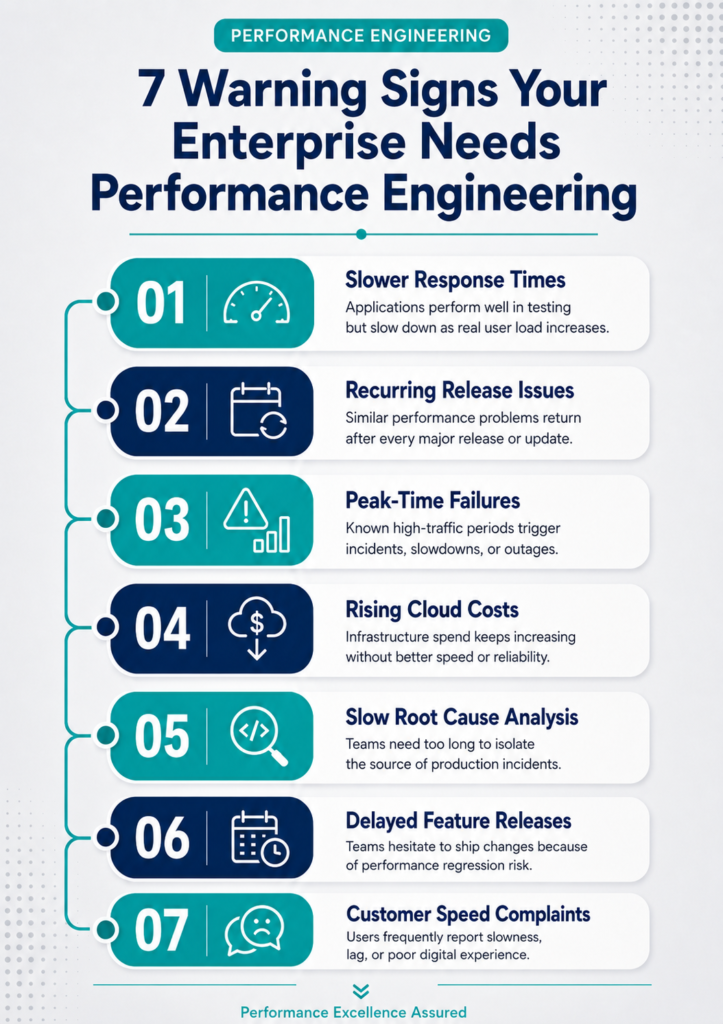
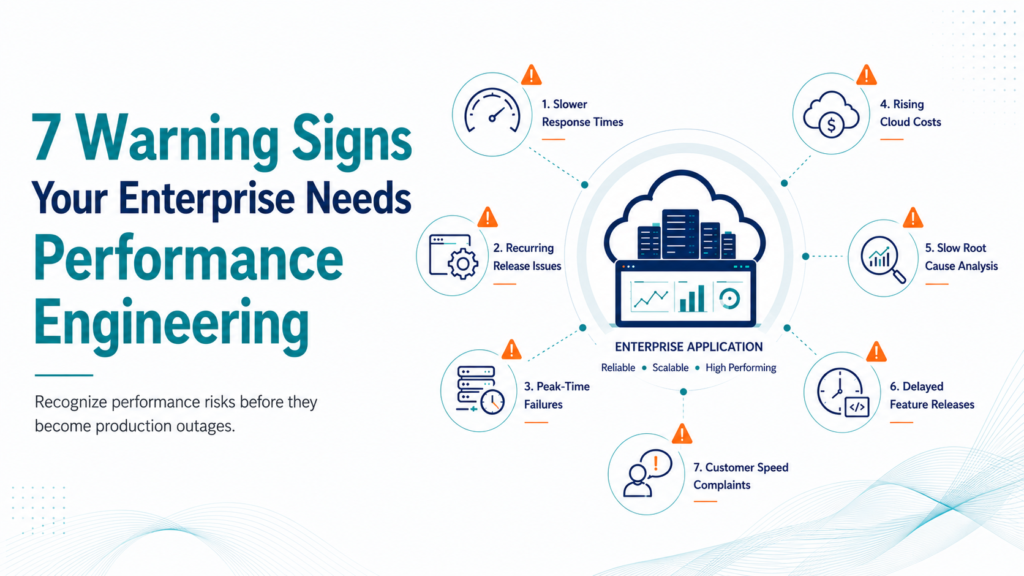
7 Warning Signs Your Enterprise Needs Performance Engineering
1. Response times degrade as user load increases
If an application performs well with 100 test users but slows down noticeably at 1,000 or 10,000 concurrent users, that is not a capacity problem you can solve by adding servers alone. It usually points to inefficient database queries, poor connection pooling, or synchronous calls that were never designed to handle concurrency at scale.
2. Performance issues resurface after every major release
Teams that fix a slowdown, only to see a similar issue reappear two releases later, are dealing with a systemic architecture gap, not an isolated bug. Without a performance engineering practice built into the development lifecycle, every release reintroduces the same category of risk.
3. Peak-time incidents happen predictably
Festive sales, salary-day banking transactions, tax filing deadlines, or ticket-booking windows: if your incidents cluster around known peak events year after year, that is a planning failure, not bad luck. These dates are predictable, and so are the loads. A system that fails during a predictable peak was never load-tested against that peak in the first place.
A mature Site Reliability Engineering practice can turn predictable demand spikes into planned capacity, resilience, and recovery work.
4. Cloud costs keep rising without a matching gain in speed or reliability
Enterprises often respond to slowdowns by scaling up infrastructure, adding more compute, more database read replicas, more caching layers. When costs climb every quarter but response times and reliability barely improve, it is a sign that the underlying inefficiency was never fixed, only masked with more hardware.
5. Root cause analysis takes days instead of hours
When a production incident occurs and multiple teams spend two or three days pointing at each other’s layer of the stack before finding the actual cause, it usually means there is no unified, transaction-level observability across the technology stack. Performance engineering builds that traceability in from the start.
Avekshaa’s Observability and Application Performance Monitoring services help teams connect user-visible symptoms with transaction-level causes.
6. New feature releases are delayed to avoid “breaking something”
If engineering leadership hesitates to ship new features because past releases caused unexpected slowdowns, that hesitation is itself a warning sign. It reflects a lack of confidence in the system’s ability to absorb change without a performance regression, which slows down the entire business, not just the IT team.
7. Customer complaints mention speed, not just bugs
Functional bugs get logged and fixed. Complaints about the app “feeling slow” or “taking forever to load” are harder to triage and often get deprioritized, because there is no clear owner or metric attached to them. When these complaints become a recurring theme in customer feedback or app store reviews, it usually means an underlying performance issue has been live for a while.
Digital Experience Monitoring can connect customer-reported slowness with real user conditions across devices, networks, and locations.
Did You Know?
Enterprises that adopt performance engineering as a continuous practice, rather than a one-time testing exercise before launch, typically catch 70 to 80 percent of critical performance risks while only 10 to 20 percent of development is complete, compared to teams that only discover these issues after 80 percent of the build is done, when the cost of fixing them is dramatically higher.
Common Mistakes When Reading These Warning Signs
- Treating each incident as isolated, instead of looking for a repeating pattern across releases or peak events.
- Assuming more infrastructure spend is a substitute for architectural or code-level fixes.
- Waiting for a major outage before escalating performance concerns to leadership.
- Relying only on functional QA sign-off as proof that a release is production-ready.
- Not tracking response time and error rate as first-class metrics alongside feature delivery timelines.
Expert Insight
Across engagements with large banks, telecom players, and retail platforms, a consistent pattern emerges: organizations that wait for a major outage to invest in performance engineering pay for it twice, once in the cost of the outage itself, and again in the rushed, reactive fix that follows. Organizations that treat these seven signs as early indicators, and act on even two or three of them, tend to avoid the outage altogether.
When an issue is already affecting live users, Production Performance Troubleshooting can help isolate bottlenecks and restore stable service more quickly.
Pro Tips to Act on These Signs Early
- Track response time percentiles (p95, p99), not just averages, since averages hide the worst-case experience most customers actually feel.
- Build a peak-event calendar (festive sales, salary days, tax deadlines) and load-test against it every year, not just once.
- Set a maximum acceptable “root cause analysis time” as an internal SLA, and investigate if incidents consistently exceed it.
- Review cloud spend and performance metrics together in the same quarterly review, not in separate conversations.
- Give customer support teams a direct channel to flag recurring “slow app” complaints to engineering, rather than letting them sit in a general bug backlog.
Performance Engineering Readiness Scorecard
- Do critical customer journeys have documented response-time, concurrency, availability, and error-rate targets?
- Can teams reproduce peak traffic, dependency failures, and release-related performance risks before production?
- Can engineers trace a slow transaction from the user request through services, databases, and downstream dependencies?
- Are cloud cost, latency, error rate, customer complaints, and release risk reviewed together by engineering and business leaders?
- Use Avekshaa’s enterprise case studies to compare your current challenges with proven performance and scalability outcomes.
Key Takeaways
- Passing functional QA does not mean an application is ready for real-world load, growth, or peak traffic.
- Recurring incidents, rising cloud costs without matching performance gains, and slow root cause analysis are all signs of a missing performance engineering practice.
- Performance engineering applied early, ideally from the planning and architecture stage, prevents the majority of these warning signs from turning into production outages.
- Enterprises that act on two or three of these seven signs early typically avoid the higher cost of a reactive, post-outage fix.
Frequently Asked Questions
How many of these 7 signs need to be present before I should invest in performance engineering? Even one or two of these signs recurring across multiple releases or peak events is enough reason to start. Waiting for all seven to appear usually means a major outage has already happened.
Is performance engineering the same as performance testing? No. Performance testing checks how an application behaves under load, usually late in the development cycle. Performance engineering is a continuous, proactive practice applied from planning through architecture, development, testing, and production monitoring. See how Avekshaa combines testing with deeper diagnosis through its Performance Testing and Engineering services.
Can a well-funded cloud infrastructure budget replace the need for performance engineering? No. Adding compute, storage, or caching can mask inefficiencies temporarily, but it does not fix the underlying architectural or code-level issues causing the slowdown, and costs tend to keep rising without a matching gain in speed or reliability.
How quickly can performance engineering show results once adopted? Enterprises that build performance validation into their planning and architecture stage typically catch the majority of critical risks while only 10 to 20 percent of development is complete, compared to discovering the same issues post-launch.
Which industries see the most impact from ignoring these warning signs? BFSI, telecom, retail, and healthcare are the most exposed, since these sectors deal with high-concurrency, real-time transactions where SLA breaches directly affect revenue and customer trust.
What is the first step an enterprise should take after recognizing these signs? Start with a capacity and architecture assessment to understand where the current system’s limits are, followed by a load test that mirrors real production and peak-time traffic, rather than jumping straight to infrastructure upgrades.
How does Avekshaa help enterprises address these warning signs? Avekshaa’s Performance Testing and Engineering practice, backed by the P-A-S-S™ Assurance platform and a repository of more than 5,000 resolved performance issues, helps enterprises in BFSI, telecom, retail, and healthcare identify root causes and fix performance, availability, and scalability gaps before they escalate into production outages. Learn more about the P-A-S-S™ Assurance Platform that supports this approach.