

Many enterprises today are confused about the difference between quality engineering and performance engineering. Teams often use the terms together, even though they solve very different problems. This is why understanding the performance engineering vs quality engineering difference is becoming important for CTOs, QA leaders, and engineering heads in 2026.
Here is the simple answer.
Quality engineering helps ensure your software works correctly, consistently, and securely. Performance engineering ensures your software performs well under real-world conditions like high traffic, large transaction volumes, and peak usage.
Both matter. But if your enterprise handles real-time transactions, digital payments, cloud native applications, or large customer traffic, performance engineering becomes critical very early.
In our experience working with enterprise systems, many organizations invest heavily in testing quality but still face outages, slow systems, and production failures because performance was treated as a late-stage activity instead of an engineering discipline.
What Is Quality Engineering? A 2026 Definition
Quality engineering is a broader approach to improving software quality across the entire development lifecycle. It focuses on preventing defects instead of only finding them later.
Unlike traditional QA, quality engineering involves automation, continuous testing, collaboration across teams, and quality ownership during development.
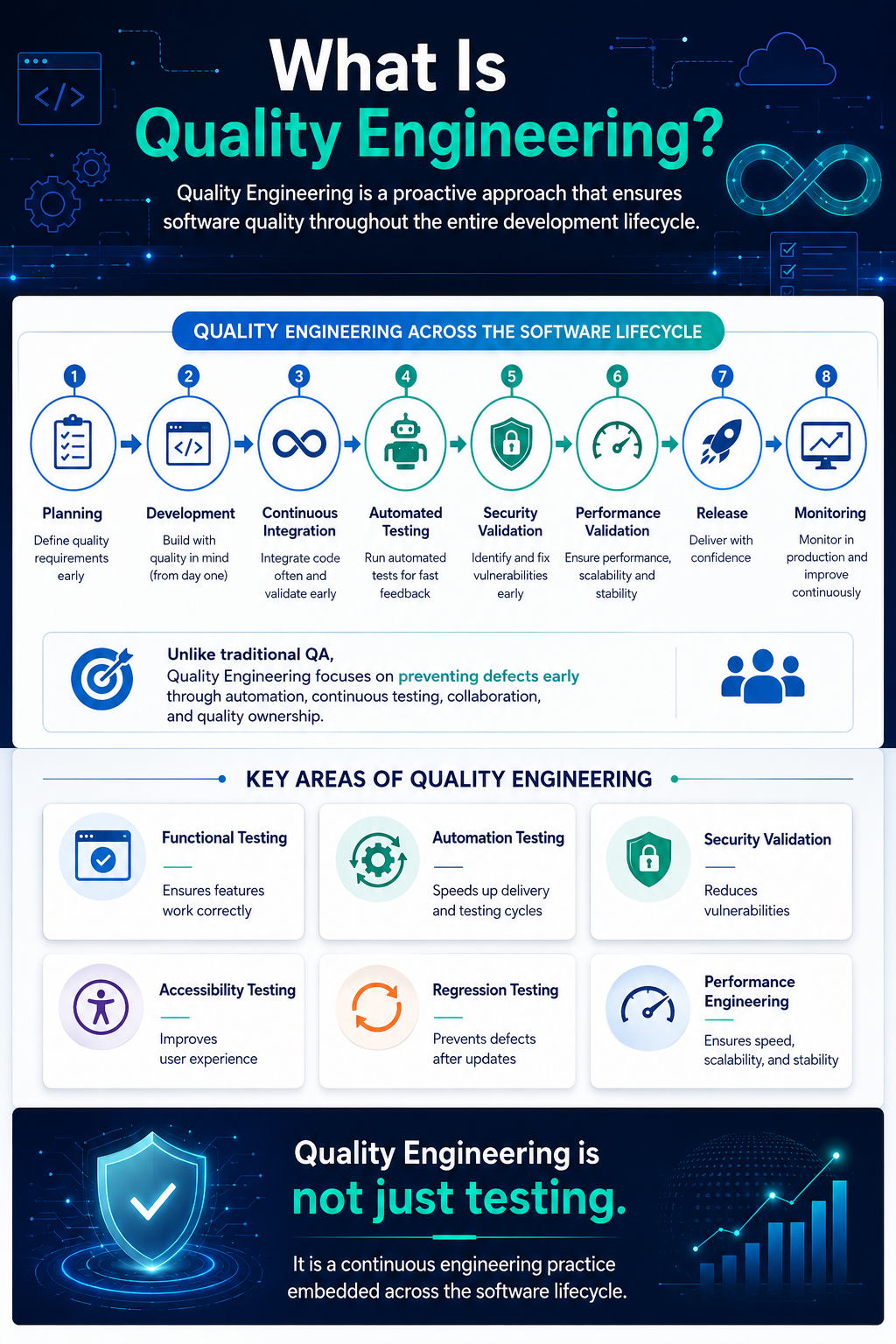
The goal is to ensure the software is functional, stable, secure, and usable.
| Area | Purpose |
|---|---|
| Functional testing | Ensures features work correctly |
| Automation testing | Speeds up testing cycles |
| Security validation | Reduces vulnerabilities |
| Accessibility testing | Improves usability |
| Regression testing | Prevents new defects |
This is why many enterprises now see quality engineering as more than just testing. It is a continuous practice embedded across the software lifecycle.
What Is Performance Engineering? A 2026 Definition
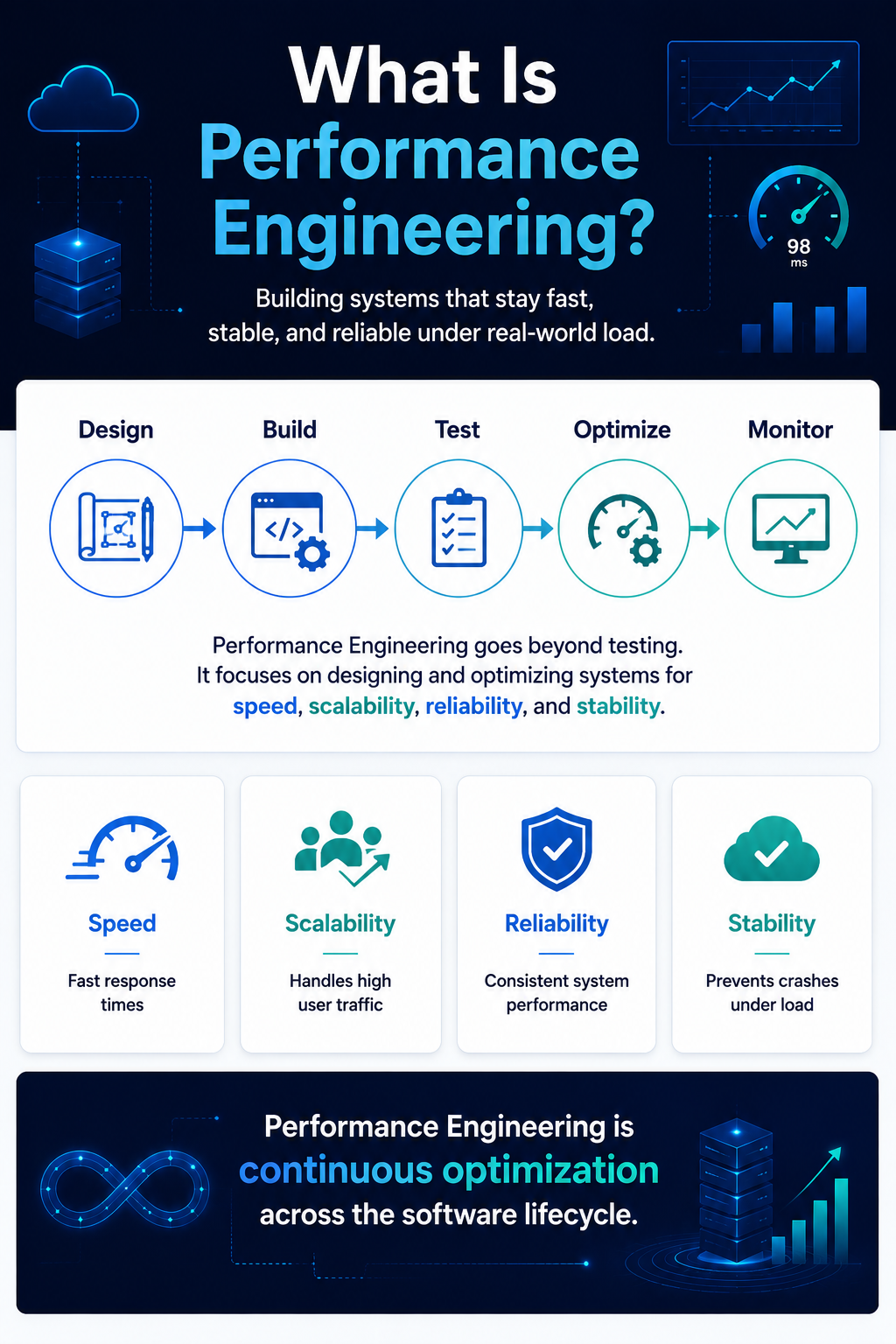
Performance engineering goes beyond performance testing. It is the process of designing, building, testing, and optimizing systems to perform reliably under real-world conditions. According to DORA’s State of DevOps research, high-performing engineering teams deploy more frequently and recover from failures significantly faster, largely because reliability and performance are treated as engineering priorities rather than afterthoughts.
Performance engineering focuses on speed, scalability, reliability, and stability under load. It looks at how systems behave when thousands or millions of users interact with them at the same time.
For BFSI and telecom enterprises, this is not optional. Slow systems directly affect customer trust and revenue.
| Area | Purpose |
|---|---|
| Load testing | Measures system behavior under traffic |
| Scalability validation | Ensures systems grow reliably |
| Capacity planning | Prevents resource bottlenecks |
| Production diagnostics | Identifies live performance issues |
| Reliability engineering | Improves uptime and resilience |
This is why the difference between performance engineering and quality engineering is not a small one. The goals are fundamentally different.
Performance Engineering vs Quality Engineering: Side by Side Comparison
| Aspect | Quality Engineering | Performance Engineering |
|---|---|---|
| Main Goal | Improve software quality | Improve system performance |
| Focus Area | Functional correctness | Speed and scalability |
| Testing Type | Functional testing | Non-functional testing |
| Timing | Throughout SDLC | Throughout SDLC and production |
| Key Metrics | Defect rates, quality coverage | Latency, throughput, uptime |
| Team Ownership | QA and development teams | Engineering, SRE, architecture teams |
| Business Risk | Bugs and poor functionality | Downtime and slow systems |
| Common Use Case | Application quality assurance | High-traffic systems and cloud platforms |
Where Performance Engineering and Quality Engineering Overlap
Even though they are different disciplines, they work together closely in modern enterprise environments.
Both support continuous delivery, both rely on automation, both improve customer experience, and both require collaboration across teams.
A modern enterprise usually needs both. Quality engineering ensures the application works correctly. Performance engineering ensures it keeps working under pressure.
This is especially true in cloud native systems where microservices communicate constantly, traffic changes rapidly, and performance problems spread quickly across services.
In our experience, organizations that separate quality and performance completely often create gaps between release speed and production stability. The independent testing and quality assurance function works best when performance and quality share the same engineering mindset.
Signs Your Enterprise Needs Performance Engineering
Some enterprises clearly need stronger performance engineering practices. The most common indicators are frequent production slowdowns, payment or transaction delays, systems crashing during peak traffic, high infrastructure costs due to poor optimization, poor customer experience during load spikes, and slow APIs affecting business operations.
| Problem | Likely Need |
|---|---|
| Slow applications during peak load | Performance Engineering |
| Outages during campaigns or festivals | Performance Engineering |
| Cloud costs rising unexpectedly | Performance Engineering |
| Microservices latency issues | Performance Engineering |
For BFSI enterprises handling real-time transactions, performance engineering should come before large-scale quality engineering transformation programs. Read more about how application performance engineering specifically benefits banks.
Signs Your Enterprise Needs Quality Engineering
Some organizations struggle more with quality consistency than scale. Common indicators include high defect leakage into production, too much manual testing, slow release cycles, frequent regression issues, inconsistent user experience, and weak test automation coverage.
| Problem | Likely Need |
|---|---|
| Frequent functional bugs | Quality Engineering |
| Slow manual testing cycles | Quality Engineering |
| Poor release confidence | Quality Engineering |
| Weak automation coverage | Quality Engineering |
This is where the distinction between QA, quality engineering, and performance engineering becomes easier to understand. QA focuses on testing. Quality engineering focuses on improving quality processes. Performance engineering focuses on system performance and reliability.
Which One Does Your Enterprise Need?
The answer depends on your biggest business risk right now.
If your biggest problem is slow systems, uptime issues, transaction failures, or scalability problems, then performance engineering should be your priority.
If your biggest problem is bugs, inconsistent releases, manual testing delays, or low automation maturity, then quality engineering should come first.
| Enterprise Situation | Best Starting Point |
|---|---|
| Digital banking platform | Performance Engineering |
| Ecommerce scaling rapidly | Performance Engineering |
| Enterprise struggling with manual QA | Quality Engineering |
| Cloud native microservices platform | Performance Engineering |
| Legacy application modernization | Both together |
Most mature enterprises eventually need both disciplines working together. The question is simply which one addresses your most immediate business risk.
How Avekshaa Approaches Performance and Quality
Avekshaa approaches performance as an engineering problem, not just a testing activity.
A typical engagement focuses on understanding system behavior under real conditions, identifying bottlenecks early, integrating performance into development workflows, and improving production stability.
This works especially well for enterprises running high-transaction digital systems, cloud native platforms, and mission-critical applications. You can see how this has worked in practice through Avekshaa’s case studies.
There is also space for enterprises to align this with broader quality transformation through the Quality and Digital Assurance CoE model, which brings both disciplines under a structured governance framework.
Conclusion
Understanding the performance engineering vs quality engineering difference is important because both disciplines solve different business problems.
Quality engineering improves software quality and release confidence. Performance engineering ensures systems remain fast, scalable, and reliable under real-world conditions.
For enterprises handling large-scale digital operations, performance engineering is becoming non-negotiable. Modern cloud native systems are too complex to treat performance as a final testing phase.
The best approach is not choosing one over the other forever. It is understanding what your enterprise needs most right now.
If your systems are struggling with scale, uptime, or production performance, this is the right time to explore how Avekshaa’s application performance engineering can help build a stronger foundation for your enterprise systems.
Frequently Asked Questions
Is performance engineering part of QA?
Performance engineering and QA are connected but they are not the same thing. Traditional QA mainly focuses on finding functional defects, while performance engineering focuses on scalability, speed, and system reliability. This is one of the biggest points in the performance engineering vs quality engineering difference discussion.
What is the difference between QA and quality engineering?
QA mainly focuses on testing software before release. Quality engineering is broader and includes automation, continuous testing, and quality ownership across the software lifecycle. This is why many enterprises now see quality engineering as a more advanced evolution of traditional QA practices.
Can one team handle both quality engineering and performance engineering?
Yes, in some organizations one team may handle both areas, especially in smaller environments. However, in large enterprises, performance engineering often requires specialized skills related to scalability, production diagnostics, and distributed systems. Many organizations eventually separate responsibilities while keeping collaboration strong.
Why is performance engineering becoming more important in cloud native systems?
Cloud native systems are highly distributed and dynamic. A small delay in one service can affect the entire application. This is why enterprises are now prioritizing application performance engineering much earlier in the development lifecycle.
What is the ROI of performance engineering compared to quality engineering?
Both deliver value but in different ways. Quality engineering reduces defects and improves release confidence, while performance engineering reduces downtime, improves customer experience, and prevents revenue loss caused by slow systems or outages. In high-traffic industries, performance engineering often delivers faster business impact.
Is performance testing the same as performance engineering?
No. Performance testing is usually one activity within performance engineering. Engineering is broader and includes architecture decisions, scalability planning, continuous monitoring, and production optimization. Learn more in our detailed guide on how application performance engineering works.
When should an enterprise invest in performance engineering first?
If your enterprise handles real-time payments, large user traffic, or cloud native applications, performance engineering should be prioritized early. Slow systems and outages directly affect revenue and customer trust in these environments. Read how Indian banks achieve 99.99 percent uptime with structured performance engineering.
How does quality engineering support DevOps teams?
Quality engineering supports DevOps by enabling continuous testing, automation, and faster release cycles. It helps teams improve release confidence and reduce manual testing delays. See how DevOps teams can improve reliability by combining quality and performance practices.
Can performance engineering reduce cloud infrastructure costs?
Yes, performance engineering can identify inefficient resource usage, unnecessary scaling, and bottlenecks that increase cloud spending. Optimizing application performance often leads to lower infrastructure costs while improving stability at the same time. Cloud engineering and performance optimization often go hand in hand for enterprises managing multi-cloud environments.
How does Avekshaa approach performance engineering and quality transformation?
Avekshaa approaches performance engineering as a continuous engineering discipline instead of a final testing phase. The focus is on helping enterprises improve scalability, reliability, and production stability while also supporting broader quality transformation goals where needed. Book a meeting to discuss your enterprise’s specific requirements.