

Fixing a performance issue in production can cost 10 to 100 times more than resolving it during development. According to a study by the National Institute of Standards and Technology (NIST), software defects cost significantly more to fix the later they are discovered in the development lifecycle.This is exactly why building a shift left performance engineering culture has become a critical question for enterprise leaders in 2026.
Shift left performance engineering means moving performance considerations earlier in the software lifecycle and making it a shared responsibility across teams. But here is the real challenge. Most enterprises already have the tools. What they lack is the culture.
In our work with large engineering teams, we have seen that performance issues rarely happen because of missing tools. They happen because performance is not owned early enough. Building a shift left performance engineering culture in large enterprises is less about tools and more about changing how teams think, collaborate, and prioritize performance from day one.
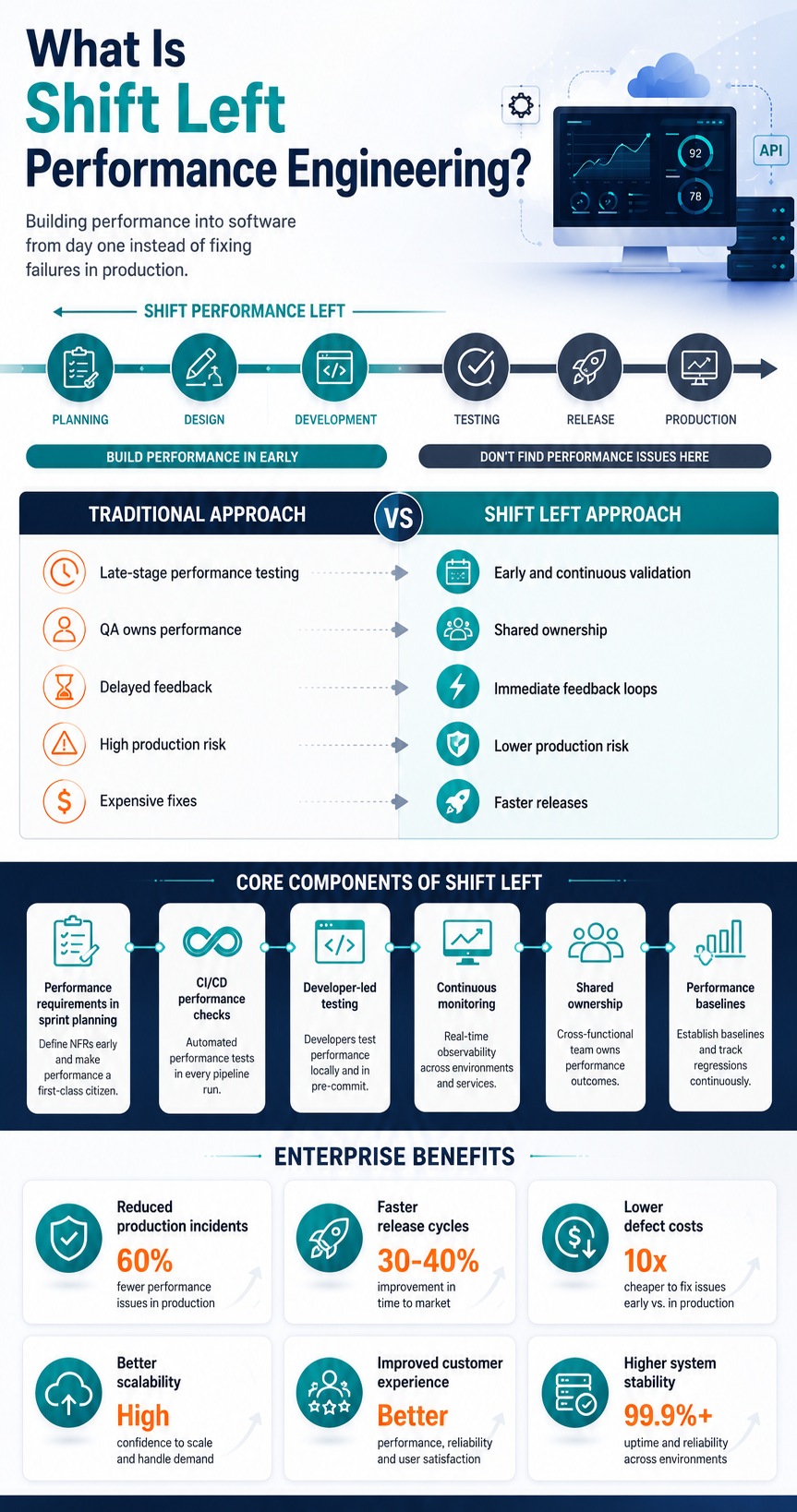
Here Is a Quick List of Steps to Build a Shift Left Performance Engineering Culture
If you are trying to get your head around where to start, this gives you a simple, no-confusion view of the whole process. Think of it as a quick snapshot of what building a shift left culture actually looks like in practice before we walk through each step in detail.
|
Step |
What You Need to Do |
Why It Matters |
|---|---|---|
|
Step 1 |
Define performance requirements early |
Prevents ambiguity and late-stage surprises |
|
Step 2 |
Establish performance baselines |
Creates a benchmark for measuring improvements |
|
Step 3 |
Integrate performance into CI/CD pipelines |
Enables continuous validation and faster feedback |
|
Step 4 |
Enable developer-led performance testing |
Shifts ownership closer to development |
|
Step 5 |
Create shared ownership across teams |
Breaks silos and improves collaboration |
|
Step 6 |
Align KPIs with performance outcomes |
Ensures teams prioritize performance |
|
Step 7 |
Build a Performance Engineering CoE |
Scales best practices across the organization |
|
Step 8 |
Continuously monitor and improve |
Keeps performance aligned with evolving systems |
What Shift Left Performance Engineering Actually Means in 2026
Shift left performance engineering is not just about testing earlier. It is about embedding performance into the way software is designed, built, and delivered.
This includes:
- Defining performance requirements at the design stage
- Validating performance continuously in CI/CD pipelines
- Making developers responsible for performance outcomes
- Monitoring performance across the entire lifecycle
|
Aspect |
Traditional Approach |
Shift Left Approach |
|---|---|---|
|
Timing |
Late-stage testing |
Early and continuous |
|
Ownership |
QA or performance team |
Shared across teams |
|
Feedback |
Delayed |
Immediate |
|
Risk |
High production failures |
Reduced risk |
This is why the shift left approach has become a foundational practice for modern engineering organizations and is closely aligned with how performance engineering has evolved from reactive fixes to proactive excellence.
Why Large Enterprises Struggle with Shift Left
Even though the benefits are clear, many organizations struggle to adopt this model.
Common Barriers
- Siloed teams – Development, QA, and performance teams operate independently with little collaboration
- Late involvement of performance engineers – Performance is often considered only before release
- Lack of defined performance requirements – Teams do not define clear non-functional requirements early
- Developer resistance – Developers may see performance as someone else’s responsibility
- No integration with CI/CD pipelines – Performance validation is not automated
These challenges make performance engineering culture transformation difficult without strong leadership alignment.
Step by Step: How to Build a Shift Left Performance Engineering Culture
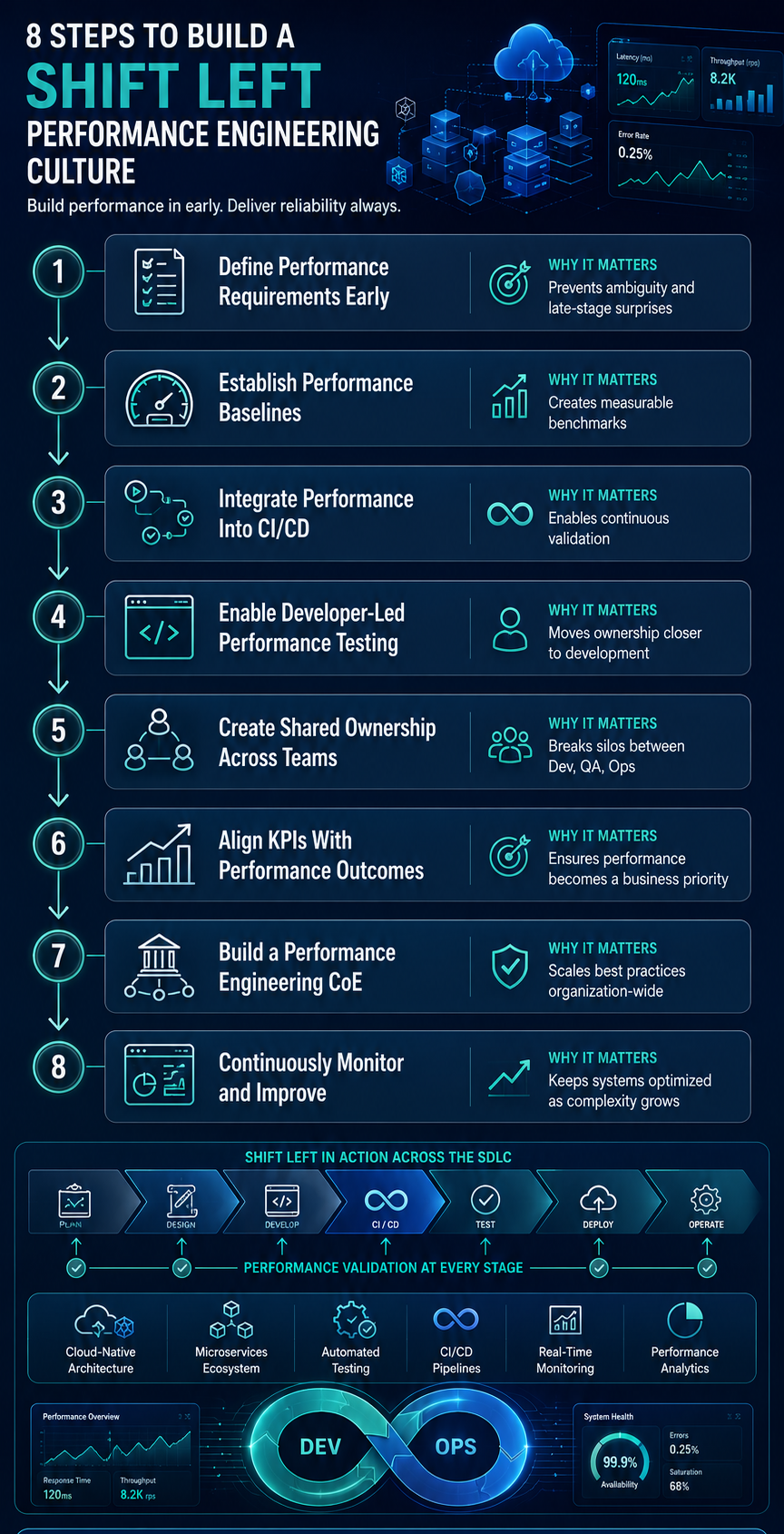
Building a shift left culture requires structured and consistent effort across teams.
Step 1: Define performance requirements early
Define non-functional requirements during sprint planning, not after development. This includes response time, throughput, and scalability expectations.
In practice: Teams document performance expectations alongside functional requirements.
Step 2: Establish performance baselines
Set clear baseline metrics for application performance early in development.
In practice: Teams measure initial performance benchmarks and use them as reference points.
Step 3: Integrate performance into CI/CD pipelines
Automate performance checks as part of your CI/CD workflow.
In practice: Every build includes performance validation before deployment.
This is a key part of shift left performance testing in CI/CD. Learn more about how DevOps teams can improve reliability by embedding these checks directly into the pipeline.
Step 4: Enable developer-led performance testing
Developers should test performance as they build features.
In practice: Developers run lightweight performance checks during development cycles.
Step 5: Create shared ownership across teams
Performance is not just a QA responsibility. It must be owned by developers, architects, and operations teams.
In practice: Teams track performance metrics collectively and address issues collaboratively.
Step 6: Align KPIs with performance outcomes
Include performance metrics in team goals and evaluations.
In practice: Teams are measured on system performance, not just feature delivery.
Step 7: Build a Performance Engineering CoE
A centralized team can guide standards, frameworks, and best practices across the organization.
In practice: Enterprises establish a dedicated Performance Engineering CoE to drive performance initiatives at scale.
Step 8: Continuously improve and iterate
Shift left is not a one-time change. It requires continuous refinement.
In practice: Teams review performance metrics regularly and optimize processes using tools like application performance management to track improvement over time.
The Role of Performance Engineering Centers of Excellence
A Performance Engineering CoE plays a critical role in scaling shift left practices across large organizations.
It helps by:
- Standardizing performance practices
- Defining frameworks and governance
- Providing expertise and training
- Ensuring consistency across teams
Without a CoE, shift left efforts often remain fragmented. With one, organizations can scale these practices effectively, particularly in BFSI environments where governance and consistency are non-negotiable.
Real World Impact: What Shift Left Delivers
When implemented correctly, shift left performance engineering delivers measurable results.
In our experience working with enterprise systems, organizations that adopt this approach see:
- Significant reduction in production performance issues
- Faster release cycles with fewer regressions
- Improved system stability under load
- Lower cost of defect resolution
In one internal transformation program, early performance validation helped identify issues that would have otherwise surfaced in production, leading to substantial cost savings and improved system reliability. You can explore similar outcomes in Avekshaa’s case studies.
Common Mistakes You Can Avoid
While building a shift left culture, organizations often make avoidable mistakes.
- Treating shift left as a tool implementation instead of a cultural change
- Overloading developers without proper training
- Ignoring performance requirements in early stages
- Not aligning leadership and teams
- Failing to integrate performance into CI/CD
For a deeper view of what happens when these practices are absent, see why testing alone is not enough to deliver on the QoS goals of an application.
Recognizing these pitfalls early can significantly improve success rates.
How Avekshaa Helps Enterprises Build a Shift Left Culture
Avekshaa approaches shift left performance engineering as a structured transformation rather than a tool adoption exercise.
A typical engagement includes:
- Assessing current performance maturity
- Defining performance engineering frameworks
- Integrating performance into development workflows
- Training teams on performance best practices
- Establishing a Performance Engineering CoE
The focus is always on building sustainable practices that scale across teams, not just solving immediate issues.