
On November 28, 2025, the Reserve Bank of India issued the Digital Banking Channels Authorisation Directions, 2025, bringing them into force from January 1, 2026. Separately, the Authentication Mechanisms for Digital Payment Transactions Directions, 2025, take effect April 1, 2026. Together, these two instruments represent the most substantive overhaul of India’s digital banking governance framework in over a decade.
For CIOs, CTOs, and application engineering leaders in banks and NBFCs, the regulatory text reads primarily as a legal and governance document. But beneath the compliance language lies a set of technical demands that fall squarely on application performance and quality assurance teams.
This article maps the key regulatory requirements to concrete obligations for testing and performance engineering functions and outlines what needs to change now.
Key Regulatory Deadlines and Testing Implications
| Deadline | Regulatory Requirement | Testing / Engineering Implication |
| January 1, 2026 | Digital Banking Channels Authorisation Directions in force | GAICA evidence, real-time alerts, onboarding/deregistration flows validated |
| April 1, 2026 | Authentication Mechanisms Directions in force | Dynamic 2FA performance tested; risk engine latency within SLA |
| October 2026 | BIN registration and cross-border CNP validation | Performance of international transaction authentication flows |
| March 31, 2028 | Full compliance with group structure and overlapping activity rules | Ongoing regression and performance testing as systems are restructured |
One Outage Can Put Your Digital Banking License at Risk
Frequent downtime, delayed alerts, or weak authentication performance can trigger regulatory action. Fix performance gaps before they escalate.
The Regulatory Landscape in Brief
The Digital Banking Channels Authorisation Directions, 2025 establish that from January 1, 2026, commercial banks must obtain explicit RBI authorisation to offer internet banking, mobile banking, USSD, and SMS-based banking services. Authorisation is conditional on meeting eligibility thresholds across four domains:
- Financial strength: Minimum CRAR compliance and paid-up capital requirements.
- Infrastructure readiness: Core Banking Solution (CBS) deployment and IPv6 enablement.
- Cybersecurity certification: A Gap Assessment and Internal Controls Adequacy (GAICA) report submitted via PRAVAAH.
- Operational resilience: Demonstrated ability to maintain service continuity under adverse conditions.
The authentication directions, effective April 1, 2026, mandate dynamic two-factor authentication (2FA) for all non-recurring digital payments, require real-time risk scoring at the transaction level, and make banks liable for losses arising from authentication design failures, not just security breaches.
RBI has also confirmed it will use data-driven, off-site monitoring alongside thematic inspections to evaluate compliance. Banks with frequent outages, high fraud rates, or persistent customer complaint backlogs will face intensified scrutiny.
What This Means for Application Performance Teams
1. Stress Testing Is Now a Regulatory Requirement
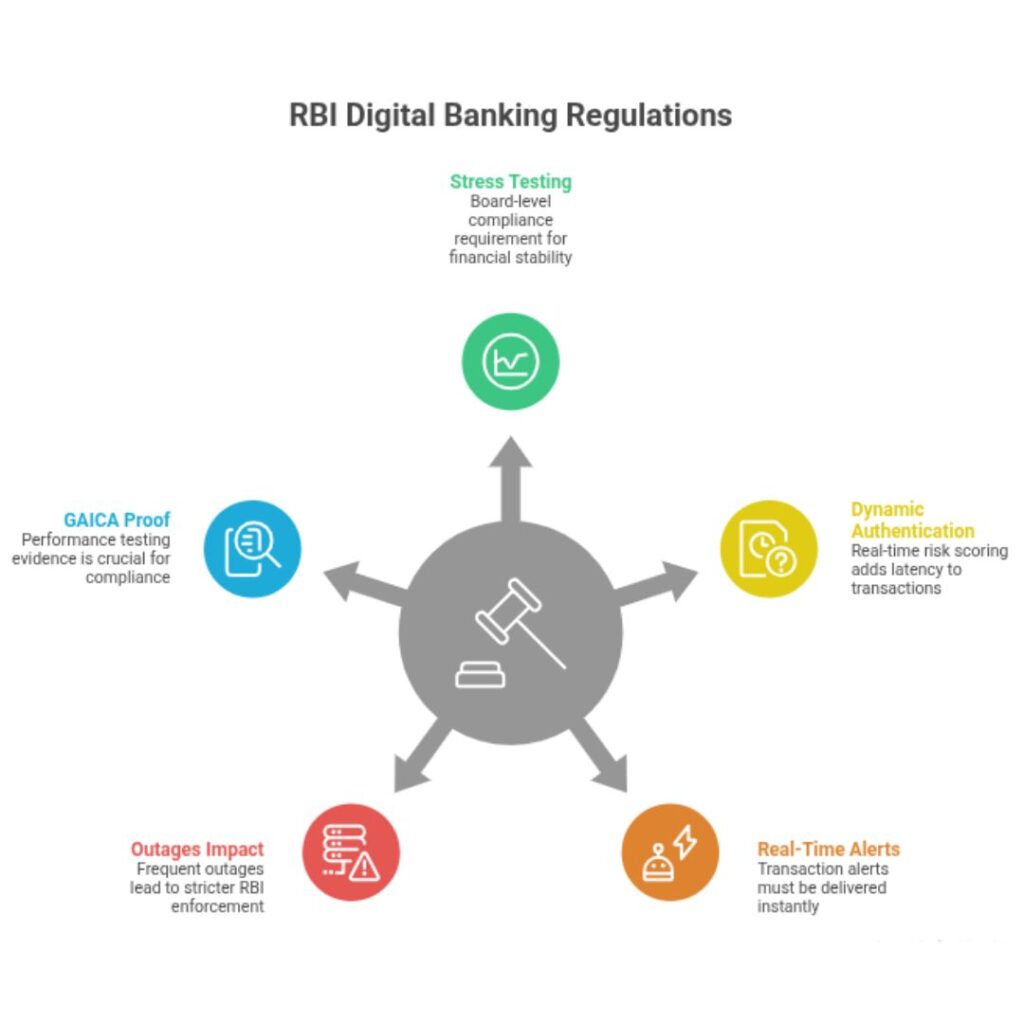
The RBI framework explicitly requires stress testing of digital banking operations against adverse scenarios, including technology failures and cyberattacks. This language drawn from the Bhatt and Joshi Associates legal analysis of the 2025 framework, moves stress testing from the engineering team’s discretion to a board-level compliance obligation.
In practice, this means performance testing results need to be documented, dated, and auditable. Teams that run load tests informally and discard results after a release cycle are now operating outside the intent of the regulatory framework.
Action required: Formalise performance testing programmes with documented test plans, execution reports, and sign-off processes. Stress test results should be retained as part of the audit trail submitted during RBI inspections.
2. Dynamic Authentication Creates New Performance Bottlenecks
The authentication directions require at least one factor in the 2FA chain to be ‘dynamic’, meaning it must be unique to that specific transaction and invalidated immediately after use. This applies to all non-recurring digital payments. Risk scoring engines must evaluate each transaction in real time, using contextual signals such as device fingerprint, IP geolocation, spending pattern, and transaction history before a payment is authorised.
For performance engineers, this introduces a new category of latency risk. Every transaction now has an additional real-time intelligence layer in its processing path. If the risk scoring engine adds even 800 milliseconds to the authentication round-trip, that directly affects the user-perceived response time of every payment transaction in the app.
Action required: Load-test authentication flows independently from transactional flows. Define and enforce latency SLAs for risk scoring APIs. Use application performance monitoring to instrument authentication endpoints in production and detect degradation before it surfaces as customer complaints.
3. Real-Time Alerts Are a Compliance Obligation
The Digital Banking Channels Authorisation Directions mandate that banks deliver real-time transaction alerts to customers as a condition of maintaining digital banking authorisation. This is not an SLA target, it is a licence condition. A bank that fails to send timely alerts, or whose alert infrastructure degrades under peak load, is in breach of its authorisation.
Alert delivery systems depend on downstream messaging infrastructure (SMS gateways, push notification services) that are often treated as low-priority in load testing scenarios. This needs to change.
Action required: Include alert delivery pipelines in performance test scope. Validate end-to-end alert latency under peak transaction volumes. Monitor alert delivery success rates via digital experience monitoring tooling.
4. Outage Frequency Now Determines Regulatory Posture
RBI has explicitly stated that banks experiencing frequent outages will face stricter enforcement under the new framework. The nine largest UK banks accumulated 803 hours of tech outages between 2023 and 2024, equivalent to 33 full days, according to BBC analysis cited by Long Finance. India’s banking sector faces comparable pressures from legacy infrastructure and rapid digital volume growth.
For testing teams, this positions reliability engineering as a primary deliverable, not an afterthought. Error budgets, SLO tracking, and incident trend analysis all become inputs to the bank’s regulatory compliance posture.
Action required: Establish SLO-based reliability targets for all customer-facing digital services. Track error budgets and escalate to leadership when burn rates indicate breach risk. Consider a structured site reliability engineering engagement to build these disciplines into the operating model.
5. GAICA Certification Requires Documented Testing Evidence
Before a bank can offer transactional digital banking services, it must submit a Gap Assessment and Internal Controls Adequacy (GAICA) report through the PRAVAAH portal. This report is an internal controls audit that covers cybersecurity, IT infrastructure, and operational resilience. Performance testing evidence including load test results, incident history, and monitoring coverage is directly relevant to the operational resilience sections of this assessment.
Action required: Engage with compliance and risk teams now to understand what evidence is required for the GAICA submission. Ensure application performance engineering outputs are structured to serve dual purposes: engineering insight and regulatory documentation.
The Accountability Gap That Testing Teams Must Close
One of the most significant provisions in the 2025 framework is the Chief Compliance Officer (CCO) accountability mechanism. Each regulated entity must designate a CCO who submits quarterly compliance certificates to the RBI. Failure to maintain adequate standards can result in personal sanctions against the CCO in addition to institutional penalties. This creates a direct line of accountability from application reliability to senior leadership.
Testing teams have historically operated at arm’s length from compliance functions. The 2025 and 2026 directives close that gap. Evidence generated by performance testing programmes load test results, monitoring dashboards, incident reports, authentication latency data is now evidence in a regulatory context.
NBFCs: The Same Standards, Faster Timelines
While the Digital Banking Channels Authorisation Directions apply primarily to commercial banks, NBFCs operating digital lending platforms are subject to parallel obligations under the Digital Lending Directions, 2025. Avekshaa’s focused resources on performance engineering for NBFCs and application performance engineering for NBFCs address the specific architecture patterns and transaction volume profiles common in the NBFC segment.
Where to Start
For application performance and QA teams in banks and NBFCs, the immediate priorities are:
- Gap assessment: Map current performance testing coverage against the stress-testing and resilience requirements of the regulatory framework.
- Authentication performance baseline: Establish current latency for authentication and risk-scoring flows before the April 1, 2026 authentication directions take full effect.
- Monitoring coverage audit: Verify that real-time alert delivery pipelines, login flows, and transaction processing are covered by instrumented monitoring, not just synthetic checks.
- Documentation uplift: Ensure test results, SLO reports, and incident logs are maintained in formats that can be referenced in regulatory submissions.
Avekshaa Technologies banking and financial services practice works with commercial banks, cooperative banks, and NBFCs to align performance engineering programmes with regulatory requirements. The P.A.S.S. Assurance Platform provides the tooling layer to make compliance-grade testing evidence a repeatable output of every release cycle.