Quick Summary
- Finance applications rarely fail all at once. Most systems degrade gradually through silent warning signs that traditional monitoring misses entirely until customers start complaining.
- Hidden causes like database query slowdowns, memory leaks, and third-party API latency can quietly erode performance for weeks before a visible outage occurs.
- Ten specific warning signs are covered in this blog, from creeping response times and peak-hour error spikes to untested DR environments and missing performance baselines.
- Teams relying only on infrastructure health dashboards are likely missing real customer experience degradation. Mobile real user monitoring closes this gap by measuring what users actually experience rather than what servers report.
- Organizations should treat performance testing as a continuous activity, not a one-time pre-launch checkpoint.
- Proactive identification of these signs, particularly before peak traffic events like salary credit days and festive seasons, is the most reliable way to protect customer trust and reduce production incident risk.
Your banking or finance application may appear stable on the surface. Dashboards may still look green. CPU usage may remain under control. But underneath, the system could already be showing early signs of trouble.
This is one of the biggest risks behind modern finance app performance problems. Applications rarely fail all at once. Most systems slowly degrade over time before customers finally notice something is wrong.
In BFSI environments, even small delays matter. A few extra seconds during loan approval, payment processing, or account access can quickly damage customer trust.
In our work with financial systems, we often see hidden performance problems weeks before an actual outage happens. The challenge is that traditional monitoring approaches do not always catch these early warning signs.
Did You Know?
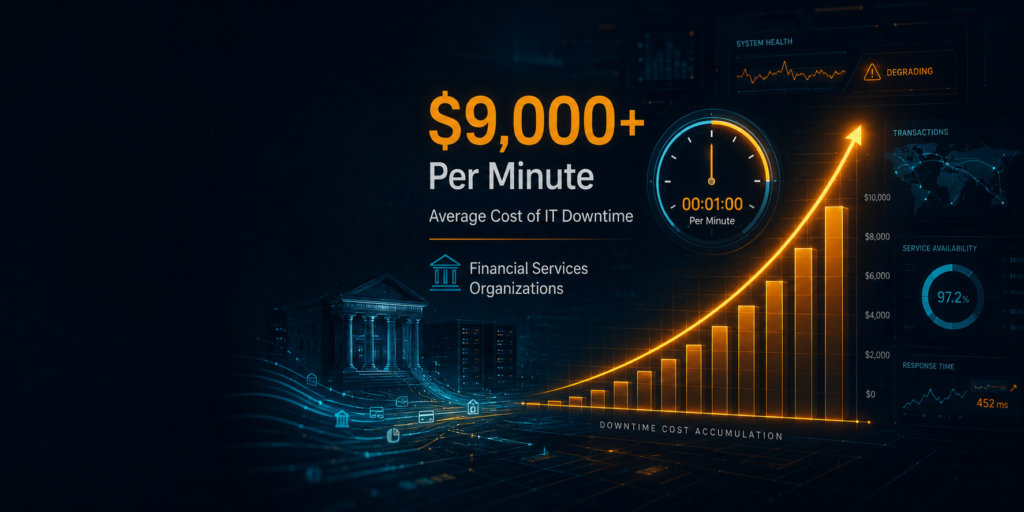
Research from the Ponemon Institute found that the average cost of IT downtime for financial services organizations can exceed $9,000 per minute, making even brief application degradation one of the most expensive operational risks a BFSI enterprise can face.
Why Finance Applications Fail Silently
Most finance applications today are highly connected systems.
They depend on:
- APIs
- cloud infrastructure
- databases
- third party services
- mobile applications
- payment gateways
This complexity creates hidden risks.
A small delay inside one service may not immediately crash the system. But over time, the delays spread across the application and slowly affect customer experience.
Traditional monitoring often focuses only on:
- server uptime
- CPU usage
- basic alerts
But modern banking application slow performance issues usually begin much earlier and much deeper inside the system.
Common Hidden Causes
| Hidden Issue | What Happens |
| Database delays | Slower transactions |
| API latency | Payment and login delays |
| Memory leaks | Gradual slowdown over time |
| Infrastructure drift | Inconsistent system behavior |
| Poor release validation | New performance bottlenecks |
This is why proactive application performance engineering is becoming critical for BFSI enterprises.
Do Not Wait for a Peak Season Outage to Find Your Application’s Weak Points
Avekshaa helps BFSI enterprises identify silent performance risks before they become production incidents, so your team goes into every high-traffic event with confidence.
Sign 1: Response Times Are Gradually Creeping Up
One of the earliest warning signs is slowly increasing response time.
The system may still remain within SLA limits, but users begin noticing:
- delayed logins
- slower dashboards
- payment confirmation lag
What It Looks Like
| Week | Average Response Time |
| Week 1 | 1.2 seconds |
| Week 3 | 1.8 seconds |
| Week 5 | 2.4 seconds |
The change happens slowly, which makes it easy to ignore.
But gradual latency increase is often one of the first signs of application performance issues financial systems teams should investigate immediately.
Sign 2: Error Rates Spike During Peak Hours
Many applications work fine during normal traffic but struggle during:
- salary credit days
- EMI processing periods
- festival shopping peaks
- UPI spikes
This usually points to hidden scalability problems.
Common Symptoms
- Transaction retries increase
- APIs timeout during traffic spikes
- Login failures rise suddenly
- Payment success rates drop temporarily
This is a major indicator of banking application performance issues in high transaction environments. Production performance troubleshooting capabilities become especially important when these spikes reveal underlying bottlenecks that normal traffic never exposed.
Sign 3: Your Monitoring Dashboard Shows Green But Users Are Complaining
This happens more often than many teams realize.
Internal monitoring may show:
- healthy infrastructure
- acceptable CPU usage
- no critical alerts
But customers still report poor experience.
This gap usually happens because traditional monitoring focuses on infrastructure instead of real user behavior.
Typical Monitoring Gap
| Monitoring View | Real Customer Experience |
| System healthy | Mobile app slow |
| API available | Transactions timing out |
| Servers stable | Users unable to complete actions |
This is why many enterprises now use mobile real user monitoring to improve application downtime BFSI visibility by measuring actual customer journeys rather than server-level metrics alone.
Sign 4: Third Party API Calls Are Taking Longer Than Expected
Modern finance applications depend heavily on external integrations.
Examples include:
- payment gateways
- KYC verification
- credit scoring services
- banking APIs
Even if your internal systems are healthy, slow external APIs can damage the customer experience.
This is one of the biggest causes of hidden finance application performance problems today.
Sign 5: Database Query Times Are Increasing
Slow databases quietly affect the entire application.
A query that once took milliseconds may slowly begin taking seconds under load.
Common Effects
- Slow account balance retrieval
- Delayed loan approvals
- Longer transaction processing times
- Increased API latency
Database bottlenecks are one of the most common causes of BFSI application slow performance and are frequently identified during structured performance engineering audits.
Sign 6: Memory Usage Trends Upward Over Time
Memory leaks rarely create immediate outages.
Instead, applications slowly consume more memory over days or weeks until the system becomes unstable.
Typical Signs
| Early Stage | Later Stage |
| Slight slowdown | Frequent application restarts |
| Higher memory usage | System instability |
| Occasional delays | Increased downtime risk |
This issue is very common in long running enterprise applications.
Sign 7: Your DR Failover Has Never Been Load Tested
Many organizations have disaster recovery environments but never fully test them under production level load.
This creates major operational risk.
During a real incident:
- failover may not work properly
- applications may perform poorly
- transaction delays may increase
In some cases, the backup environment becomes slower than the original system itself. Site reliability engineering practices specifically address this gap by ensuring DR environments are regularly validated under realistic traffic conditions.
Sign 8: Performance Testing Was Last Done Before Migration
A system that worked well before cloud migration may not behave the same way afterward.
Changes in:
- infrastructure
- databases
- network paths
- scaling behavior
can all introduce hidden performance problems.
This is a common source of application downtime BFSI risks after modernization projects. Application migration assurance helps enterprises validate performance comprehensively after infrastructure changes before issues reach production.
Sign 9: New Feature Releases Consistently Introduce Performance Regressions
Every new release slightly slows the application.
At first, teams may not notice. But over time:
- APIs become heavier
- database calls increase
- user experience degrades
This usually happens when enterprises release features quickly without proper performance validation inside CI CD pipelines.
Sign 10: You Have No Defined Performance Baseline or SLA
If teams do not know what normal performance looks like, they cannot identify degradation early.
Without clear baselines:
- slowdowns go unnoticed
- teams react too late
- incidents become harder to investigate
Important Metrics to Track
| Metric | Why It Matters |
| Response time | User experience |
| Transaction success rate | Business continuity |
| API latency | Application stability |
| Error rate | Reliability tracking |
| Uptime | SLA compliance |
This is essential for reducing hidden performance issues financial systems teams often miss until the impact is already significant.
How Silent Failures Compound During Peak Banking Events
The ten signs above become significantly more dangerous when they coincide with predictable high-traffic events in the BFSI calendar.
Salary credit days, EMI due dates, festive season shopping peaks, and IPO subscription windows all create sudden, concentrated surges in transaction volume. An application that has been silently degrading for weeks may appear functional during normal load but collapse entirely when traffic multiplies. This is a pattern seen repeatedly in banking and NBFC environments, where a system that passed its last performance test months ago encounters conditions it was never re-validated for.
Organizations investing in quality assurance services for banks are increasingly building peak-season performance validation into their annual calendars rather than treating it as an optional exercise. Key steps include:
- Running load tests that simulate 150 to 200 percent of expected peak traffic, not just average traffic
- Validating third-party API behavior under surge conditions, not just internal systems
- Testing transaction rollback and retry behavior when peak-load failures occur
- Reviewing and refreshing performance baselines after every major release and infrastructure change
Catching a silent failure two weeks before a peak event is entirely manageable. Discovering it during one is not.
Know The Actual Cost of Your App’s Downtime
Use our Downltime Calculator and get a reality check for how much this downtime costing you.
What to Do When You Spot These Signs
The good news is that most silent performance problems can be identified early if enterprises take a proactive approach.
Recommended Actions
- Start continuous monitoring across applications
- Measure real user experience
- Define clear performance baselines
- Validate systems during peak traffic conditions
- Include performance checks before every release
- Regularly test DR and failover systems
In one recent engagement, a leading NBFC identified hidden database latency during a pre peak season audit. The issue was resolved weeks before high traffic periods, helping the organization avoid major transaction slowdowns during peak demand.
Conclusion
Finance applications rarely fail suddenly.
Most systems quietly show warning signs long before customers experience major problems. The challenge is that these signals are often ignored because the system still appears healthy on the surface.
For BFSI enterprises, waiting until users complain is no longer a safe strategy.
By identifying:
- slow response trends
- hidden latency
- scaling weaknesses
- release related regressions
organizations can reduce downtime risk and improve customer experience before major incidents happen.If your enterprise is starting to notice signs of banking application slow performance, this is the right time to explore how Avekshaa can help identify hidden risks and strengthen production performance stability across your critical applications.
Ready to Take the Next Step?
Explore our Application Performance Monitoring solutions or book a meeting with our team to discuss where your applications stand today.
Frequently Asked Questions
- How do I know if my banking app has performance issues?
Some of the earliest signs include slow login times, delayed transactions, rising API latency, and customer complaints during peak hours. You may also notice increasing response times even when infrastructure dashboards appear healthy. These are common indicators of banking application performance issues that should be investigated early. - What is silent application failure?
Silent application failure happens when a system slowly degrades without causing a complete outage. The application may still remain online, but users experience delays, failed transactions, or poor responsiveness over time. Many finance app performance problems begin this way before turning into major production incidents. - How often should performance testing be done for BFSI applications?
Performance testing should not be treated as a one time activity. BFSI applications should ideally be tested before major releases, after infrastructure changes, and during expected peak traffic periods like salary days or festive seasons. Teams building a continuous testing practice can explore performance testing and engineering approaches that integrate validation directly into the release pipeline. Continuous validation helps reduce the risk of application downtime BFSI environments often face. - Why do finance applications slow down during peak traffic?
Peak traffic increases pressure on APIs, databases, and third party integrations. If systems are not properly optimized, response times begin increasing and transaction failures may occur. This is one of the most common causes of BFSI application slow performance during high transaction periods. - Can cloud migration create hidden performance issues?
Yes, cloud migration can introduce new latency, scaling, and infrastructure related challenges. Applications that worked well in older environments may behave differently after migration. This is why post migration performance validation is critical for modern financial systems. - What causes API latency in banking applications?
API latency can happen because of slow database queries, overloaded services, network delays, or third party dependency issues. In many cases, these delays gradually increase over time before users fully notice them. This is a major contributor to application performance issues financial systems teams monitor closely. - Why do users complain even when monitoring dashboards look normal?
Traditional monitoring often focuses on infrastructure health instead of actual customer experience. Servers may appear healthy while users still face slow pages or failed transactions. Mobile real user monitoring helps close this gap and improves visibility into hidden performance issues financial systems organizations often miss. - How important is disaster recovery performance testing?
Disaster recovery environments should always be tested under realistic load conditions. A failover system that has never been load tested may struggle during a real incident. This is especially important for enterprises trying to reduce application downtime BFSI risks. - What metrics should finance companies track regularly?
Important metrics include response time, API latency, transaction success rate, error rates, uptime, and database performance. Tracking these metrics continuously helps organizations identify early warning signs before customer experience is affected. - How can enterprises prevent silent application failures?
Enterprises can reduce silent failures by using continuous monitoring, regular performance testing, proactive capacity planning, and release validation practices. Early detection is the key to preventing major incidents and improving long term application stability.