Digital lending has changed how people borrow money. For NBFCs, the mobile app is no longer just a service channel. It is the business itself. Customers discover the app, evaluate trust, complete KYC, and receive loan approvals all within a few minutes. In this environment, speed has become a deciding factor.
A delay of even a few seconds can change user behavior. When an app feels slow, users hesitate. They abandon journeys, doubt credibility, and often switch to another lender. In a market where multiple apps offer similar interest rates and products, performance becomes the differentiator.
Overview
This blog explores why milliseconds matter in NBFC mobile apps and how performance directly impacts loan conversions, customer acquisition costs, and retention. By walking through the full user journey from app launch to loan approval, it highlights where speed matters most and which performance metrics truly influence outcomes. The blog also addresses common mistakes like feature overload and closes with a practical framework to help NBFCs prioritize performance improvements that deliver measurable business value.
Quick Summary:
| Focus Area | What It Means for NBFC Apps |
| User Expectations | Users expect lending apps to be as fast and responsive as payment or shopping apps. |
| Conversion Impact | Even small delays increase drop offs during KYC, credit checks, and approval stages. |
| Trust and Perception | Slow performance creates doubt and reduces confidence in the lender. |
| Critical Journey Points | App launch, KYC, credit evaluation, and loan confirmation are most performance sensitive. |
| Metrics That Matter | Time to interactive, API latency, crash rates, and background processing speed directly affect outcomes. |
| Revenue Connection | Faster apps improve conversions, reduce customer acquisition costs, and increase retention. |
| Feature Overload Risk | Too many features slow apps and distract users from core lending actions. |
| Performance Prioritization | Core lending flows should always be optimized before secondary features. |
| Optimization Approach | Fix startup time and crashes first, then KYC and backend delays, then non essential features. |
| Competitive Advantage | Speed has become a differentiator that influences trust before interest rates do. |
How milliseconds influence loan conversions
Speed shapes perception long before a loan is approved. When an app responds quickly, users feel confident that the lender is reliable. When screens lag or actions take too long, users sense risk even if they cannot explain it.
In lending apps, every pause feels heavier than it would in an entertainment or shopping app. Waiting during a financial decision creates anxiety. Users begin to question whether their data is safe or whether the loan will actually go through.
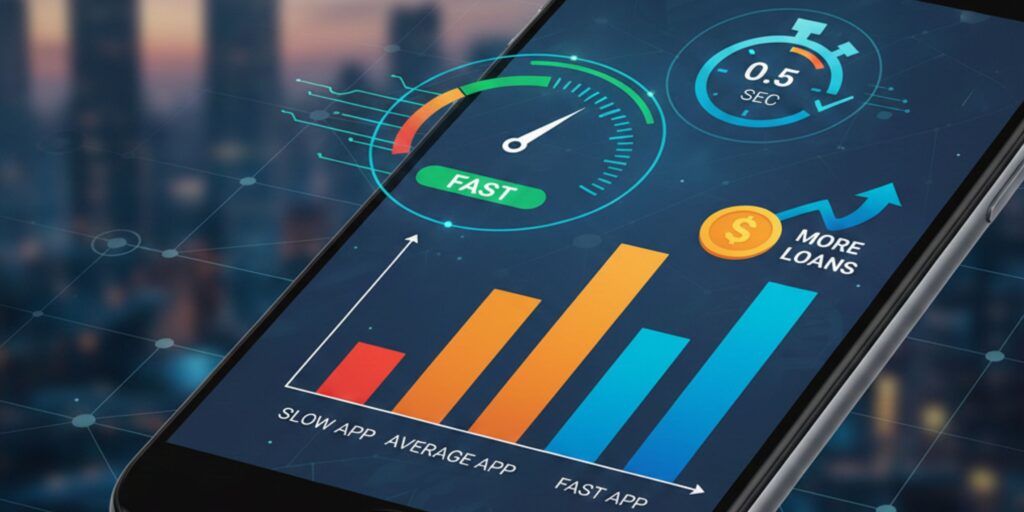
This is why milliseconds matter. Faster interactions lead to higher completion rates. Slower flows lead to drop offs even when users were initially interested. According to Google research, 53% of mobile users abandon sites that take longer than 3 seconds to load, and this behavior is even more pronounced in financial applications where trust is paramount.
Looking at performance through the user journey
To understand where performance matters most, it helps to follow the actual user journey inside an NBFC app.
App launch and first interaction
The first few seconds set expectations. If the app takes too long to open or becomes unresponsive during the first interaction, users lose patience quickly. Many will exit before even exploring loan options.
Fast launch times signal professionalism and trust. Slow launch times signal friction from the very beginning. Mobile application performance testing helps identify and resolve these critical first-impression issues.
KYC and document upload
KYC is one of the most sensitive stages. Users are sharing personal information and documents. Any delay during uploads or verification feels uncomfortable.
When screens freeze or processing takes too long, users worry that something has gone wrong. Some abandon the process midway and never return. Functional testing ensures these critical flows work reliably under various conditions.
Credit checks and risk evaluation
This stage depends heavily on backend systems and external APIs. From the user perspective, they only see a waiting screen. The longer it lasts, the higher the chance of abandonment.
Users expect clarity and responsiveness. Even when processing cannot be instant, apps must remain responsive and transparent.
Loan approval and confirmation
Surprisingly, many drop offs happen near the end. After users have invested time and effort, a slow approval screen can still cause exits.
This is the moment when speed matters emotionally. Fast confirmation reinforces trust and satisfaction. Slow confirmation creates doubt.
Performance metrics that truly matter for NBFC apps
Not all metrics are equally useful. Some look good on dashboards but do not reflect real user experience.
Time to interactive measures how quickly users can actually use the app, not just see a screen. API response time affects every step of the lending journey, especially credit checks and approvals. Crash rates are critical because a crash during KYC or approval almost always results in lost users. Background processing speed matters because many lending actions happen behind the scenes while users wait.
These metrics directly affect how users feel, not just how systems behave. Real user monitoring provides insights into actual user experiences across different devices and network conditions.
Why performance directly impacts revenue and acquisition costs
Performance is not just a technical concern. It has a direct business impact.
Faster apps convert more users with the same marketing spend. When performance improves, customer acquisition cost effectively drops because fewer users abandon the funnel. Retention improves because users remember smooth experiences and return when they need another loan.
App store ratings also benefit from speed. Users are more likely to leave positive reviews when apps feel reliable and responsive. Over time, this creates a compounding advantage. Research from Akamai shows that a 100-millisecond delay in load time can decrease conversion rates by 7%, with even greater impacts in competitive markets like digital lending.
Search engines and platforms also favor apps that deliver good user experiences, especially in financial services where trust is critical.
Feature overload is slowing down many NBFC apps
A common mistake in competitive lending is trying to do too much. In an effort to stand out, apps keep adding features, banners, and flows.
While features can add value, they also add weight. Heavier apps load slower. More screens increase complexity. Confusing journeys create friction.
In lending, simplicity converts better than novelty. Users want to complete one core task quickly. Extra features that slow down that task hurt performance and conversion.
The fastest growing lending apps often do fewer things, but they do them very well. The high stakes of uptime in NBFCs highlights why focusing on core functionality matters more than feature proliferation.
Finding the right balance between speed and functionality
This does not mean NBFC apps should remove all features. It means prioritization matters.
Core lending flows should always be the fastest and most stable. Secondary features should not interfere with critical actions like KYC and approval. Performance testing should follow the user journey, not just individual screens or APIs.
When teams view performance from the user perspective, decisions become clearer.
At Avekshaa, we often see that focusing on journey level performance reveals issues that isolated testing misses. When teams optimize based on real user paths, improvements translate directly into better outcomes.
A practical optimization framework for NBFC apps
Improving performance does not require fixing everything at once. A staged approach works best.
Fix first
Start with app startup time, crash issues, and critical API latency. These have the biggest immediate impact on user trust and conversion. Application performance monitoring helps teams identify and prioritize these critical issues in real-time.
Fix second
Next, focus on KYC flow delays and background processing inefficiencies. These areas cause silent drop offs that teams often underestimate. Application performance engineering provides a systematic approach to addressing these complex issues.
Fix third
Finally, review non essential features and visual elements that add weight without adding value. Simplifying here often unlocks significant performance gains.
This prioritization keeps efforts focused and measurable. Performance engineering teams can help implement this framework systematically to deliver measurable business outcomes.
Final thoughts
In competitive lending, speed has become a form of trust. Users may not analyze interest rates deeply, but they instantly feel whether an app is reliable. Performance shapes that feeling before any loan is approved.
NBFCs that treat performance as a business priority gain an advantage that compounds over time. Faster apps convert more users, reduce acquisition costs, and build lasting confidence.
At Avekshaa, we work closely with NBFC teams to understand how performance impacts real lending journeys and business outcomes. If your mobile app is struggling with drop offs or slow conversions, it may be time to look beyond features and focus on speed.
Frequently Asked Questions
- Why does mobile app speed matter so much for NBFCs?
Mobile app speed directly affects how users perceive trust and reliability. Slow apps increase drop offs during critical stages like KYC and loan approval, which leads to lost conversions.
- How much can small delays really impact loan conversions?
Even delays of a few seconds can cause users to abandon the process. In financial apps, waiting creates doubt and discomfort, which lowers completion rates. According to industry research, even a 1-second delay can reduce conversions by up to 20% in financial applications.
- Which part of the lending journey is most sensitive to performance?
App launch, KYC verification, credit checks, and loan approval screens are the most sensitive stages. Performance issues at these points often lead to permanent drop offs.
- What performance metrics should NBFCs track first?
NBFCs should focus on time to interactive, API response times, crash rates, and background processing speed, as these directly affect user experience and trust. Learn more about monitoring tools that can track these metrics effectively.
- How does app performance influence customer acquisition cost?
Faster apps convert more users from the same marketing spend. When fewer users abandon the funnel, the effective cost of acquiring each customer goes down.
- Why do many NBFC apps feel slow even on good devices?
This often happens due to heavy feature sets, inefficient backend APIs, and poor handling of background processes. Device speed alone cannot compensate for these issues. Root cause analysis can help identify the underlying performance bottlenecks.
- Is adding more features hurting NBFC app performance?
In many cases, yes. Feature overload increases app size and complexity, which slows down critical lending flows and confuses users.
- Can performance improvements really increase user trust?
Yes. Users associate fast and responsive apps with reliability and safety. This is especially important in lending, where users are sharing sensitive financial information.
- Should NBFCs prioritize performance over new features?
Performance should come first for core lending journeys. New features should only be added if they do not slow down or complicate critical user actions. Engaging performance engineering experts early in SDLC helps prevent performance issues from the start.
- When should NBFCs seek external performance expertise?
NBFCs should seek help when they see high drop off rates, slow approvals, frequent crashes, or rising acquisition costs despite steady demand. Consider exploring performance testing and engineering services designed specifically for financial institutions.