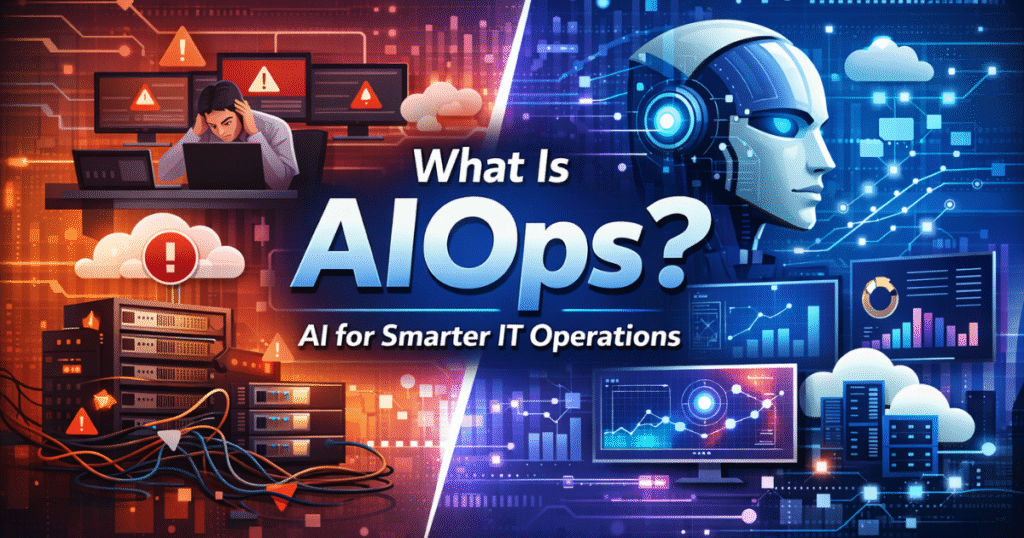
AIOps (Artificial Intelligence for IT Operations) refers to the use of machine learning, analytics, and automation to manage, monitor, and improve modern IT operations at scale. It helps organizations detect issues faster, identify root causes accurately, and resolve incidents proactively by analyzing massive volumes of operational data in real time.
In simple terms, AIOps answers this question:How can IT systems detect, diagnose, and fix problems on their own before users are impacted?
As digital ecosystems grow more distributed and data-heavy, AIOps has become a foundational capability for reliability, performance, and cost control.
Why AIOps Has Become Critical for Modern Enterprises
Traditional IT operations rely heavily on manual monitoring, static thresholds, and human-driven incident response. This model breaks down in environments powered by cloud, microservices, containers, and third-party APIs.AIOps helps organizations:
- Cut through alert noise and reduce false positives
- Detect anomalies earlier than rule-based systems
- Accelerate root cause analysis across complex stacks
- Reduce Mean Time to Detect (MTTD) and Resolve (MTTR)
- Move from reactive firefighting to predictive operations
For enterprises running business-critical platforms, AIOps directly impacts uptime, customer experience, and operational efficiency.
AIOps vs Traditional IT Operations
Traditional IT Ops tells you something is broken. AIOps explains what is breaking, why it’s breaking, and what to do next. So, for example, traditional monitoring triggers hundreds of alerts during a slowdown. This is where AIOps correlates metrics, logs, and events to identify a single database contention issue caused by abnormal traffic. The difference lies in intelligence, correlation, and automation.
How AIOps Works
AIOps platforms ingest and analyze large volumes of operational data from across the IT ecosystem, including:
- Metrics (CPU, memory, latency, throughput)
- Logs (application and system events)
- Traces (end-to-end request flows)
- Events (deployments, configuration changes)
Using machine learning models, AIOps:
- Detects anomalies and deviations from normal behavior
- Correlates related signals across systems
- Identifies probable root causes
- Recommends or triggers corrective actions
This continuous learning loop improves accuracy over time.
Core Capabilities of AIOps
Noise Reduction and Alert Correlation
AIOps filters thousands of raw alerts into a small number of actionable incidents by identifying patterns and relationships across signals.
Anomaly Detection
Instead of static thresholds, AIOps learns what “normal” looks like and flags deviations that may indicate emerging issues.
Root Cause Analysis
By correlating telemetry data across applications, infrastructure, and dependencies, AIOps pinpoints the most likely source of failure.
Predictive Insights
AIOps can forecast capacity issues, performance degradation, or failure risks before they impact users.
Intelligent Automation
Based on confidence levels, AIOps can trigger automated remediation workflows or guide operators with precise recommendations.
AIOps in Action Across Key Industries
BFSI (Banking, Financial Services, Insurance)
In BFSI environments, where uptime and compliance are non-negotiable, AIOps helps:
- Detect transaction anomalies and latency spikes early
- Reduce alert fatigue during peak loads
- Improve audit readiness through correlated insights
The result is higher system reliability and stronger customer trust.
Telecom
Telecom networks generate massive real-time data streams. AIOps enables providers to:
- Identify congestion, packet loss, and routing issues quickly
- Correlate network and application performance
- Resolve issues before they degrade customer experience
Together, it leads to improved SLAs and lower churn.
Healthcare
In healthcare IT, reliability affects patient safety. AIOps supports:
- Early detection of system slowdowns in clinical platforms
- Stability during peak usage hours
- Faster incident resolution with minimal manual intervention
This ensures continuity of care and operational confidence.
AIOps and Observability: How They Work Together
Observability provides visibility into system behavior.AIOps applies intelligence to that visibility. Together, it helps: :
- Observability supplies high-quality telemetry
- AIOps interprets patterns and anomalies
- Teams gain faster insights with less manual effort
AIOps amplifies the value of observability investments.
Common Challenges in AIOps Adoption
Despite its benefits, AIOps initiatives often struggle due to:
- Poor data quality or siloed tools
- Lack of contextual business mapping
- Overreliance on automation without governance
- Treating AIOps as a tool purchase instead of a strategy
Successful AIOps requires the right data foundation and operational maturity.
Best Practices for Implementing AIOps
High-impact AIOps programs focus on:
- Unified data pipelines across tools and teams
- Clear mapping between technical signals and business impact
- Gradual automation with human oversight
- Continuous model tuning and validation
AIOps works best as an evolution, not a one-time deployment.
How Avekshaa Technologies Enables Outcome-Driven AIOps
At Avekshaa Technologies, AIOps is not treated as a standalone platform or automation layer. It is integrated into a performance and reliability engineering strategy that aligns operational intelligence with business outcomes.
Business-Aligned AIOps Design
Avekshaa ensures AIOps initiatives are mapped to SLAs, customer experience metrics, and revenue-impacting workflows, not just infrastructure signals.
High-Fidelity Data Correlation
By combining observability data with domain context, Avekshaa enables accurate anomaly detection and faster root cause identification across complex systems.
Reduced MTTR and Operational Load
Clients benefit from fewer false alerts, faster incident resolution, and lower operational overhead through intelligent correlation and guided automation.
Regulated Industry Readiness
With deep experience in BFSI, telecom, and healthcare, Avekshaa designs AIOps frameworks that support compliance, auditability, and risk controls.
Continuous Performance Assurance
AIOps insights feed into Avekshaa’s P-A-S-S™ Assurance approach, ensuring ongoing performance, availability, scalability, and security improvements.
Why Avekshaa Over Generic AIOps Vendors?
Most vendors sell AIOps tools. Avekshaa delivers operational outcomes:
- Actionable insights instead of black-box predictions
- Faster ROI through reduced downtime and effort
- Strong alignment between IT signals and business impact
- Sustainable automation with governance
AIOps becomes a capability, not just a dashboard.
AIOps as the Future of IT Operations
AIOps represents a shift from human-led monitoring to intelligence-driven operations. It allows IT teams to manage complexity, reduce risk, and scale with confidence.
With Avekshaa Technologies, AIOps moves beyond automation and becomes a strategic engine for reliability, performance, and digital resilience.
Connect with Avekshaa today