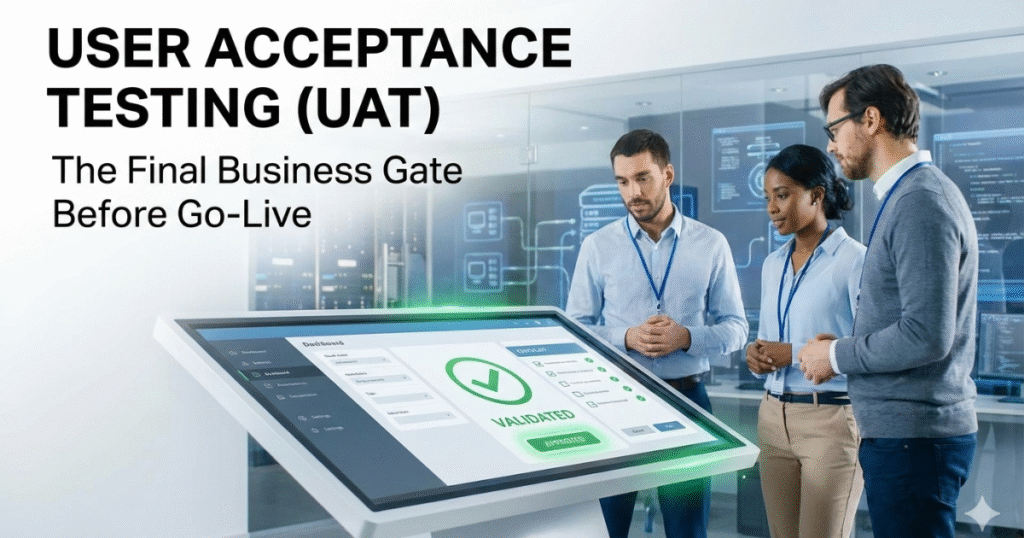
User Acceptance Testing (UAT) is the final validation phase of the software testing lifecycle where real business users verify whether a system works as expected in real-world scenarios. The goal is simple: confirm that the application meets business requirements, supports actual workflows, and is ready for production use.
Unlike functional or performance testing, UAT does not focus on how the system is built. It focuses on whether the system solves the right problem for the end user.
At its core, UAT answers one question: Can business users confidently use this system in production without disruption?
Why User Acceptance Testing Matters More Than Ever
Modern digital platforms support mission-critical operations across BFSI, telecom, healthcare, and enterprise ecosystems. A technically stable system can still fail if it does not align with business expectations, user behavior, or operational workflows.
User Acceptance Testing helps organizations:
- Prevent business-impacting defects from reaching production
- Reduce post-go-live rework and escalations
- Validate real user journeys, not just test cases
- Improve adoption, usability, and stakeholder confidence
- Ensure readiness for regulatory and audit reviews
In high-stakes environments, skipping or rushing UAT often leads to costly rollbacks, customer dissatisfaction, and operational chaos.
UAT vs System Testing: The Key Difference
System testing checks whether the software works.But User acceptance testing checks whether the software works for the business.
Let’s understand this with an example:
System testing confirms a payment flow completes successfully. UAT validates whether the flow aligns with actual customer journeys, exception handling, reporting needs, and operational handoffs.Both are essential, but only UAT provides business sign-off.
When Should User Acceptance Testing Be Performed?
UAT typically occurs:
- After system and integration testing
- Before production deployment
- Before major releases, upgrades, or migrations
- During large process or compliance changes
It is especially critical when:
- Business rules are complex
- Multiple user roles are involved
- External systems or vendors are integrated
- Regulatory or financial impact is high
Types of User Acceptance Testing
Different scenarios require different UAT approaches.
Business Acceptance Testing (BAT)
Validates whether the solution meets business objectives, rules, and workflows as defined by stakeholders.
Operational Acceptance Testing (OAT)
Ensures the system is ready for operational use, covering aspects like:
- Backup and recovery
- Monitoring and alerts
- Access control
- Support processes
Regulatory or Compliance Acceptance Testing
Used in regulated industries to confirm adherence to legal, audit, and policy requirements before go-live.
Contract Acceptance Testing
Confirms that the delivered system meets contractual commitments agreed with vendors or partners.
How User Acceptance Testing Works in Practice
A structured UAT process typically includes:
- Defining Acceptance Criteria
Clear business scenarios, success conditions, and expected outcomes. - Preparing Realistic Test Scenarios
Scenarios mirror day-to-day operations, edge cases, and exception flows. - Executing Tests by Business Users
Actual users validate workflows using production-like data. - Defect Logging and Prioritization
Issues are categorized by business impact, not just technical severity. - Sign-Off or Go-Live Readiness
Stakeholders confirm whether the system is fit for release.
Well-executed UAT acts as a risk gate before production.
Common Challenges in User Acceptance Testing
Many UAT cycles fail to deliver value due to:
- Poorly defined acceptance criteria
- Limited involvement from real users
- Incomplete or unrealistic test data
- Time pressure close to release dates
- Treating UAT as a formality
When UAT becomes a checkbox exercise, defects escape into producti
User Acceptance Testing in Key Industries
BFSI (Banking, Financial Services, Insurance)
In BFSI, UAT ensures:
- Transaction flows match regulatory and audit expectations
- Role-based access and approvals work correctly
- Reporting and reconciliation align with finance teams
UAT failures here often translate into financial loss or compliance risk.
Telecom
Telecom UAT validates:
- Customer onboarding and service activation flows
- Billing accuracy across plans and usage types
- Support and escalation workflows
Even small mismatches can lead to billing disputes and churn.
Healthcare
In healthcare, UAT focuses on:
- Clinical workflows and data accuracy
- Integration with labs, devices, and EHR systems
- Access controls and data privacy compliance
UAT protects both patient safety and operational continuity.
User Acceptance Testing vs QA Automation
Automated testing validates consistency and regression.UAT validates business intent and usability. However, automation cannot replace:
- Human judgment
- Workflow validation
- Business exception handling
- Cross-team coordination
The strongest delivery models use both, with UAT acting as the final business gate.
Best Practices for Effective User Acceptance Testing
High-performing teams follow these principles:
- Involve business users early
- Base UAT on real workflows, not generic scripts
- Use production-like environments and data
- Prioritize issues by business impact
- Avoid rushing UAT close to release
UAT quality directly influences go-live success.
How Avekshaa Technologies Enables Outcome-Driven User Acceptance Testing
At Avekshaa Technologies, User Acceptance Testing is not treated as a standalone testing phase. It is integrated into a business assurance framework that aligns technology outcomes with operational readiness.
Business-Centric UAT Design
Avekshaa works closely with stakeholders to define acceptance criteria rooted in real business workflows, SLAs, and compliance needs.
Real-World Scenario Validation
UAT scenarios are designed around actual user journeys, peak-load conditions, exception cases, and downstream dependencies, not ideal paths.
Risk-Based Defect Prioritization
Issues are assessed based on business impact, revenue risk, compliance exposure, and customer experience, ensuring the right fixes happen first.
Faster Go-Live Confidence
By combining UAT insights with performance, availability, and scalability validation, Avekshaa ensures systems are not only functional but production-ready.
Continuous Assurance Beyond Go-Live
UAT findings feed into ongoing quality and performance assurance, reducing post-release surprises and repeat issues.
Why Avekshaa Over Traditional Testing Vendors?
Most vendors focus on test execution. Avekshaa focuses on release confidence and business outcomes:
- UAT aligned to real operations
- Reduced post-launch escalations
- Stronger compliance readiness
- Predictable, stable go-lives
UAT as the Final Business Gate
User Acceptance Testing is where technology meets reality. It determines whether a system is truly ready for the people who rely on it every day.With Avekshaa Technologies, UAT moves beyond validation and becomes a strategic layer of business assurance, helping enterprises launch with confidence, clarity, and control.
Connect with Avekshaanow