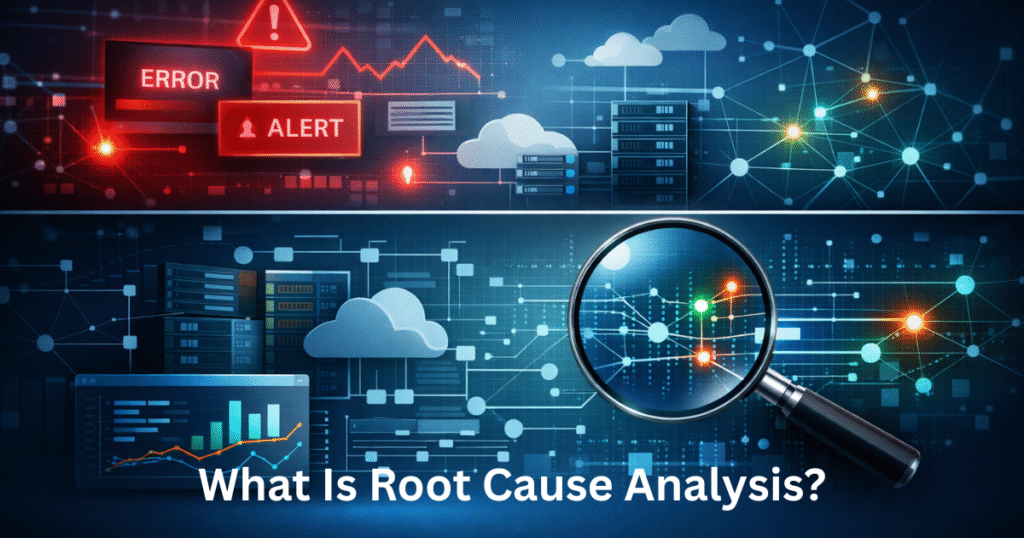
Root Cause Analysis (RCA) is a structured, data-driven approach to identifying the actual reason behind a problem rather than addressing its surface-level symptoms. It focuses on answering one critical question: why did this issue happen in the first place, and how do we ensure it never happens again?
In complex digital environments, where applications, infrastructure, networks, and third-party services are deeply interconnected, RCA becomes the foundation of reliability, performance, and operational stability.
At its core, root cause analysis moves organizations from reactive firefighting to preventive engineering.
Why Root Cause Analysis Is No Longer Optional
Modern enterprises run on distributed systems, cloud-native architectures, and real-time digital services. A single failure can cascade across systems and directly impact revenue, compliance, and customer trust.
Root cause analysis helps organizations:
- Stop recurring incidents instead of repeatedly fixing symptoms
- Reduce Mean Time to Resolution (MTTR)
- Improve uptime, performance, and user experience
- Strengthen audit and regulatory readiness
- Turn incidents into long-term system improvements
For industries such as BFSI, telecom, and healthcare, RCA is directly tied to business continuity and risk management.
Root Cause vs Symptom: Why Most Fixes Fail
A symptom is what teams see.
A root cause is what created the symptom.
Example:
- Symptom: Application outage during peak traffic
- Temporary fix: Restart services
- Root cause: Unhandled connection pooling limits introduced after a recent release
Without RCA, outages return. With RCA, the system evolves.
When Should Teams Perform Root Cause Analysis?
RCA is most valuable when:
- Incidents repeat over time
- Downtime impacts customers or revenue
- Performance degradation affects SLAs
- Compliance gaps or audit failures occur
- Critical releases introduce instability
Not every alert needs RCA. High-impact and recurring issues always do.
Common Root Cause Analysis Techniques Used in Enterprises
1. The 5 Whys Method
A simple but effective method that involves asking “why” repeatedly until the underlying cause is identified.
Best suited for:
- Isolated incidents
- Smaller systems
- Quick investigative cycles
2. Fishbone (Ishikawa) Analysis
This method categorizes possible causes across:
- Technology
- Process
- People
- Tools
- Environment
It prevents tunnel vision and encourages systemic thinking.
3. Change Analysis
By comparing what changed between a stable state and a failure state, teams uncover issues related to:
- Code deployments
- Configuration updates
- Infrastructure scaling
- Traffic surges
- Vendor changes
In digital systems, many incidents trace back to unobserved changes.
4. Fault Tree Analysis
Used in large-scale and safety-critical systems, this approach maps multiple failure paths leading to a single incident. Common in telecom, manufacturing, and regulated environments.
5. Telemetry-Driven RCA (Logs, Metrics, Traces)
Modern RCA relies heavily on observability data:
- Logs provide context
- Metrics reveal trends and thresholds
- Traces show how requests fail across services
This approach is essential for microservices and cloud-native platforms.
Root Cause Analysis in Digital & IT Operations
In IT operations, RCA is a core pillar of incident management, SRE, and performance engineering.
Typical RCA focus areas include:
- Application latency and failures
- Infrastructure bottlenecks
- Network congestion
- Third-party dependency breakdowns
- Release and configuration errors
Effective RCA combines technical evidence with process-level insights such as handoffs, alert fatigue, and response gaps.
Industry-Specific Impact of Root Cause Analysis
BFSI (Banking, Financial Services, Insurance)
High transaction volumes and regulatory pressure leave no room for repeated failures.
RCA enables BFSI organizations to:
- Trace transaction failures across APIs and databases
- Identify compliance and audit gaps
- Reduce recurring outages in mission-critical systems
The result is higher uptime, faster resolution, and stronger customer confidence.
Telecom
Telecom ecosystems operate at massive scale with real-time demand.
RCA helps providers:
- Isolate packet loss, latency, and congestion
- Identify region-specific or tower-level issues
- Prevent recurring service degradation
Faster RCA directly improves SLAs and reduces customer churn.
Healthcare
In healthcare IT, reliability affects patient outcomes.
Root cause analysis supports:
- Stable EHR and clinical systems
- Reliable device and lab integrations
- Continuous compliance with data protection standards
The outcome is safer, more predictable digital care delivery.
Root Cause Analysis vs Observability
Traditional RCA often begins after an incident occurs. Observability enables teams to detect weak signals before failure. Together, it helps:
- Observability surface the signals
- RCA explains the cause
- Corrective actions prevent recurrence
Shifts teams from reactive response to proactive resilience.
Common RCA Pitfalls Enterprises Face
RCA efforts often fail when:
- Teams stop at the first obvious cause
- Individuals are blamed instead of systems
- Data is missing or fragmented
- Findings are documented but never acted upon
So, RCA delivers value only when insights lead to engineering and process change.
Best Practices for Effective Root Cause Analysis
High-performing organizations follow these principles:
- Use evidence over assumptions
- Involve cross-functional teams
- Document causes and corrective actions clearly
- Track whether fixes prevent recurrence
- Review RCA outcomes periodically
How Avekshaa Technologies Delivers Outcome-Driven Root Cause Analysis
Root cause analysis is not just a post-incident exercise. At Avekshaa Technologies, RCA is embedded into a broader performance and reliability engineering framework that aligns technical insights with business outcomes.
Outcome-Focused RCA Framework
Avekshaa applies RCA across Performance, Availability, Scalability, and Security to ensure issues are eliminated at the system level, not patched temporarily.
Data-Led Investigations
By correlating logs, metrics, traces, and events across the stack, Avekshaa identifies precise failure points across applications, infrastructure, and dependencies.
Faster MTTR, Fewer Recurrences
Clients experience faster incident resolution and a measurable drop in repeat issues by addressing systemic bottlenecks instead of surface symptoms.
Domain Expertise Across Regulated Industries
With deep experience in BFSI, telecom, and healthcare, Avekshaa ensures RCA findings are aligned with compliance, SLAs, and business risk thresholds.
Beyond RCA: Continuous Assurance
Insights from RCA feed into Avekshaa’s P-A-S-S™ Assurance approach, enabling continuous performance optimization and long-term system resilience.
Why Avekshaa Over Traditional Vendors?
Most vendors stop at dashboards and reports. Avekshaa focuses on:
- Actionable root causes, not raw data
- Reduced downtime and performance risk
- Measurable business impact and ROI
- Long-term stability instead of recurring incidents
RCA becomes a strategic capability, not a reactive task.
Root Cause Analysis as a Business Enabler
Root cause analysis is not about assigning blame. It is about building systems that fail less, recover faster, and scale safely.
With Avekshaa Technologies, RCA moves beyond problem-solving and becomes a driver of reliability, performance, and sustained digital confidence.